

9 items | 26 visits

A 3D-Earth viewer enables navigating through the virtual environment and can be easily downloaded from the internet. How might this rapid development support steady, long-term development of institutions such as Rijkswaterstaat, the roads and water regulatory authority of the Netherlands? The authors consider and compare three standard 3D-Earth viewers: Google Earth, MSN Virtual Earth 3D and NASA’s World Wind. Each is combined with Open Geospatial Consortium (OGC) Services to examine their performance in disseminating geo-information to the general public. While Google Earth proves technically superior, other aspects must also be considered.
OGC Network™ is a window onto the dynamic, constantly changing geospatial web as described by the OpenGIS® Reference Model (ORM). Multiple communities of interest for research in geospatial interoperability are supported, and persistent demonstration capability is provided. Here you will find the latest information on OGC-compatible software, services, and information models (e.g. GML profiles, SLD examples, etc.). From this site you can quickly locate OGC-compatible geospatial web services, the latest XML schema documents, discussion forums, conformance testing resources, and GML profile working areas. Instructions on signing up for authoring privileges are on the help page.
The Virtual Knowledge Studio for the Humanities and Social Sciences (KNAW) supports researchers in the humanities and social sciences in the Netherlands in the creation of new scholarly practices and in their reflection on e-research in relation to their fields.
A core feature of the Virtual Knowledge Studio is the integration of design and analysis in a close cooperation between social scientists, humanities researchers, information technology experts and information scientists. This integrated approach provides insight in the way e-research can contribute to new research questions and methods.
Exploratory visualization based on multiple coordinated views is a rapidly growing area of information visualization. Ideally, users would be able to explore their data by switching freely between building and browsing in a flexible, integrated, interactive graphical environment that requires little or no programming skill to use. However, the possibilities for displaying data across multiple views depends on the flexibility of coordination, the expressiveness of graphical encoding, and the ability of users to comprehend the structure of their visualizations as they work. As a result, exploration has been limited in practice to a small fraction of useful visualizations.
Improvise is a fully-implemented Java software architecture and user interface that enables users to build and browse highly-coordinated visualizations interactively. By coupling a shared-object coordination model with a declarative visual query language, users gain precise control over how navigation and selection affects the appearance of data across multiple views, using a potentially infinite number of variations on well-known coordination patterns such as synchronized scrolling, overview+detail, brushing, drill-down, and semantic zoom.
Improvise has been used to build numerous visualizations for exploring information including election results, particle trajectories, network loads, music collections, the chemical elements, and even the dynamic coordination structure of its own visualizations in situ. This last technique—integrated metavisualization—is unique to Improvise.
Reconceptualizing Digital Objects is a three year project in collaboration with the A:shiwi A:wan Museum and Heritage Center, UCLA and the Museum. The aims of the research are to study anonymously how the Zuni community views its original cultural objects relative to the ways in which museums typically classify and represent them. It is to understand and uncover a new model of describing cultural objects according to the original indigenous voices of the culture that created these objects.
One of a kind, a cosmopolite of the first kind, a lover of men, a mind and a half. A true genius, an Einstein of humanities on a par with Geertz
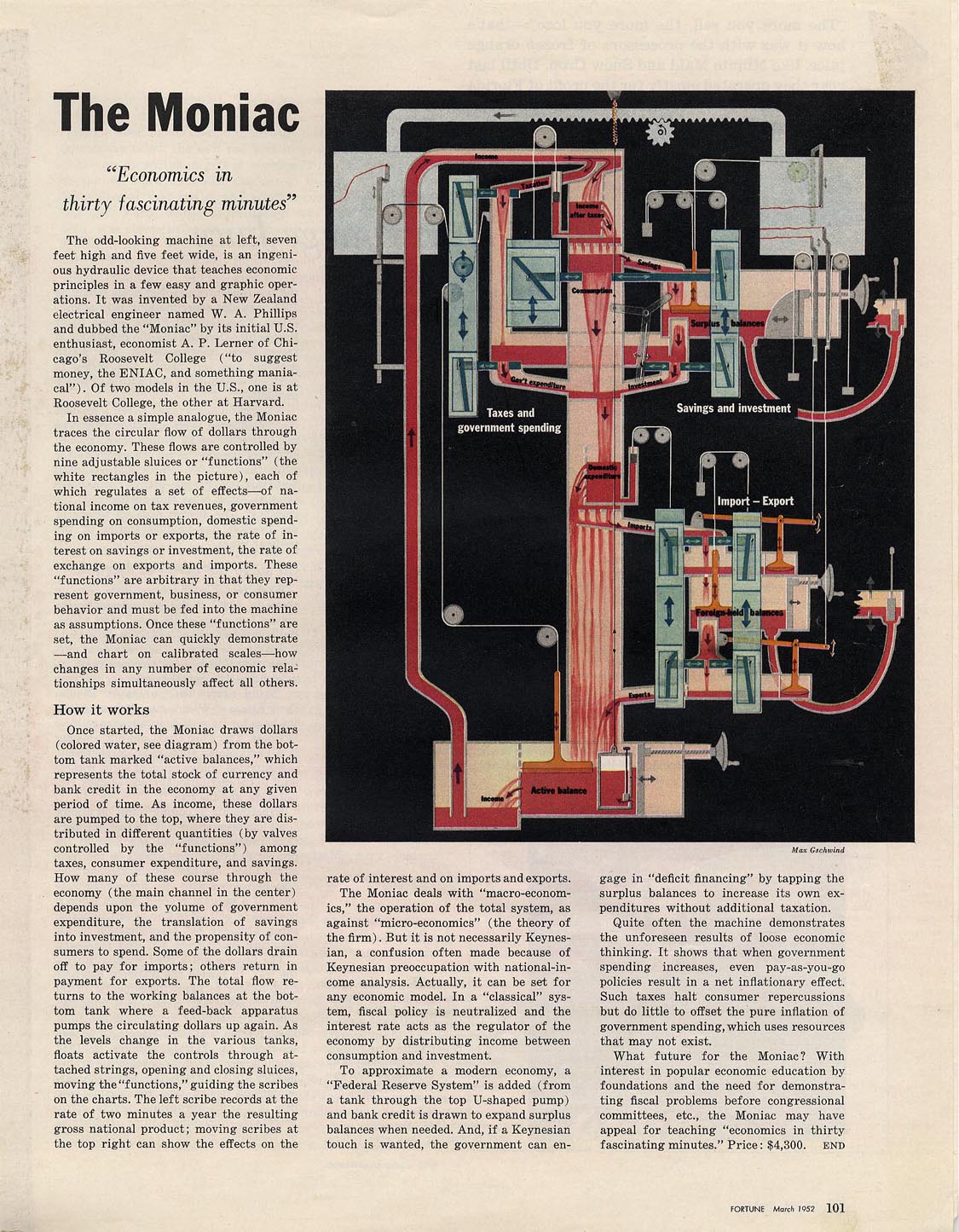
moniac, a hydraulic computer used to model the economic system of any counry
Excutions supervised by Che Guevara during the Cuban insurection
9 items | 26 visits