
so true, so true!

Michael Marlatt's List: A Look at Social Network Aggregators
-
-
"Managing scattered online Social Life on multiple Social Networking sites, I sense, will become a Killer App Category 2008. There are several startups now in the "Social Network Aggregation" space and this App Category should diversify and catch momentum in 2008. Some startups are focusing on identity consolidation, others on messaging consolidation and on tracking friends. Some like Profilefly offer consolidation of multiple things like Profiles, Contacts and Bookmarks....The need for users to be a member of not just one but multiple social networks can be understood through Barry Wellman's concept of 'networked individualism'..."
-
-
-
-
Too Many Choices, Too Much Content
Written by Sarah Perez / May 14, 2008 4:00 AM / 42 Comments -
Too Many Choices
However, there are certain areas we've noticed that seem to be the biggest sources of conflict as of late. In these areas, several companies are clamoring to be the winner of the space, releasing duplicate or similar products, constantly adding new features, and generally trying to one-up their competitors in an effort to come out on top. When there are several companies doing the same thing, it gets confusing for the average user and time-consuming for the early adopters who play with everything. In the end, the hope is that one great service would come out on top, but that's hardly ever the case. We're already on MySpace, Bebo, Facebook, and LinkedIn because there's no one winner for social networks...are we going to have to use all these newcomers battling it out, too?
-
-
-
June 3, 2008 (PC World) Whether you're a social butterfly constantly seeking new sites to cross-pollinate, or a caterpillar creeping after your friends from one network to the next, you have likely experienced social-site fatigue by now.
-
-
-
- 8Hands
- Ex.plode.us
- Fuser
- HypeIt
- Minggl
- MyLifeBrand
- Naymz
- OtherEgo
- Profilactic
- Profileomat
- Profilefly
- Profilelinker
- Snag
- Socialnetwork.in
- Socialurl
- Spokeo
- Tabber
- Upscoop
- Zoolit
Alright everybody, I’ve tried at least 10 of these, and I was going to go on a site by site basis and rank each one, but to be quite honest there are too many different factors involved that this post would’ve been 5+ pages long, so here it is, my list…
COMMENTERS! Please help choose the top 5 of the following Social Network Aggregator Sites by basing your votes on the following criteria:
-
-
-
-
-
Similar to FriendFeed, it presents the latest actions on the Web from your friends as a continually updating stream.
-
What makes Spokeo compelling, at least initially, is that it is dead-simple to set up. In one fell swoop Spokeo can ingest all of your contacts from Gmail, Yahoo, or Hotmail, and then go out to the 30+ sites it monitors and bring back any new content from people in your address book. I tried this with my Gmail account, and it built up a friend reader with more than 500 contacts in less than three minutes. Before, this was a laborious process on Spokeo. You had to add each friend’s blog or feed one by one. (In comparison, FriendFeed
 lets you suck in your Facebook friends, but only the ones who are also FriendFeed users—plus each member must specify which sites he wants to expose to others.
-
Hey, Spokeo is pretty cool!
-
-
-
-
Spokeo combines the top 20 social networking destinations with any RSS feeds you like into one glimpse through a multimedia RSS reader. But you can’t actually navigate within the networks. It just gives you a run-down. Sort of like My Yahoo! for Web 2.0 sites.
-
-
- Remember to evaluate Profilatic against other social aggregators - Michael Marlatt on 2008-03-21
-
-
-
Companies like FriendFeed — and there seem to be a growing number of them these days — are trying to solve a problem that the Internet itself created. The proliferating number of blogs, user-generated content services and online news sources has created a dense information jungle that no human could machete his or her way through in a lifetime, let alone in an afternoon of surreptitious procrastination at work.
-
the online information jungle
-
-
Last month, bowing to the appeal of feed services, Facebook began to let users share their activities on other sites, like the photo services Flickr and Picasa, and the review site Yelp. The company says it plans to continue to link more Web sites to the social network.
-
-
-
Data Portability is working to help make that happen through consensus driven policies and procedures. In essence, data portability embraces the Decentralized Me, but lets users re-centralize it wherever they please.
Frankly, not enough people know much about DataPortability yet. That will start to change, as founder Chris Saad is starting a road show presentation to talk at a high level about what he’s trying to accomplish. Some big partners are joining, even if just in spirit so far.
Ultimately, Data Portability is to the Centralized Me (all your stuff) as OpenID is to identity (your literal identity). And just as the big players are sort of supporting/exploiting OpenId to maintain their user accounts, they will also support/exploit Data Portability to remain the place users consider the Centralized Me.
-
Loic Le Meur
sort of summed it all up tonight in a blog post where he says that we grew used to having a Centralized Me in the days before all these services popped up, starting in 2004 and spreading since then. That Centralized Me was the blog. Then we grew used to having a Decentralized Me - your stuff was literally everywhere. Go here for photos, here for the blog, here for videos, and here for bookmarks. Robert Scoble today is sort of the quintessential Decentralized Me - his stuff is everywhere, and he seems to love the chaos.What Loic wants, and I think other people will want it too, is a place that they control where this information is aggregated. That may be right back at the blog for some people. For others it may be Facebook (who understands this fully). Wherever a person considers their home turf is where they’ll want all this data.
-
we all need a centralized "me"!
-
- A centralized "me" - Michael Marlatt on 2008-04-18
-
-
-
Today at the Mobile World Congress in Spain, Yahoo announced a mobile app called oneConnect
 that will be available in the second quarter as part of the upcoming release of Yahoo Go 3.0. I have not seen a demo of this myself, but it sounds like a much-needed integration of messaging and social apps. OneConnect will pull together contacts from your mobile phone, Yahoo address book, and social networks, including:
 Bebo
Bebo
Dopplr
Facebook
Flickr
Friendster
Hi5
Last.fm
LinkedIn
Myspace
TwitterYou will be able to see whether your contacts are online, recent messages, status updates, uploaded photos, and other activity streams for each one. Of course, you will also be able to send them messages via e-mail, IM, and SMS. The mobile app will save SMS and IM conversations as a single thread, even if you are texting and the other person is using Yahoo Messenger. The app also supports AIM, MSN Messenger, and Google Talk.
A feature called “Pulse” will give you the most recent updates of all your contacts across all the social networks it monitors. You’d see, for instance, that your girlfriend just added a photo to Flickr, your business partner just updated his Facebook page to say he landed in London, and your brother just sent out a Twitter. It is like Friendfeed
or Spokeo on your mobile phone, tied to your address book so that you can message your friends based on what they are doing. -
Yahoo didn’t invent anything here, but simply integrating all of these services is powerful stuff. If you think about it, oneConnect is a mobile portal for the social Web.
-
-
-
Yahoo! has announced Y! One Connect -- an application in Yahoo! Go for Mobiles -- that will allow Social Network Aggregation. One Connect will launch in Q2 (pdf announcement). Quite as I had predicted Social Network Aggregation will be super hot in 2008.
-
 There's
  This one will really surprise those not following the mobile networking space closely. When researching mobile network up-and-comer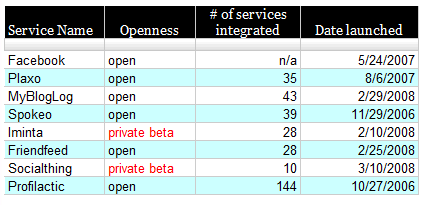
1 - 14 of 14
20 items/page
List Comments
(0)
List Info

14 items | 139 visits
Here's a quick look at social network aggregation tools. Let's explore some cool ways to consolidate our lifestreams!
Updated on Jun 17, 08
Created on Jun 17, 08
Category: Computers & Internet
URL: