


So, I believe he is saying that virtual communities of practice that form naturally are more real and approach what Wenger was talking about better than contrived "communities" put together in classes. That may be true. but does it have to be? If people come together to with a common purpose and the instructor allows the students freedom to explore what is important to them then I would hope that this kind of community can develop even in formal educational settings. Relevance is a key issue here!
This link has been bookmarked by 119 people . It was first bookmarked on 16 Oct 2007, by shang jianxin.
-
09 Mar 17
 corinneht
This article published as E-Learning 2.0 in eLearn Magazine Oct 16, 2005. Type: C - Publications in Trade Journals
-
13 Oct 14
-
As a consequence, the dominant learning technology employed today is a type of system that organizes and delivers online courses—the learning management system (LMS). This piece of software has become almost ubiquitous in the learning environment; companies such as WebCT, Blackboard, and Desire2Learn have installed products at thousands of universities and colleges and are used by tens of thousands of instructors and students.
-
They absorb information quickly, in images and video as well as text, from multiple sources simultaneously. They operate at "twitch speed," expecting instant responses and feedback. They prefer random "on-demand" access to media, expect to be in constant communication with their friends (who may be next door or around the world), and they are as likely to create their own media (or download someone else's) as to purchase a book or a CD [
-
n learning, these trends are manifest in what is sometimes called "learner-centered" or "student-centered" design. This is more than just adapting for different learning styles or allowing the user to change the font size and background color; it is the placing of the control of learning itself into the hands of the learner
-
In short, the structures and organization that characterized life prior to the Internet are breaking down. Where intermediaries, such as public relations staff, journalists or professors, are not needed, they are disregarded. Consumers are talking directly to producers, and more often than not, demanding and getting new standards of accountability and transparency. Often, they inform the productive process itself, and in many cases, replace it altogether. Passive has become active. Disinterested has become engaged. The new Internet user may not vote, but that is only because the vote is irrelevant when you govern yourself
-
"Enter Web 2.0, a vision of the Web in which information is broken up into "microcontent" units that can be distributed over dozens of domains. The Web of documents has morphed into a Web of data. We are no longer just looking to the same old sources for information. Now we're looking to a new set of tools to aggregate and remix microcontent in new and useful ways
-
In a nutshell, what was happening was that the Web was shifting from being a medium, in which information was transmitted and consumed, into being a platform, in which content was created, shared, remixed, repurposed, and passed along.
-
But it wasn't just blogging. Creating an online community became a snap with tools such as Plone and Drupal. Moreover, using a collaborative writing tool called the wiki Jimmy Wales and a few thousand of his friends created a site called Wikipedia, rendering Encyclopedia Britannica obsolete in the process. Others, using the free audio-recording tool Audacity, began recording their own talk and music; this, when combined with RSS, became podcasting, a rapidly rising phenomena that is transforming what we think about radio.
-
n the world of e-learning, the closest thing to a social network is a community of practice, articulated and promoted by people such as Etienne Wenger in the 1990s. According to Wenger, a community of practice is characterized by "a shared domain of interest" where "members interact and learn together" and "develop a shared repertoire of resources.
-
community" in online learning were artificial and often contrived "discussions" supported by learning management systems
-
Educators began to notice something different happening when they began to use tools like wikis and blogs in the classroom a couple of years ago. All of a sudden, instead of discussing pre-assigned topics with their classmates, students found themselves discussing a wide range of topics with peers worldwide. Imagine the astonishment, for example, when, after writing a review of a circus she had viewed, a Grade 5 student received a response from one of the performers [16]. In a very short time, blogs were used for a wide variety of purposes in education; an educational bloggers' network formed and by this year thousands of teachers were encouraging their students to blog.
-
What happens when online learning ceases to be like a medium, and becomes more like a platform? What happens when online learning software ceases to be a type of content-consumption tool, where learning is "delivered," and becomes more like a content-authoring tool, where learning is created? The model of e-learning as being a type of content, produced by publishers, organized and structured into courses, and consumed by students, is turned on its head. Insofar as there is content, it is used rather than read— and is, in any case, more likely to be produced by students than courseware authors. And insofar as there is structure, it is more likely to resemble a language or a conversation rather than a book or a manual.
-
It also begins to look like a personal portfolio tool [18]. The idea here is that students will have their own personal place to create and showcase their own work. Some e-portfolio applications, such as ELGG, have already been created. IMS Global as put together an e-portfolio specification [19]. "The portfolio can provide an opportunity to demonstrate one's ability to collect, organize, interpret and reflect on documents and sources of information. It is also a tool for continuing professional development, encouraging individuals to take responsibility for and demonstrate the results of their own learning"
-
Papert writes, "The most important learning skills that I see children getting from games are those that support the empowering sense of taking charge of their own learning. And the learner taking charge of learning is antithetical to the dominant ideology of curriculum design" [21]. This is most evidenced when learners engage not only in playing, but in the design, of games. In the gaming world this practice is widely recognized and encouraged—game "modding" allows players to make the game their own
-
A similar motivation underlies the rapidly rising domain of mobile learning [24]—for after all, were the context in which learning occurs not important, it would not be useful or necessary to make learning mobile. Mobile learning offers not only new opportunities to create but also to connect. As Ellen Wagner and Bryan Alexander note, mobile learning "define(s) new relationships and behaviors among learners, information, personal computing devices, and the world at large" [
-
-
28 May 14
-
25 Nov 13
-
16 Jul 13
-
For all this technology, what is important to recognize is that the emergence of the Web 2.0 is not a technological revolution, it i
-
-
11 Jun 13
-
30 May 13
 Lisa Rosa
"the emergence of the Web 2.0 is not a technological revolution, it is a social revolution. "Here's my take on it: Web 2.0 is an attitude not a technology. It's about enabling and encouraging participation through open applications and services. "
-
the emergence of the Web 2.0 is not a technological revolution, it is a social revolution. "Here's my take on it: Web 2.0 is an attitude not a technology. It's about enabling and encouraging participation through open applications and services.
-
-
02 Jan 13
-
28 Dec 12
-
20 Aug 12

-
10 Jul 12
-
personal learning center,
-
-
12 Jun 12
-
09 Mar 12

-
-
E-learning
-
E-learning
-
effectiveness
-
-
18 Dec 11
-
04 Oct 11
-
Learning is characterized not only by greater autonomy for the learner, but also a greater emphasis on active learning, with creation, communication and participation playing key roles, and on changing roles for the teacher, indeed, even a collapse of the distinction between teacher and student altogether
-
-
07 Sep 11
-
10 Aug 11
-
The learning management system takes learning content and organizes it in a standard way, as a course divided into modules and lessons, supported with quizzes, tests and discussions, and in many systems today, integrated into the college or university's student information system.
-
In learning, these trends are manifest in what is sometimes called "learner-centered" or "student-centered" design. This is more than just adapting for different learning styles or allowing the user to change the font size and background color; it is the placing of the control of learning itself into the hands of the learner
-
Learning is characterized not only by greater autonomy for the learner, but also a greater emphasis on active learning, with creation, communication and participation playing key roles, and on changing roles for the teacher, indeed, even a collapse of the distinction between teacher and student altogether
-
the Web was shifting from being a medium, in which information was transmitted and consumed, into being a platform, in which content was created, shared, remixed, repurposed, and passed along.
-
And this became, and looked like, and behaved like, a network.
-
the emergence of the Web 2.0 is not a technological revolution, it is a social revolution. "Here's my take on it: Web 2.0 is an attitude not a technology. It's about enabling and encouraging participation through open applications and services.
-
And the learner taking charge of learning is antithetical to the dominant ideology of curriculum design"
-
-
07 May 11
 Nuno Maria
"E-Learning 2.0
By Stephen Downes" -
28 Jan 11
-
24 Jan 11
-
23 Jan 11
-
21 Jan 11
-
18 Jan 11
-
16 Jan 11
-
13 Jan 11
 Andreas Auwärter
E-learning as we know it has been around for ten years or so. During that time, it has emerged from being a radical idea—the effectiveness of which was yet to be proven—to something that is widely regarded as mainstream. It's the core to numerous business plans and a service offered by most colleges and universities.And now, e-learning is evolving with the World Wide Web as a whole and it's changing to a degree significant enough to warrant a new name: E-learning 2.0.
e-learning web2.0 elearning Education downes learning blog future
-
 Teresa Pombo
"E-Learning 2.0
By Stephen Downes" -
03 Dec 10
-
12 Nov 10
 lynne quartermaine
2005 manifesto for e-learning
-
[18] . The idea here is that students will have their own personal place to create and showcase their own work. Some e-portfolio applications, such as ELGG, have already been created. IMS Global as put together an e-portfolio specification [19] . "The portfolio can provide an opportunity to demonstrate one's ability to collect, organize, interpret and reflect on documents and sources of information. It is also a tool for continuing professional development, encouraging individuals to take responsibility for and demonstrate the results of their own learning" [20] .
-
-
24 Oct 10
 Heinz Krettek
Taking this approach even further is George Siemens's Connectivism. "We derive our competence," writes Siemens, "from forming connections... Chaos is a new reality for knowledge workers... Unlike constructivism, which states that learners attempt to foste
-
10 Oct 10
-
20 Sep 10
-
20 Aug 10
-
06 May 10
 Ania Rolinska
A 2005 e-learning manifesto explaining how digital natives learn and what they expect from learning. Perhaps some ideas are already a bit out of date but still worth reading to see where we are coming from.
-
15 Mar 10
-
22 Feb 10
-
16 Feb 10
-
14 Feb 10
-
07 Jan 10
 Michael Johnson
Stephen Downes' take on eLearning and what the future holds
eLearning social media teaching learning web 2.0 e-learning Downes
-
In general, where we are now in the online world is where we were before the beginning of e-learning [1]. Traditional theories of distance learning, of (for example) transactional distance, as described by Michael G. Moore, have been adapted for the online world. Content is organized according to this traditional model and delivered either completely online or in conjunction with more traditional seminars, to cohorts of students, led by an instructor, following a specified curriculum to be completed at a predetermined pace.
-
networked markets
-
In learning, these trends are manifest in what is sometimes called "learner-centered" or "student-centered" design. This is more than just adapting for different learning styles or allowing the user to change the font size and background color; it is the placing of the control of learning itself into the hands of the learner
-
creation, communication and participation playing key roles
-
The breaking down of barriers has led to many of the movements and issues we see on today's Internet. File-sharing, for example, evolves not of a sudden criminality among today's youth but rather in their pervasive belief that information is something meant to be shared. This belief is manifest in such things as free and open-source software, Creative Commons licenses for content, and open access to scholarly and other works. Sharing content is not considered unethical; indeed, the hoarding of content is viewed as antisocial [9]. And open content is viewed not merely as nice to have but essential for the creation of the sort of learning network described by Siemens [10].
-
"Enter Web 2.0, a vision of the Web in which information is broken up into "microcontent" units that can be distributed over dozens of domains. The Web of documents has morphed into a Web of data. We are no longer just looking to the same old sources for information. Now we're looking to a new set of tools to aggregate and remix microcontent in new and useful ways"
-
And what people were doing with the Web was not merely reading books, listening to the radio or watching TV, but having a conversation, with a vocabulary consisting not just of words but of images, video, multimedia and whatever they could get their hands on. And this became, and looked like, and behaved like, a network.
-
Web 2.0 is not a technological revolution, it is a social revolution.
-
Web 2.0 is not a technological revolution, it is a social revolution. "Here's my take on it: Web 2.0 is an attitude not a technology. It's about enabling and encouraging participation through open applications and services. By open I mean technically open with appropriate APIs but also, more importantly, socially open, with rights granted to use the content in new and exciting contexts"
-
In the world of e-learning, the closest thing to a social network is a community of practice, articulated and promoted by people such as Etienne Wenger in the 1990s. According to Wenger, a community of practice is characterized by "a shared domain of interest" where "members interact and learn together" and "develop a shared repertoire of resources."
-
Yahoo! Groups
-
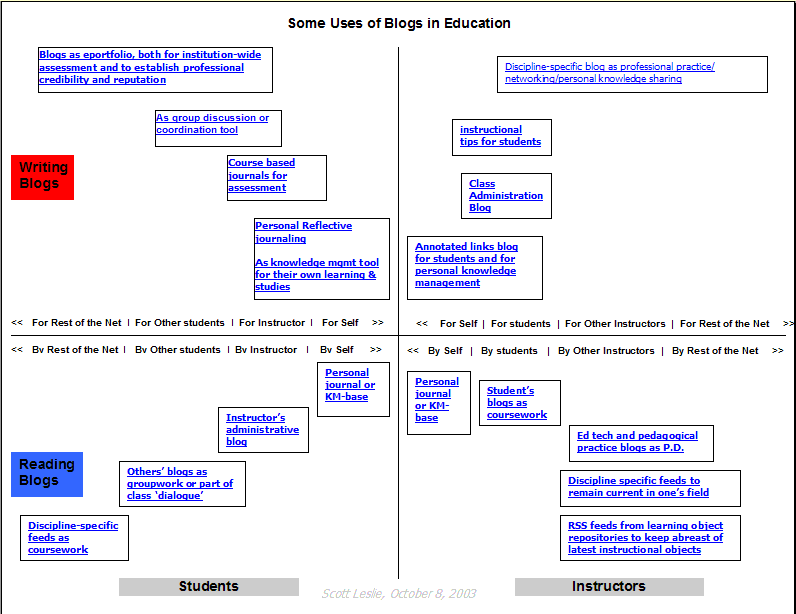
Add Sticky NoteBlogging is very different from traditionally assigned learning content. It is much less formal. It is written from a personal point of view, in a personal voice. Students' blog posts are often about something from their own range of interests, rather than on a course topic or assigned project. More importantly, what happens when students blog, and read reach others' blogs, is that a network of interactions forms-much like a social network, and much like Wenger's community of practice.
-
-
I wonder though about the primary community that students have is really to their own academic goals. This dictates what classes to take, how much effort to put into a course etc. I wonder if in domains outside of academia if the community of practice for a particular domain (instructional technology or even teaching) is higher than the community of students.
-
-
"We're talking to the download generation," said Peter Smith, associate dean, Faculty of Engineering. "Why not have the option to download information about education and careers the same way you can download music? It untethers content from the Web and lets students access us at their convenience." Moreover, using an online service such as Odeo, Blogomatrix Sparks, or even simply off-the-shelf software, students can create their own podcasts.
-
The e-learning application, therefore, begins to look very much like a blogging tool. It represents one node in a web of content, connected to other nodes and content creation services used by other students. It becomes, not an institutional or corporate application, but a personal learning center, where content is reused and remixed according to the student's own needs and interests. It becomes, indeed, not a single application, but a collection of interoperating applications—an environment rather than a system.
-
Add Sticky NoteIt also begins to look like a personal portfolio tool [18]. The idea here is that students will have their own personal place to create and showcase their own work. Some e-portfolio applications, such as ELGG, have already been created. IMS Global as put together an e-portfolio specification [19]. "The portfolio can provide an opportunity to demonstrate one's ability to collect, organize, interpret and reflect on documents and sources of information. It is also a tool for continuing professional development, encouraging individuals to take responsibility for and demonstrate the results of their own learning" [20].
-
Also a place to receive and give feedback. I believe that one of the things that learners need to have to be prepared for learning in this space (social media or web 2.0) is the ability to evaluate, to give good feedback. Additionally, to be able to receive feedback constructively.
-
-
Add Sticky NoteThis approach to learning means that learning content is created and distributed in a very different manner. Rather than being composed, organized and packaged, e-learning content is syndicated, much like a blog post or podcast. It is aggregated by students, using their own personal RSS reader or some similar application. From there, it is remixed and repurposed with the student's own individual application in mind, the finished product being fed forward to become fodder for some other student's reading and use.
-
I like the idea of students passing on their work to be fodder for someone else's learning. In this way we change to from a learner to a learner/teacher! (See Dillon Inouye's work and Comments from John Seeley Brown)
-
-
More formally, instead of using enterprise learning-management systems, educational institutions expect to use an interlocking set of open-source applications. Work on such a set of applications has begun in a number of quarters, with the E-Learning Framework defining a set of common applications and the newly formed e-Framework for Education and Research drawing on an international collaboration. While there is still an element of content delivery in these systems, there is also an increasing recognition that learning is becoming a creative activity and that the appropriate venue is a platform rather than an application.
-
he most important learning skills that I see children getting from games are those that support the empowering sense of taking charge of their own learning. And the learner taking charge of learning is antithetical to the dominant ideology of curriculum design
-
game "modding" allows players to make the game their own
-
Words are only meaningful when they can be related to experiences," said Gee. If I say "I spilled the coffee," this has a different meaning depending on whether I ask for a broom or a mop. You cannot create that context ahead of time— it has to be part of the experience.
-
A similar motivation underlies the rapidly rising domain of mobile learning [24]—for after all, were the context in which learning occurs not important, it would not be useful or necessary to make learning mobile. Mobile learning offers not only new opportunities to create but also to connect. As Ellen Wagner and Bryan Alexander note, mobile learning "define(s) new relationships and behaviors among learners, information, personal computing devices, and the world at large"
-
"ubiquitous computing."
-
what this means is having learning available no matter what you are doing.
-
Add Sticky NoteThe challenge will not be in how to learn, but in how to use learning to create something more, to communicate.
-
I still think part of the challenge is how to learn. How to wade through a sea of all that is out there and "learn from the best" that is available. Find, organize, evaluate, analyze, synthesize, as well as create. I agree with Chris Lott (@fncll) that creativity is vital! (I am just not so sure that it is a non-starter to say that we should be moral first...though it could be argued that we should become moral through the creative process).
-
-
-
01 Jan 10

-
12 Dec 09
 Peter van der Reijden
E-learning as we know it has been around for ten years or so. During that time, it has emerged from being a radical idea—the effectiveness of which was yet to be proven—to something that is widely regarded as mainstream. It's the core to numerous business
web2.0 elearning e-learning education technology training blog teaching e-learning2.0 downes
-
08 Oct 09
-
01 Oct 09
-
09 Sep 09
-
17 Jun 09
-
30 Apr 09
-
22 Apr 09
-
16 Apr 09
-
04 Apr 09
 Fernando Cassola Marques
Ainda não analisei o artigo, mas parece-me que é um tema interessante a explorar para a tese. O autor é bastante conceituado na área das TIC Educação. I have presented on the topic of E-Learning 2.0 a number of times in the last few months, but this is th
-
22 Mar 09
-
17 Mar 09
 Jean-Rémy Duboc
Perpectives on what eLearning is now, and what the futur holds, by the excellent Stephen Downes.
-
25 Feb 09
-
12 Feb 09
-
09 Feb 09
-
02 Feb 09
-
01 Feb 09
-
29 Nov 08
 lara g.r.
By Stephen Downes
October 17, 2005
This article published as E-Learning 2.0 in eLearn Magazine October 16, 2005. [Link] Type: C - Publications in Trade Journals [List all Publications] -
22 Nov 08
-
07 Nov 08
-
In general, where we are now in the online world is where we were before the beginning of e-learning [1].
-
People in networked markets have figured out that they get far better information and support from one another than from vendors
-
Learning is characterized not only by greater autonomy for the learner, but also a greater emphasis on active learning, with creation, communication and participation playing key roles, and on changing roles for the teacher, indeed, even a collapse of the distinction between teacher and student altogether [7].
-
major parts of the World Wide Web were acquiring the properties of communications networks
-
the Web was shifting from being a medium, in which information was transmitted and consumed, into being a platform, in which content was created, shared, remixed, repurposed, and passed along.
-
the emergence of the Web 2.0 is not a technological revolution, it is a social revolution.
-
what constituted "community" in online learning were artificial and often contrived "discussions" supported by learning management systems [15].
-
a community of practice is characterized by "a shared domain of interest" where "members interact and learn together" and "develop a shared repertoire of resources."
-
The model of e-learning as being a type of content, produced by publishers, organized and structured into courses, and consumed by students, is turned on its head.
-
what happens when students blog, and read reach others' blogs, is that a network of interactions forms-much like a social network, and much like Wenger's community of practice.
-
Rather than being composed, organized and packaged, e-learning content is syndicated, much like a blog post or podcast. It is aggregated by students, using their own personal RSS reader or some similar application. From there, it is remixed and repurposed with the student's own individual application in mind, the finished product being fed forward to become fodder for some other student's reading and use.
-
While there is still an element of content delivery in these systems, there is also an increasing recognition that learning is becoming a creative activity and that the appropriate venue is a platform rather than an application.
-
-
03 Nov 08
-
21 Oct 08
-
18 Oct 08
-
13 Oct 08
-
08 Oct 08
 Theron DesRosier
the evolution of education is discussed by downes in this post.
-
Educators began to notice something different happening when they began to use tools like wikis and blogs in the classroom a couple of years ago. All of a sudden, instead of discussing pre-assigned topics with their classmates, students found themselves discussing a wide range of topics with peers worldwide. Imagine the astonishment, for example, when, after writing a review of a circus she had viewed, a Grade 5 student received a response from one of the performers [16]. In a very short time, blogs were used for a wide variety of purposes in education; an educational bloggers' network formed and by this year thousands of teachers were encouraging their students to blog.
-
Add Sticky NoteWhat happens when online learning ceases to be like a medium, and becomes more like a platform? What happens when online learning software ceases to be a type of content-consumption tool, where learning is "delivered," and becomes more like a content-authoring tool, where learning is created? The model of e-learning as being a type of content, produced by publishers, organized and structured into courses, and consumed by students, is turned on its head. Insofar as there is content, it is used rather than read— and is, in any case, more likely to be produced by students than courseware authors. And insofar as there is structure, it is more likely to resemble a language or a conversation rather than a book or a manual.
-
good questions!
-
I think this is a tremendous goal for online learning.
- 1 more sticky notes...
-
-
However, I think one challenge is to create effective assessment measures for content-authoring. But then again, that may also be solved by social media (rankings of twitter users is an example of evaluating content-authoring).
-
-
-
The e-learning application, therefore, begins to look very much like a blogging tool. It represents one node in a web of content, connected to other nodes and content creation services used by other students. It becomes, not an institutional or corporate application, but a personal learning center, where content is reused and remixed according to the student's own needs and interests. It becomes, indeed, not a single application, but a collection of interoperating applications—an environment rather than a system.
-
-
01 Oct 08
-
08 Sep 08

-
29 Aug 08
-
27 Aug 08
-
25 Jul 08
-
24 Jul 08
-
form of online courses
-
system that organizes and delivers online courses
-
These changes are sweeping across entire industries as a whole and are not unique to education; indeed, in many ways education has lagged behind some of these trends and is just beginning to feel their wake.
-
This is more than just adapting for different learning styles or allowing the user to change the font size and background color; it is the placing of the control of learning itself into the hands of the learner
-
The new Internet user may not vote, but that is only because the vote is irrelevant when you govern yourself
-
In a nutshell, what was happening was that the Web was shifting from being a medium, in which information was transmitted and consumed, into being a platform, in which content was created, shared, remixed, repurposed, and passed along
-
Web 2.0 is an attitude not a technology. It's about enabling and encouraging participation through open applications and services. By open I mean technically open with appropriate APIs but also, more importantly, socially open, with rights granted to use the content in new and exciting contexts
-
These communities were typically limited to a given group of learners, such as a university class, had a fixed start and end-point
-
It becomes, not an institutional or corporate application, but a personal learning center, where content is reused and remixed according to the student's own needs and interests.
-
It becomes, indeed, not a single application, but a collection of interoperating applications—an environment rather than a system.
-
Rather than being composed, organized and packaged, e-learning content is syndicated, much like a blog post or podcast.
-
More formally, instead of using enterprise learning-management systems, educational institutions expect to use an interlocking set of open-source applications.
-
In the future it will be more widely recognized that the learning comes not from the design of learning content but in how it is used.
-
Mobile learning offers not only new opportunities to create but also to connect
-
-
22 Jul 08
-
28 Jun 08
-
27 Jun 08
-
24 Jun 08
-
18 Jun 08
-
10 Jun 08
 maike online
Web 2.0 is not a technological revolution, it is a social revolution.
web2.0 learning2.0 elearning forevideo downes szenarien forproject vortrag240309 delicious
-
26 May 08
-
05 May 08
-
18 Apr 08
-
08 Apr 08
-
03 Apr 08
-
Papert writes, "The most important learning skills that I see children getting from games are those that support the empowering sense of taking charge of their own learning. And the learner taking charge of learning is antithetical to the dominant ideology of curriculum design"
-
-
31 Mar 08

-
14 Mar 08
 Javed Alam
E-learning as we know it has been around for ten years or so.
During that time, it has emerged from being a radical idea—the
effectiveness of which was yet to be proven—to something that is widely
regarded as mainstream. -
 Zaid Ali Alsagoff
This article written in 2005, explores what lies ahead in the field of e-learning. Just read it!
-
01 Mar 08

-
20 Feb 08
-
13 Feb 08
-
08 Feb 08
-
11 Jan 08
 Janet Burstall
"Imagine the astonishment, for example, when, after writing a review of a circus she had viewed, a Grade 5 student received a response from one of the performers "
-
13 Dec 07
-
06 Dec 07
-
28 Nov 07
-
22 Nov 07

-
One trend that has captured the attention of numerous pundits is the changing nature of Internet users themselves. Sometimes called "digital natives" and sometimes called "n-gen," these new users approach work, learning and play in new ways [2].
They absorb information quickly, in images and video as well as text, from multiple sources simultaneously. They operate at "twitch speed," expecting instant responses and feedback.
-
In learning, these trends are manifest in what is sometimes called "learner-centered" or "student-centered" design. This is more than just adapting for different learning styles or allowing the user to change the font size and background color; it is the placing of the control of learning itself into the hands of the learner [5].
-
Taking this approach even further is George Siemens's Connectivism. "We derive our competence," writes Siemens, "from forming connections... Chaos is a new reality for knowledge workers... Unlike constructivism, which states that learners attempt to foster understanding by meaning-making tasks, chaos states that the meaning exists— the learner's challenge is to recognize the patterns which appear to be hidden. Meaning-making and forming connections between specialized communities are important activities." Readers of Douglas Rushkoff's Cyberia will recognize a similar theme as knowledge-working is no longer thought of as the gathering and accumulation of facts, but rather, the riding of waves in a dynamic environment [8].
-
n a nutshell, what was happening was that the Web was shifting from being a medium, in which information was transmitted and consumed, into being a platform, in which content was created, shared, remixed, repurposed, and passed along
-
For all this technology, what is important to recognize is that the emergence of the Web 2.0 is not a technological revolution, it is a social revolution. "Here's my take on it: Web 2.0 is an attitude not a technology. It's about enabling and encouraging participation through open applications and services. By open I mean technically open with appropriate APIs but also, more importantly, socially open, with rights granted to use the content in new and exciting contexts"
-
-
12 Nov 07
-
16 Oct 07
-
Today
-
(LMS).
-
WebCT, Blackboard
-
Desire2Learn
-
One trend
-
In learning, these trends are manifest in what is sometimes called "learner-centered" or "student-centered" design
-
autonomy
-
emphasis on active learning, with creation, communication and participation playing key roles, and on changing roles for the teacher,
-
Meaning-making and forming connections between specialized communities are important activities
-
the Read Web" to the "Read-Write Web,"
-
According to Wenger, a community of practice is characterized by "a shared domain of interest" where "members interact and learn together" and "develop a shared repertoire of resources."
-
"a shared domain of interest" where "members interact and learn together" and "develop a shared repertoire of resources."
-
an environment rather than a system.
-
-
22 Aug 07
-
04 Aug 07


Public Stiky Notes
I think social networking facilitates communities of practice, but is only a community of practice in name only. There are phrases that we relate to social networking, but there isn't a community that is specific for social networking. It's like Teaching or Learning. Is there a community that is devoted to teaching or learning explicity? Well, there are many organizations involved in granting degrees or preparing for employment. There are also organizations that perform incredible research. But I don't think you can separate out teaching & learning enough to form its own community of practice. A CoP by definition requires a domain to practice.
Would you like to comment?
Join Diigo for a free account, or sign in if you are already a member.