
The steady state theory is not supported by the bulk of the evidence and thus not generally accepted by the cosmological society.

James Linzel's List: Assignment 1: Origins of the Universe
-
Assignment One: The Origins of the Universe
1 State, then compare and contrast the "Steady State Theory" and the "Big Bang" theories of the formation of the universe.
2 Explain the evidence Mr. Edwin Hubble detected and explain what this evidence tells us about our universe.
3 State what the Cosmic Microwave Background Radiation [CMBR] is, and how it supports the "Big Bang" theory of cosmology.
4 State the approximate age of the universe and the evidence used to determine this approximate age.
5 The Big Bang theory explains the expansion of the early universe was too quick to allow synthesis of atoms larger than Helium - He [approximately]. Investigate, state and explain the nucleosynthesis process as it occurs in stars and other celestial events, to form the more massive elements found on the periodic table.
6 Explain how some of the more massive elements spread throughout the universe ended up on Earth. -
-
-
The steady state theory of cosmology claims that the Universe simply exists without changing with time. This theory presents many physical as well as philosophical difficulties. Evidence suggests that the Universe is expanding. While there are ways to explain expansion in a steady state universe, few astrophysicists believe this theory, because there is little evidence to support it. As the first widely held theory about the Universe it is included here for historical completeness.
-
-
-
-
After the Big Bang, the Universe was an incredibly hot fireball,
-
Not only that, but by measuring this pattern across all of the sky, astronomers can calculate the shape and size of the whole Universe
-
-
-
that generates
-
Explain why the word, generates, was used here. What does this imply?
-
-
The universe begins with a cataclysm that generates space and time, as well as all the matter and energy the universe will ever hold. For an incomprehensibly small fraction of a second, the universe is an infinitely dense, hot fireball. The prevailing theory describes a peculiar form of energy that can suddenly push out the fabric of space. On a rare occasion, a runaway process called "Inflation" can cause a vast expansion of space filled with this energy. The inflationary expansion is stopped only when this energy is transformed into matter and energy as we know it.
-
-
-
The so-called Big Bang theory is the current favoured hypothesis of the formation of the universe according to astronomy. This asserts that some 12-15 billion years ago there was a suddenly expansion and explosion of all matter and energy out of an original point - out of literally nothing - and that not only space but even time began at this moment. (So we cannot speak of an explosion in space - because there was no space before, or no time at which this could be measured - space and time being properties of the universe rather than something outside of it).
-
According to quantum theory, matter and antimatter particles are created in pairs all the time out of nothing (i.e. vacuum) and cancel each other out with no effect on the universe. They are therefore called virtual particles). At the Big Bang, however, massive amounts of matter and antimatter were created and although much of it was similarly cancelled out with a huge release of energy, matter won the day and spawned the universe as we know it.
-
-
-
The idea of a static universe is one which demands that space is not expanding nor contracting but rather is dynamically stable. Albert Einstein proposed such a model as his preferred cosmology by adding a cosmological constant to his equations of general relativity to counteract the dynamical effects of gravity which in a universe of matter would cause the universe to collapse. After the discovery by Edwin Hubble that there was a relationship between redshift and distance, Einstein declared this formulation to be his "biggest blunder".
Even after Hubble's observations, Fritz Zwicky proposed that a static universe could still be viable if there was an alternative explanation of redshift due to a mechanism that would cause light to lose energy as it traveled through space, a concept that would come to be known as "tired light". Subsequent cosmological observations have shown such a model to be an unviable alternative, leading most astrophysicists to conclude that the static universe is essentially falsified.
-
Here is another historical account of the steady state hypothesis.
-
-
-
-
Add Sticky NoteObservations suggest that the universe as we know it began around 13.7 billion years ago. Since then, the evolution of the universe has passed through three phases. The very early universe, which is still poorly understood, was the split second in which the universe was so hot that particles had energies higher than those currently accessible in particle accelerators on Earth. Therefore, while the basic features of this epoch have been worked out in the big bang theory, the details are largely based on educated guesses.
-
made public
-
-
-
-
-
Because of its name many people think of the Big Bang as a kind of explosion that happened at some specific point in space, but this isn't correct, as the Universe didn't spring from one central ignition point. Instead, during the Big Bang space was first created and then stretched
-
Please make note of this very important distinction.
<br><ul><li>Not an explosion <b>IN </b>space.
</li><li>The formation and <b>STRETCHING</b> of space!</li></ul>
-
-
-
-
-
The following Scientific American Article should be able to be found in the library.
You should be able to be found this acrticle in the library. Ask the librarian for help.
-
-
-
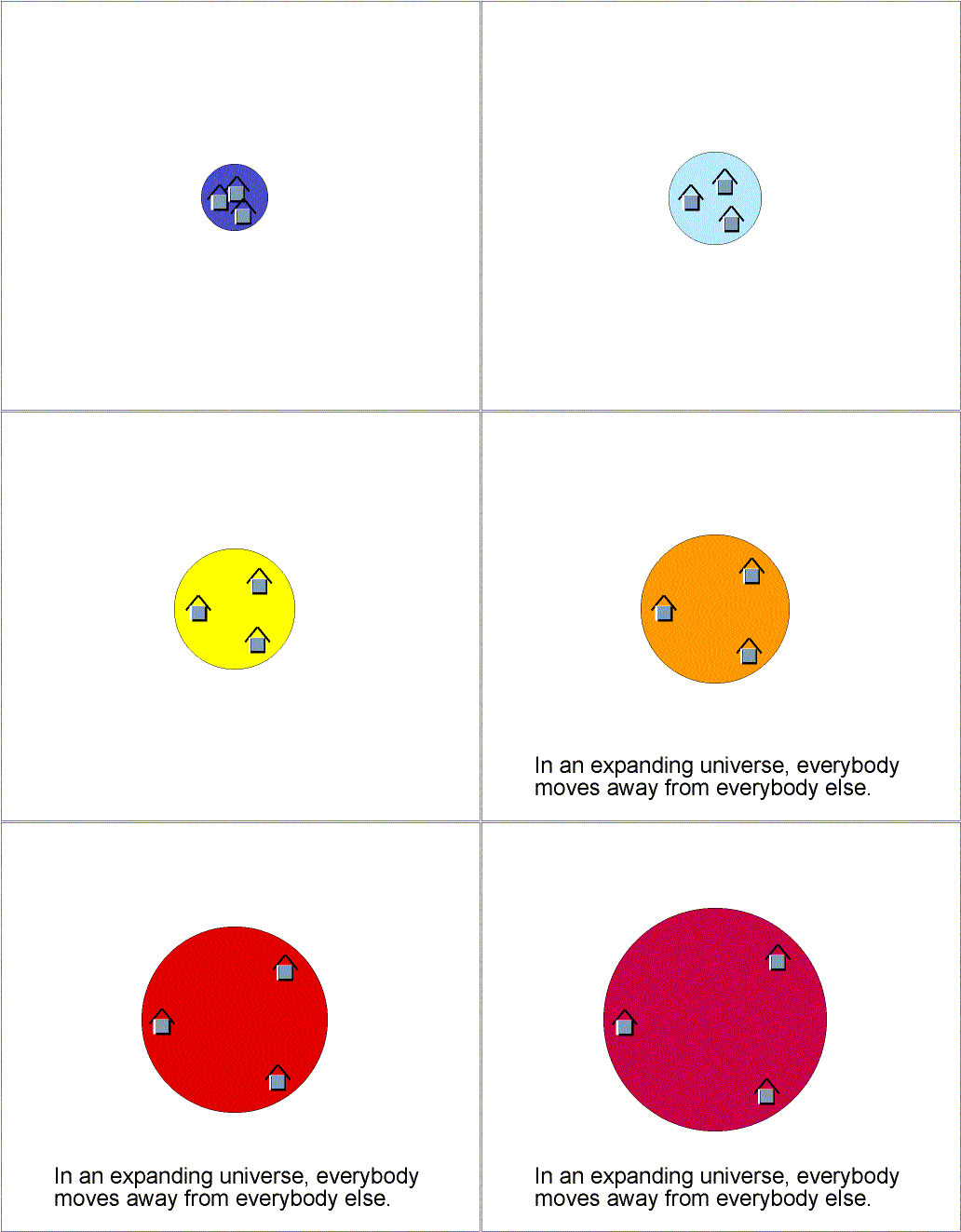
The idea of a curved surface also explains why astronomers in every galaxy will see the other galaxies moving away from it and, therefore, derive the same Hubble Law. Go back to the balloon analogy, imagine that there are flat houses on it. As the balloon expands, the elastic material moves the houses apart from each other. A person sitting on their front porch see everybody else moving away from her and she appears to be the center of the expansion.
-
-
-
-
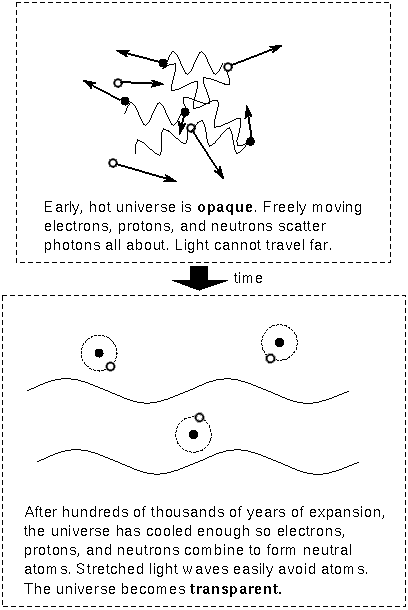
Since the universe is observed to be expanding, it means that the galaxies were originally right on top of each other. Also, the energy of the universe was concentrated in a smaller volume. The entire universe would have glowed first in the gamma ray band, then the X-ray band, then to less energetic bands as the universe expanded. By now, about 14 billion years after the start of the expansion, the cold universe should glow in the radio band. The expansion rate has slowed down over time because of the force of gravity. This means that the early expansion was faster than it is now. At the start of the expansion, the expansion rate was extremely rapid.
The early large expansion rate and very high temperatures made Fred Hoyle (lived 1915 - 2001) call this theory of the birth of the universe, the Big Bang. At the time he coined the term, Hoyle was advocating another theory that used the perfect cosmological principle called the Steady State theory. So at the time, Hoyle's "Big Bang" term was made in joking disdain. However, the Big Bang proponents liked the term and used it from then on.
-
Arno Penzias and Robert Wilson observed in 1965 a radio background source that was spread all over the universe---the cosmic microwave background radiation. The radiation has the same intensity and spectral character as a thermal continuous source at 3 K (more precisely, 2.728 ± 0.004 K) as measured by the COBE satellite in every direction observed.
-
-
-
After about 15 minutes from the Big Bang, the universe had expanded and cooled so much that fusion was no longer possible. The composition of the universe was 10% helium and 90% hydrogen (or if you use the proportions by mass, then the proportions are 25% helium and 75% hydrogen).
-
List Comments
(0)
List Info

30 items | 89 visits
Websites explaining the origin, evidence and expansion of the universe.
Updated on Dec 07, 09
Created on Jan 14, 08
Category: Schools & Education
URL:
People who saved the list (1)
-
on Jul 22, 16