
can you see

James Linzel's List: Assignment 2: Origins and Fate of Stars
-
-
-
-
hey have collapsed so much that their atoms have been crushed, squashing the protons and electrons together until they merge to leave only neutrons.
-
-
-
The dying core eventually forms a white dwarf - a spherical diamond the size of the Earth, made of carbon and oxygen. From this point on the Sun will gradually fade away, becoming dimmer and dimmer until its light is finally snuffed out.
-
-
-
it took 300,000 years for stable hydrogen and helium atoms to form. Gradually these atoms began to clump together into gas clouds called nebulae.
-
-
-
-
Hydrogen and helium and some lithium, boron, and beryllium were created when the universe was created. All of the rest of the elements of the universe were produced by the stars in nuclear fusion reactions. These reactions created the heavier elements from fusing together lighter elements in the central regions of the stars. When the outer layers of a star are thrown back into space, the processed material can be incorporated into gas clouds that will later form stars and planets. The material that formed our solar system incorporated some of the remains of previous stars. All of the atoms on the Earth except hydrogen and most of the helium are recycled material---they were not created on the Earth. They were created in the stars.
-
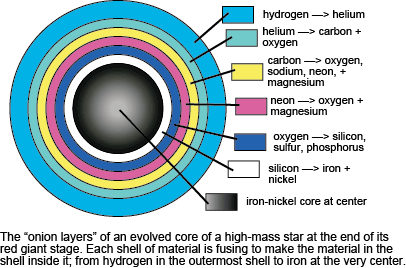
The atoms heavier than helium up to the iron and nickel atoms were made in the cores of stars (the process that creates iron also creates a smaller amount of nickel too). The lowest mass stars can only synthesize helium. Stars around the mass of our Sun can synthesize helium, carbon, and oxygen. Massive stars (M* > 8 solar masses) can synthesize helium, carbon, oxygen, neon, magnesium, silicon, sulfur, argon, calcium, titanium, chromium, and iron (and nickel). Elements heavier than iron are made in supernova explosions from the rapid combination of the abundant neutrons with heavy nuclei. Massive red giants are also able to make small amounts of elements heavier than iron (up to mercury and lead) through a slower combination of neutrons with heavy nuclei, but supernova probably generate the majority of elements heavier than iron and nickel (and certainly those heavier than lead up to uranium). The synthesized elements are dispersed into the interstellar medium during the planetary nebula supernova stage (with supernova being the best way to distribute the heavy elements far and wide). These elements will be later incorporated into giant molecular clouds and eventually become part of future stars and planets (and life forms?)
-
-
-
Add Sticky NoteDuring the supernova outburst, elements heavier than iron are produced as free neutrons produced in the explosion rapidly combine with heavy nuclei to produce heavier and very rare nuclei like gold, platinum, uranium among others. This happens in about the first 15 minutes of the supernova. The most massive stars may also produce very powerful bursts of gamma-rays that stream out in jets at the poles of the stars at the moment their cores collapse to form a black hole.
-
-
Add Sticky NoteWhat remains after the outer layers are thrown off depends on the mass of the core. The core remnants are described fully in the next section. Here a brief description of each type of core remnant will be given. If the core has a mass less than 1.4 solar masses, it will shrink down to a white dwarf the size of the Earth. The electrons in the compressed gas bump right against each other to form a strange sort of gas called a degenerate gas. The electrons prevent further collapse of the core.
If the core has a mass between 1.4 and 3 solar masses, the neutrons will bump up against each other to form a degenerate gas in a neutron star about the size of small city. The neutrons prevent further collapse of the core. Nothing can prevent the highest mass cores (greater than 3 solar masses) from collapsing to a point. On the way to total collapse, it may momentarily create a neutron star and the resulting supernova rebound explosion and powerful
bursts of gamma-rays in bipolar jets (possibly the source of some of the ``gamma-ray burst'' objects). Gravity finally wins. Nothing holds it up. The gravity around the collapsed core becomes so great that Newton's law of gravity becomes inadequate and the gravity must be described by the more powerful theory of General Relativity developed by Albert Einstein. This will be discussed further below.The supercompact point mass is called a black hole because the escape velocity around the point mass is greater than the speed of light. Since the speed of light is the fastest that any radiation or any other information can travel, the region is totally black. The distance at which the escape velocity equals the speed of light is called the event horizon because no information of events occurring inside the event horizon can get to the outside. The radius of the event horizon in kilometers = 3 × core mass in solar masses.
-
wow
-
-
-
-
If the star is massive enough, gravity can compress the core enough to create high enough temperatures to start fusing helium (or heavier elements if it is repeating this stage).
-
When the core fuel runs out again, the core resumes its collapse. If the star is massive enough, it will repeat stage 5. The number of times a star can cycle through stages 5 to 7 depends on the mass of the star. Each time through the cycle, the star creates new heavier elements from the ash of fusion reactions in the previous cycle. This creation of heavier elements from lighter elements is called stellar nucleosynthesis. For the most massive stars, this continues up to the production of iron in the core. Stars like our Sun will synthesize elements only up to carbon and oxygen in their cores. Each repeat of stages 5 to 7 occurs over a shorter time period than the previous repeat.
-
-
-
Eventually the star becomes stable because hydrostatic equilibrium has been established. The star settles down to spend about 90% of its life as a main sequence star. It is fusing hydrogen to form helium in the core.
Stars initially begin their lives near other stars in a cluster. After a few orbits around the galactic center, gravitational tugs from other stars in the galaxy cause the stars in the cluster to wander away from their cluster and live their lives alone or with perhaps one or two companions.
-
Eventually the star becomes stable because hydrostatic equilibrium has been established. The star settles down to spend about 90% of its life as a main sequence star. It is fusing hydrogen to form helium in the core.
Stars initially begin their lives near other stars in a cluster. After a few orbits around the galactic center, gravitational tugs from other stars in the galaxy cause the stars in the cluster to wander away from their cluster and live their lives alone or with perhaps one or two companions.
-
-
-
A giant molecular cloud is a large, dense gas cloud (with dust) that is cold enough for molecules to form. Thousands of giant molecular clouds exist in the disk part of our galaxy. Each giant molecular cloud has 100,000's to a few million solar masses of material.
-
The Orion Complex is about 1500 light years away, several hundred light years across, and has enough material to form many tens of thousands of suns
-
-
Feb 24, 08
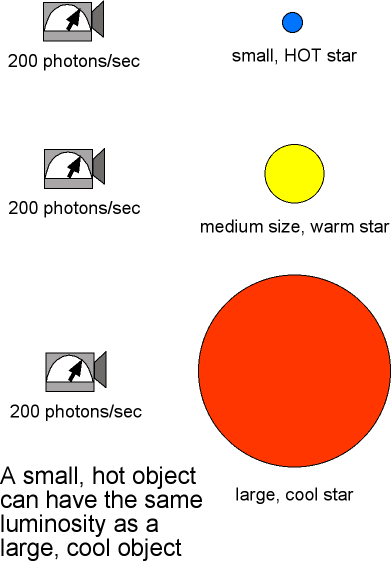
The figure below illustrates the inter-dependence of measurable quantities with the derived values that have been discussed so far. In the left triangular relationship, the apparent brightness, distance, and luminosity are tied together such that if you know any two of the sides, you can derive the third side. For example, if you measure a glowing object's apparent brightness (how bright it appears from your location) and its distance (with trigonometric parallax), then you can derive the glowing object's luminosity. Or if you measure a glowing object's apparent brightness and you know the object's luminosity without knowing its distance, you can derive the distance (using the inverse square law). In the right triangular relationship, the luminosity, temperature, and size of the glowing object are tied together. If you measure the object's temperature and know its luminosity, you can derive the object's size. Or if you measure the glowing object's size and its temperature, you can derive the glowing object's luminosity---its electromagnetic energy output.\n\napparent brightness, distance, luminosity triangle + luminosity, temperature, size triangle\n\nFinally, note that a small, hot object can have the same luminosity as a large, cool object. So if the luminosity remains the same, an increase in the size (surface area) of the object must result in a DEcrease in the temperature to compensate.\n\n
-
The figure below illustrates the inter-dependence of measurable quantities with the derived values that have been discussed so far. In the left triangular relationship, the apparent brightness, distance, and luminosity are tied together such that if you know any two of the sides, you can derive the third side. For example, if you measure a glowing object's apparent brightness (how bright it appears from your location) and its distance (with trigonometric parallax), then you can derive the glowing object's luminosity. Or if you measure a glowing object's apparent brightness and you know the object's luminosity without knowing its distance, you can derive the distance (using the inverse square law). In the right triangular relationship, the luminosity, temperature, and size of the glowing object are tied together. If you measure the object's temperature and know its luminosity, you can derive the object's size. Or if you measure the glowing object's size and its temperature, you can derive the glowing object's luminosity---its electromagnetic energy output.
-

-
-
-
Gravity Holds a Star Together
Stars are held together by gravity. Gravity tries to compress everything to the center. What holds an ordinary star up and prevents total collapse is thermal and radiation pressure. The thermal and radiation pressure tries to expand the star layers outward to infinity.
Hydrostatic equilibrium: gravity compression is balanced by pressure outward.
Greater gravity compresses the gas, making it denser and hotter, so the outward pressure increases.In any given layer of a star, there is a balance between the thermal pressure (outward) and the weight of the material above pressing downward (inward). This balance is called hydrostatic equilibrium. A star is like a balloon. In a balloon the gas inside the balloon pushes outward and the elastic material supplies just enough inward compression to balance the gas pressure. In a star the star's internal gravity supplies the inward compression. Gravity compresses the star into the most compact shape possible: a sphere. Stars are round because gravity attracts everything in an object to the center. Hydrostatic equilibrium also explains why the Earth's atmosphere does not collapse to a very thin layer on the ground and how the tires on your car or bicyle are able to support the weight of your vehicle.
-
-
-
Core
The core is the innermost 10% of the Sun's mass. It is where the energy from nuclear fusion is generated. Because of the enormous amount of gravity compression from all of the layers above it, the core is very hot and dense. Nuclear fusion requires extremely high temperatures and densities. The Sun's core is about 16 million K and has a density around 160 times the density of water. This is over 20 times denser than the dense metal iron which has a density of ``only'' 7 times that of water. However, the Sun's interior is still gaseous all the way to the very center because of the extreme temperatures. There is no molten rock like that found in the interior of the Earth. -
Convective Zone
Energy in the outer 15% of the Sun's radius is transported by the bulk motions of gas in a process called convection. At cooler temperatures, more ions are able to block the outward flow of photon radiation more effectively, so nature kicks in convection to help the transport of energy from the very hot interior to the cold space. This part of the Sun just below the surface is called the convection zone.
-
-
Jan 17, 08
Astronomers believe that molecular clouds, dense clouds of gas located primarily in the spiral arms of galaxies are the birthplace of stars. Dense regions in the clouds collapse and form "protostars". Initially, the gravitational energy of the collapsing star is the source of its energy. Once the star contracts enough that its central core can burn hydrogen to helium, it becomes a "main sequence" star.
-
Add Sticky NoteAstronomers believe that molecular clouds, dense clouds of gas located primarily in the spiral arms of galaxies are the birthplace of stars. Dense regions in the clouds collapse and form "protostars". Initially, the gravitational energy of the collapsing star is the source of its energy. Once the star contracts enough that its central core can burn hydrogen to helium, it becomes a "main sequence" star.
-
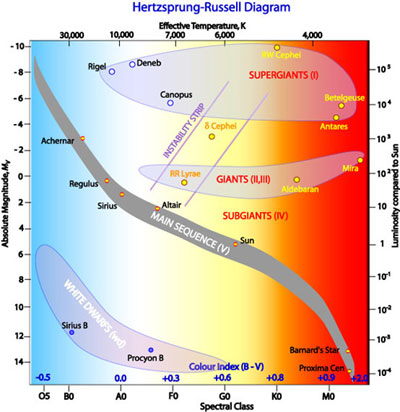
To understand this paragraph you need to make yourself familar with the Hertzsprung-Russel diagram. Look up an image of these diagrams that are used to classify stars according to two criteria. What are the criteria? You should also remember that colour is related to temperature.
-
-
Main sequence stars are stars, like our Sun, that fuse hydrogen atoms together to make helium atoms in their cores. For a given chemical composition and stellar age, a stars' luminosity, the total energy radiated by the star per unit time, depends only on its mass. Stars that are ten times more massive than the Sun are over a thousand times more luminous than the Sun. However, we should not be too embarrassed by the Sun's low luminosity: it is ten times brighter than a star half its mass. The more massive a main sequence star, the brighter and bluer it is. For example, Sirius, the dog star, located to the lower left of the constellation Orion, is more massive than the Sun, and is noticeably bluer. On the other hand, Proxima Centauri, our nearest neighbor, is less massive than the Sun, and is thus redder and less luminous.
-
-
Jan 17, 08
Despite what you might think, space is not a perfect vacuum. The space between the stars is filled with a tenuous range of material that provides the building blocks of stars. This material is gas and dust and collectively is known as the interstellar medium (ISM). The ISM gas is predominantly hydrogen whilst the dust is about 1% by mass and includes carbon compounds and silicates. Dust is responsible for the interstellar reddening and extinction of starlight. The more of the ISM a star's light travels through on its way to an observer on Earth the more it gets scattered and absorbed, decreasing the star's apparent brightness and reddening its appearance.
-
Despite what you might think, space is not a perfect vacuum. The space between the stars is filled with a tenuous range of material that provides the building blocks of stars. This material is gas and dust and collectively is known as the interstellar medium (ISM). The ISM gas is predominantly hydrogen whilst the dust is about 1% by mass and includes carbon compounds and silicates. Dust is responsible for the interstellar reddening and extinction of starlight. The more of the ISM a star's light travels through on its way to an observer on Earth the more it gets scattered and absorbed, decreasing the star's apparent brightness and reddening its appearance.
-
Stars form in regions of the ISM where there is sufficient material available. These are the giant molecular clouds or GMCs
-
-
-
Stellar Evolution
If the star is about the same mass as the Sun, it will turn into a white dwarf star. If it is somewhat more massive, it may undergo a supernova explosion and leave behind a neutron star. But if the collapsing core of the star is very great—at least three times the mass of the Sun—nothing can stop the collapse. The star implodes to form an infinite gravitational warp in space—a black hole.

The brightest X-ray sources in our galaxy are the remnants of massive stars that have undergone a catastrophic collapse—neutron stars and black holes. Other powerful sources of X-rays are giant bubbles of hot gas produced by exploding stars. White dwarf stars and the hot, rarified outer layers, or coronas, of normal stars are less intense X-ray sources.
-



List Comments
(0)
List Info

22 items | 46 visits
These pages help describe the formation of, the aging and fate of stars found in our universe.
Updated on Dec 14, 09
Created on Sep 21, 07
Category: Schools & Education
URL: