History of Western Thought
Web Address: http://www.diigo.com/list/linzel/history-of-western-thoughtYou are here: Diigo Home > James Linzel > James Linzel's lists
Items:16 | Visits:95
Category:Schools & Education | Tags:astronomy, science, western
Created:on 2008-01-29 | Updated:on 2008-04-10
A summary of Western astronomical thought and its development over the last two millenia.
-
3Expand
History and Philosophy of Western Astronomy
Tags: astronomy, philosophy, science, scienceliteracy, scientificmethod on 2008-02-25 and saved by4 people -All Annotations (0) -About
more fromwww.astronomynotes.com
-
The emphasis was on the process of
learning about the universe rather
than attaining the goal. But people eventually got tired of learning and wanted
absolute answers. -
A paradigm is a general consensus of belief of how the world works. It is
a mental framework we use to interpret what happens around us. It is what could
be called ``common sense''.
The Pythagorean Paradigm had three key points about the movements
of celestial objects:- The planets, Sun, Moon and stars move in perfectly circular orbits;
- The speed of the planets, Sun, Moon and stars in their circular orbits is
perfectly uniform; - The Earth is at the exact center of the motion of the celestial bodies.
- The planets, Sun, Moon and stars move in perfectly circular orbits;
-
Socrates (lived 470--399 B.C.E.) disagreed with the Sophists,
teaching that we can attain real truth through
collaboration with others. By exploring together and being skeptical about ``common
sense'' notions about the way things are, we can get a correct understanding of
how our world and society operate. This idea of being skeptical so that a truer understanding
of nature can be found is still very much a part of modern science.
-
-
11Expand
History and Philosophy of Western Astronomy
Tags: astronomy, science, western on 2008-02-25 -All Annotations (0) -About
more fromwww.astronomynotes.com
-
They had preserved and translated the
Greek writings and adopted the Greek ideals of logic and rational inquiry. Islamic
astronomers were careful observers of the sky and created accurate star catalogs
and tables of planet motions. Many of the names of the bright stars in our sky
have Arabic names (e.g., Deneb, Alberio, Aldebaran, Rigel to name a few). -
However,
advances in the explanations of the motions of the stars and planets were
made by astronomers in Europe starting in the 16th century. -
Scientists use a guiding principle called Occam's Razor to
choose between two or more models that accurately explain the observations. This
principle, named after the English philosopher, William
of Occam, who stated this principle in the mid-1300's, says:
the best model is the simplest one---the one requiring the fewest
assumptions and modifications
in order to fit the observations. Guided by Occam's Razor some scientists
began to have serious doubts about Ptolemy's geocentric model in the early days
of the Renaissance. -
By the 16th century the following paradigm had developed: Man is God's
special creation of the physical
universe; the Earth is the center of a mathematically-planned universe and we
are given the gift of reading this harmony. -
During the years between Ptolemy and Copernicus, many small epicycles
had been added to the main epicycles to make Ptolemy's model agree with the
observations. By Copernicus' time, the numerous sub-epicycles and offsets had
made the Ptolemaic model very complicated -
He
adopted Aristarchus' heliocentric (Sun-centered) model because he felt that
God should be at the center of the universe. Copernicus' model had the
same accuracy as the revised Ptolemaic one but was more elegant. -
He found that the
planets farther from the Sun move slower. The different speeds of the planets
around the Sun provided a very simple explanation for the observed retrograde
motion. -

-
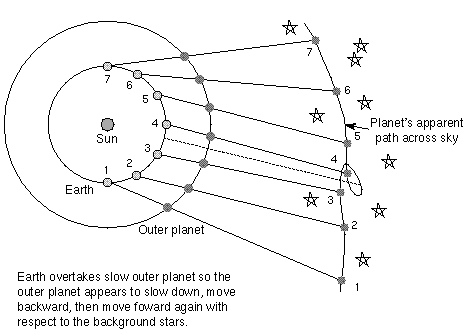
Retrograde motion is the projected position of a planet on the
background stars as the Earth overtakes it (or is passed by, in the case of the
inner planets). The figure below illustrates this. Retrograde motion is just an
optical illusion! You see the
same sort of effect when you pass a slower-moving truck on the highway. As you
pass the truck, it appears to move backward with respect to the background
trees and mountains. If you continue observing the truck, you will eventually see
that the truck is moving forward with respect to the background scenery. The
relative geometry of you and the other object determines what you see projected
against some background.
-
Though Tycho's beliefs of the universe did not have that much of an effect on
those who followed him, his exquisite observations came to play a key role in
determining the true motion of the planets by Johannes Kepler. Tycho was
one of the best observational astronomers who ever lived. Without using a
telescope, Tycho was able to
measure the positions of the planets to within a few arc minutes---a
level of precision and accuracy that was at least ten times better than anyone
had obtained before! -
Our view of the history of astronomy will now skip almost 1500 years to the next
major advances in astronomy
-
-
2Expand
History and Philosophy of Western Astronomy
Tags: astronomy, scienceliteracy, western on 2008-02-25 -All Annotations (0) -About
more fromwww.astronomynotes.com
-
- In what ways was the Ptolemaic model a good scientific model and in
what ways was it not? - What is the Copernican model and how did it explain retrograde motion?
- In what ways was the Ptolemaic model a good scientific model and in
-
- What two basic kinds of models have been proposed to explain the
motions of the planets? - What is the Ptolemaic model? What new things did Ptolemy add to his
model? - Why are epicycles needed in Ptolemy's model?
- What two basic kinds of models have been proposed to explain the
-
-
7Expand
History and Philosophy of Western Astronomy
Tags: astronomy, philosophy, science, scienceliteracy on 2008-02-25 and saved by2 people -All Annotations (0) -About
more fromwww.astronomynotes.com
-
Galileo Galilei (1564--1642 C.E.) was
the first person we know of that used the telescope for astronomical
observations (starting in 1609). The telescope was originally used as a naval
tool to assess the strength
of the opponent's fleet from a great distance. He found many new things when
he looked through his telescope:- The superior light-gathering power of his telescope over the naked eye
enabled him to see many,
many new fainter stars that were never seen before. This made Bruno's argument more
plausible. - The superior resolution and magnification over the naked eye enabled him to
see pits and craters on the Moon and spots on the Sun. This meant that the
Earth is not only place of change and decay!
- The superior light-gathering power of his telescope over the naked eye
-
- With his superior ``eye'' he discovered four moons orbiting Jupiter. These
four moons (Io, Europa, Ganymede, and
Callisto) are called the Galilean satellites in his honor. In this system
Galileo saw a mini-model of the heliocentric system. The moons are not
moving around the Earth but are centered on Jupiter. Perhaps other objects,
including the planets, do not move around the Earth. - He also made the important discovery that Venus goes through a complete set
of phases. The gibbous and full phases
of Venus are impossible in the Ptolemaic model but possible in Copernican model
(and Tychonic model too!). In the Ptolemaic model Venus was always
approximately between us and the Sun and was never found further away from the
Earth than the Sun. Because of this geometry, Venus should always be in a
crescent, new, or quarter phase. The only way to arrange Venus to make a
gibbous or full phase is to have it orbiting the Sun so that, with respect
to our viewpoint, Venus could get on the other side of, or behind, the Sun
further away from us than the Sun. This was
possible only if Venus orbited the Sun (see the figure at the end of the
planetary motions section
of the previous chapter).
- With his superior ``eye'' he discovered four moons orbiting Jupiter. These
-
A scientific model cannot be proven correct, only
disproven. A model
that survives repeated tests is one that is consistent with the available
data.
His observations were consistent with the heliocentric model, but could also be
explained with a geocentric model like Tycho's. But for Galileo, the observations
were enough---he was convinced of the heliocentric system before he used his
telescope and his observations confirmed his belief. -
More convincing evidence of the
Earth's motion around the Sun would have to
wait until 1729 when James Bradley
(lived 1693--1762 C.E.) discovered
that a telescope has to be slightly tilted because of the Earth's motion, just
as you must tilt an umbrella in front of you when walking quickly in the rain
to keep the
rain from hitting your face. The direction the telescope must
be tilted constantly changes as the Earth orbits the Sun.
Over a century later, Friedrich W. Bessel
(lived 1784--1846 C.E.) provided
further evidence for the Earth's motion by
measuring the parallax of a nearby star in the late 1830s. -
Evidence of the Earth's rotation (from west to east) is seen with the
deflection of objects moving in north-south direction
caused by the differences in the linear speed of the
rotation at different
latitudes. All parts of the Earth take 23 hours 56 minutes to turn once, but
the
higher latitudes are closer to the Earth's rotation axis, so they do
not need to rotate as fast as regions nearer the equator. A moving
object's west-east speed will stay at the original value it had at the
start of its motion (unless some force changes it). If the object is
also changing latitudes, then its west-east speed will be different
than that for the part of the Earth it is over. Therefore,
moving objects appear to be deflected to the right in the northern
hemisphere and to the left in the southern hemisphere. This is called
the coriolis effect after Gustave-Gaspard Coriolis (lived
1792--1843 C.E.)
who deduced the effect in 1835 to
explain why cannonballs shot long distances kept missing their target
if the cannon was aimed directly at its target. See
energy
flow section for applications (and illustrations) of the
coriolis effect to planet atmospheres. -
The coriolis effect and the Foucault pendulum are both based on
Galileo's discovery that an object's motion (speed and/or direction)
are changed only if there is a force acting on it. -
Giordano Bruno (lived 1548--1600 C.E.) revived
Democritus' (a contemporary of Socrates) view that the Sun was
one of an infinite number of stars.
-
-
10Expand
History and Philosophy of Western Astronomy
Tags: astronomy, philosophy, western on 2008-02-25 -All Annotations (0) -About
more fromwww.astronomynotes.com
-
Kepler was motivated by his
faith in
God to try to discover God's plan in the universe---to ``read the mind of God.''
Kepler shared the Greek view that mathematics was the language of God. He knew that
all previous models were inaccurate, so he believed that other scientists had not
yet ``read the mind of God.'' -
This idea went against the 2,000 year-old Pythagorean
paradigm of the perfect shape being a circle! Kepler had a hard time convincing
himself that planet orbits are not circles and his contemporaries, including the
great scientist Galileo, disagreed with Kepler's conclusion. He discovered
that planetary orbits
are ellipses with the Sun at one focus. This is now known as Kepler's
1st law. -
An ellipse is a
squashed circle that can be drawn by punching two thumb tacks into some paper,
looping a string around the tacks, stretching the string with a pencil, and moving
the pencil around the tacks while keeping the string taut. The figure traced out
is an ellipse and the thumb tacks are at the two foci of the ellipse. An oval shape
(like an egg) is not an ellipse: an oval tapers at one end, but an ellipse is
tapered at both ends (Kepler had tried oval shapes but he found they did not work). -
- Major axis---the length of the longest dimension of an ellipse.
- Semi-major axis---one half of the major axis and equal to the distance
from the center of the ellipse to one end of the ellipse. It is also the average
distance of a planet from the Sun at one focus. - Minor axis---the length of the shortest dimension of an ellipse.
- Perihelion---point on a planet's orbit that is closest to the Sun. It
is on the major axis. - Aphelion---point on a planet orbit that is farthest from the Sun. It
is on the major axis directly opposite the perihelion point. The aphelion +
perihelion = the major axis. - Focus---one of two special points along the major axis such that the
distance
between it and any point on the ellipse + the distance between the other focus
and the same point on the ellipse is always the same value. The Sun is at one of
the two foci (nothing is at the other one). The Sun is NOT at the center of the
orbit!
- Major axis---the length of the longest dimension of an ellipse.
-
As the foci are moved farther apart from each other, the ellipse becomes more
eccentric (skinnier). See the figure below.
A circle is a special form of an ellipse that has the two foci at the same
point (the center of the ellipse). -
The eccentricity (e) of an ellipse is a number that
quantifies how elongated the ellipse is. -
To account for the planets' motion (particularly Mars') among
the stars,
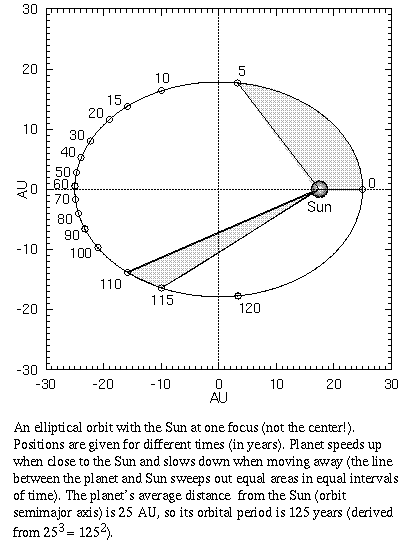
Kepler found that the planets must move around the Sun at a variable speed.
When the planet is close to perihelion, it moves quickly; when
it is close to aphelion, it moves slowly. This was another break with the
Pythagorean paradigm of uniform motion! Kepler discovered another rule of
planet orbits: a line between the planet and the Sun sweeps out equal areas
in equal times. This is now known as Kepler's 2nd law. -
Johaness Kepler (lived 1571--1630 C.E.) was hired
by Tycho Brahe to work out the mathematical details of Tycho's version of the
geocentric universe. -
The figure above illustrates how the shape of an ellipse depends on the
semi-major axis and the eccentricity. The eccentricity of
the ellipses increases from top left to bottom left in a counter-clockwise direction
in the figure but the semi-major axis remains the same. Notice where the Sun
is for each of the orbits. As the eccentricity increases, the Sun's position is closer
to one side of the elliptical orbit, but the semi-major axis remains the same. -

-
-
2Expand
History and Philosophy of Western Astronomy
Tags: astronomy, philosophy, science, scienceliteracy on 2008-02-25 -All Annotations (0) -About
more fromwww.astronomynotes.com
-
Experiments are the sole
judge of scientific truth---nature eventually wins. The ideas are crucial to
understanding the world but they eventually yield to the facts. Science makes us
confront the world. -
Every age has its paradigms. Though scientists try to be
objective, philosophical
considerations do intrude on the scientific, creative process. That is not a bad
thing because these beliefs are crucial in providing direction to
their inquiries and fuel for the creativity mill.
-
-
6Expand
History and Philosophy of Western Astronomy
Tags: philosophy, science, scienceliteracy, western on 2008-04-10 -All Annotations (0) -About
more fromwww.astronomynotes.com
-
Plato gave his students a major problem to work on. Their task was to find a
geometric explanation for the apparent motion of the planets, especially
the strange retrograde motion. One key observation: as a planet undergoes
retrograde motion (drifts westward with respect to the stars), it becomes brighter.
Plato and his students were, of course, also guided by the
Pythagorean Paradigm. This meant that regardless of the scheme they came up with,
the Earth should be at the unmoving center of the planet motions. One student named
Aristarchus violated that rule and developed a model with the Sun at the center.
His model was not accepted because of the obvious observations against a moving
Earth. -
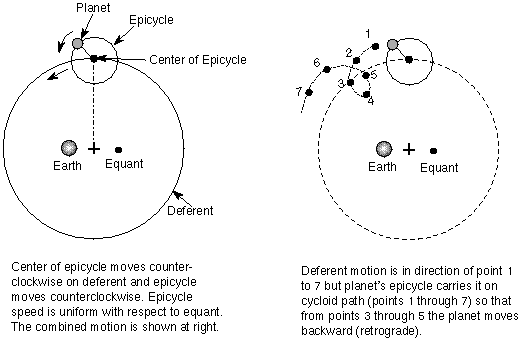
In order to explain the retrograde motion some models used
epicycles---small circles attached to larger circles centered on the Earth. The
planet was on the epicycle so it executed a smaller circular motion as it moved around the
Earth. This meant that the planet's distance from us changed and if the epicyclic motion
was in the same direction (e.g., counter-clockwise) as the overall motion around the Earth,
the planet would be closer to the Earth as the epicycle carried the planet backward with
respect to the usual eastward motion. This explained why planets are brighter as they
retrogress. -

-
- The celestial objects are bright points of light while the Earth is an
immense, nonluminous sphere of mud and rock. Modern astronomers now know that the stars are
objects like our Sun but very far away and the planets are just reflecting
sunlight. - The Greeks saw little change in the heavens---the stars are the same night after night.
In contrast to this, they saw the Earth as the home of birth, change, and destruction. They
believed that the celestial bodies have an immutable
regularity that is never achieved on the corruptible Earth. Today astronomers know that
stars are born and eventually die (some quite spectacularly!)---the length of
their lifetimes are much more than a human lifetime so they appear unchanging.
Also, modern astronomers know that the stars do change positions with respect to each other
over, but without a telescope, it takes hundreds of years to notice the
slow changes. - Finally, our senses show that the Earth appears to be stationary!
Air, clouds, birds, and other things unattached to the ground are not left
behind as they would be if the Earth was moving. There should be a strong wind
if the Earth were spinning as suggested by some radicals. There is no strong wind.
If the Earth were moving, then anyone jumping from a high point would
hit the Earth far behind from the point where the leap began. Furthermore, they knew
that things can be flung off an object that is spinning rapidly. The observation that
rocks, trees, and people are not hurled off the Earth proved to them that the Earth was
not moving. Today we have the
understanding of inertia and forces that explains why this does not happen even
though the Earth is spinning and orbiting the Sun. That understanding, though, developed
about 2000 years after Plato.
- The celestial objects are bright points of light while the Earth is an
-
Ptolemy
(lived 85--165 C.E.) set out to
finally solve the problem of the planets motion.
He combined the best features of the geocentric models that used epicycles with the most
accurate observations of the planet positions to create a model that would last for
nearly 1500 years. He added some refinements to explain the
details of the observations: an ``eccentric'' for each planet that was the true center
of its motion (not the Earth!) and an ``equant'' for each planet moved uniformily in
relation to (not the Earth!). See the figure below for a diagram of this setup. -
Aristotle chose this model because most popular and observational evidence supported it
and his physics and theory of motion necessitated a geocentric
(Earth-centered) universe. In his theory of motion, things naturally move to the
center of the Earth and
the only way to deviate from that is to have a force applied to the object.
So a ball
thrown parallel to the ground must have a force continually pushing it along.
This idea was unchallenged for almost two thousand years until Galileo showed
experimentally that things will not move or change their motion unless a force
is applied. Also, the crystalline spheres model agreed with the Pythagorean paradigm of
uniform, circular motion (see the previous
section).
-