
This link has been bookmarked by 61 people . It was first bookmarked on 05 Dec 2007, by Scott Vine.
-
10 Mar 12
-
01 Mar 12
-
22 Feb 12
-
04 Jan 12
-
29 Sep 10
-
19 Jan 10
 Karen O'Hara
Describes JCintra intranet wiki & knowledge sharing culture
-
29 Jul 09
-
23 Mar 09
-
22 Mar 09

-
-
Reducing additional work
Collaboration and knowledge sharing take time. The technical process takes time, but more significantly, wording your thoughts takes time.
Tools for collaboration must do everything possible to reduce the friction of contributing. It needs to be so easy to use, that you can literally laugh at anyone who tells you it is too hard (in a nice, let me show you, kind of way). In practice this means single sign on, one-click editing and instant gratification on saving. Hurdles like slow technology, login screens, workflow approvals or training kill collaboration before you even start.
The time taken to correctly phrase thoughts and distil ideas is unavoidable, but can be minimised by changing our expectation of shared content away from “finished product” towards “work in progress”. Publishing information early and often (rather than infrequently and completely) moves authorship away from essays and succinct conclusions towards sharing of insights and decisions. The ultimate method for sharing without increasing work is to move the work in progress into an open environment (share everything by default).
Policy opportunities exist to move (but not reduce) the work of sharing knowledge. For example, information is shared verbally on the condition that the recipient will publish it for wider consumption. He who asks, documents. A solution like this rewards the giver with time, builds knowledge on-demand and provides learning reinforcement for the recipient.
-
- The system always contains the latest information, building trust and adoption.
- The process is easy to enforce and success is readily measured (by monitoring email announcements, the only alternative).
- Work and risk is minimised for contributors.
- Through search, archived flows become a rich and readily available stock.
A focus on capturing the flow has many advantages:
Over time, the flow of decisions and insights washes over the organisation, helping each person refine their mental map and build a personal body of knowledge. When new items fit their mental model, they can be increasingly confident and aligned in decision making. When news doesn't fit their mental model, they can seek clarity or raise an area of concern.
-
- Individuals and interactions over processes and tools.
- Ease of use over comprehensive training.
- Flexible tools over completeness.
- Responding to needs over creating demand.
-
(That is, while there is value in the items on the right, we value the items on the left more.)
-
-
19 Mar 09
-
18 Mar 09
-
26 Feb 09
-
05 Feb 09
 giannatelli
Non recentissimo, ma abbastanza interessante articolo che parla delle difficoltà concrete di introduzione del Web 2.0 in azienda, partendo dall'esperienza concreta di Janssen-Cilag, azienda farmaceutica australiana del gruppo Johnson & Johnson, che dal 2006 utilizza Wiki Confluence (customizzato e semplificato per massimizzarne l'usabilità) per la condivisione e lo scambio di informazioni sulla sua intranet
ecollaboration_strumenti fondirigenti enterprise2.0_examples impreseweb2.0 what_is_enterprise2.0
-
28 Dec 08
-
27 Dec 08
-
10 Dec 08
-
09 Nov 08
 L@jost EU project
The two cultural barriers to collaboration
There are dozens of reasons and millions of excuses as to why people won't share knowledge; but they all fall within two areas:
1. Sharing knowledge adds more work (“I don’t have time to share”); and
2. S -
 laura malita
The two cultural barriers to collaboration
There are dozens of reasons and millions of excuses as to why people won't share knowledge; but they all fall within two areas:
1. Sharing knowledge adds more work (“I don’t have time to share”); and
2. S -
18 Oct 08
-
03 Oct 08
-
28 May 08
-
07 Apr 08
-
10 Mar 08
-
06 Mar 08
-
25 Feb 08
-
13 Feb 08
-
06 Feb 08
 Martin Lindner
JCintra continues to function as an incredibly easy to use Intranet, rather than as a genuine Wiki. In fact, 85% of our 3000 pages only have one contributing author.
-
05 Feb 08
 ken .
ken .Aww, you had me from the first stocks-and-flows - "Through search, archived flows become a rich and readily available stock" - extra complexity of collaboration, burden of sharing knowledge, CMM style progression from email to wikis, participation..
agile business change collaboration communication complexity culture email flow information intranet search social systems wikis
-
04 Feb 08
-
01 Feb 08
-
09 Jan 08
 Joe B
Joe BAn article about etreprise 2.0 in practice
** .article [EN] enterprise2.0 collaboration wiki web2.0 management for:hannes
-
02 Jan 08

-
26 Dec 07
-
13 Dec 07
 Marcel de Ruiter
Great article full of structure and lessons.
-
11 Dec 07
-
10 Dec 07
 Dan Keldsen
Nice post on embedding Enterprise 2.0, primarily wikis, into a 1.0 culture. Making the "wiki whackiness invisible" seems to be key.
enterprise2.0 wiki collaboration socialsoftware jcintra e-gineer culture1.0 intranet e2casestudy
-
07 Dec 07
-
06 Dec 07
 Michel Roland
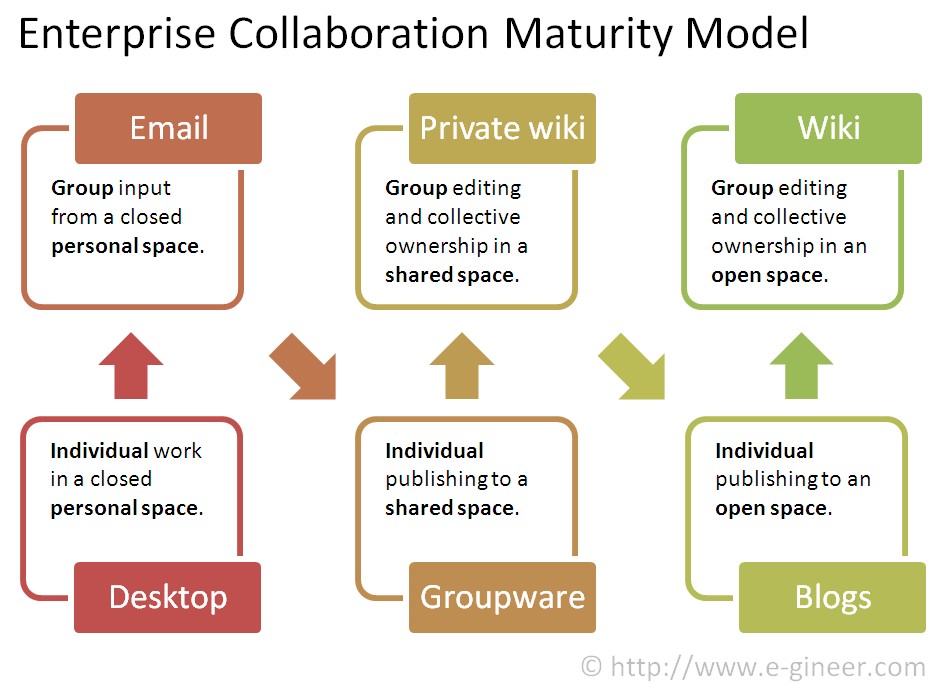
All knowledge work is either individual or group based, and it is always performed in an individual, shared or open environment.TheEnterprise Collaboration Maturity Modeldepicts these work models, and incorporates the cultural journey that enterprises t-
- Make contributions in an open space that are not policy or announcements.
- Edit work or information that is owned collectively.
- Sharing knowledge adds more work (“I don’t have time to share”); and
- Sharing knowledge increases personal risk (“I don’t want to share”).
All knowledge work is either individual or group based, and it is always performed in an individual, shared or open environment.
The Enterprise Collaboration Maturity Model depicts these work models, and incorporates the cultural journey that enterprises take to reach each stage. Currently, Janssen-Cilag provides an open Wiki (high capability maturity) but primarily uses it as Groupware (medium usage maturity).
To continue our journey, Janssen-Cilag needs to become comfortable with the idea that published content is not finalised. Specifically, we need users to:
Successful Enterprise 2.0 style collaboration requires both technical and cultural maturity. While technology opens immediate potential, organisations must grow towards new patterns of usage and collaboration.
The two cultural barriers to collaboration
There are dozens of reasons and millions of excuses as to why people won't share knowledge; but they all fall within two areas:
These negatives cannot be eradicated, but they can be minimised.
-
Tools for collaboration must do everything possible to reduce the friction of contributing. It needs to be so easy to use, that you can literally laugh at anyone who tells you it is too hard (in a nice, let me show you, kind of way). In practice this means single sign on, one-click editing and instant gratification on saving. Hurdles like slow technology, login screens, workflow approvals or training kill collaboration before you even start.
-
changing our expectation of shared content away from “finished product” towards “work in progress”
-
The ultimate method for sharing without increasing work is to move the work in progress into an open environment (share everything by default).
-
He who asks, documents.
-
The solution is to encourage content contributions that are finished enough to be low-risk publishable, but are not so big as to never reach completion.
-
- Individuals and interactions over processes and tools.
- Ease of use over comprehensive training.
- Flexible tools over completeness.
- Responding to needs over creating demand.
-
First we will make internal blogging available to all employees.
-
-
To encourage an organisational shift along the enterprise collaboration maturity model, Enterprise 2.0 leaders should focus on capturing the flow of information. Over time, the flow builds not only a stock of searchable knowledge but also a reputation as the source of fresh ideas and trusted up-to-date content.
-
-
05 Dec 07
 Frank Hamm
Technology creates opportunity for changes of behaviour and helps shift the conversation away from excuses (it’s too hard) to reasons (it’s too risky).
wiki case-study intranet corporate-culture collaboration serena enterprise20


Would you like to comment?
Join Diigo for a free account, or sign in if you are already a member.