
This link has been bookmarked by 393 people . It was first bookmarked on 02 Mar 2006, by Chris Lott.
-
22 Mar 17
-
18 Mar 17
-
17 Mar 17
-
13 Sep 16
-
add tags to online items, such as images, videos, bookmarks and text
-
Rather, they are a supplemental means to organise information and order search results."
-
what makes folksonomies work
-
folksonomy community could offset such problems and create systems that are conducive to searching, sorting and classifying.
-
A simple definition would be to say that tags are keywords, category names, or metadata
-
a tag is simply a freely chosen set of textual keywords
-
In order to understand how we can make tags more searchable it is important to understand users and why they submit certain tags
-
Mejias draws from his study is that although the tags used often have a hidden meaning known only to their creator, there are clearly certain tags (repeated tags) that have a social shared meaning alongside the personal meaning.
-
andom sampling of tags from both del.icio.us and flickr.
-
- using plurals rather than singulars
- using lower case,
- grouping words using an underscore,
- following tag conventions started by others and
- adding synonyms.
a number of tag selection "best practices" [14]. These include:
-
compound tags, including tags that concatenate more than two words, may suggest that users miss the richness of the sentence structure.
-
concatenating terms – the "non-breakable space"
-
for consideration is that of tag bundles
-
This is the tagging of tags that results in the creation of hierarchical folksonomies.
-
folksonomies need to evolve through links to more formal systems
-
Treating them as major parts of a single metadata ecology might expose a useful symbiosis: encourage authors and users to generate folksonomies, and use those terms as candidates for inclusion in richer, more current controlled vocabularies that can evolve to best support findability"
-
private pseudo-hierarchy of terms, by establishing tag conventions that resemble directory structures, such as,
-
Programming/Java,Programming/XHTML. Furthermore, many taggers on del.icio.us have chosen to tag URLs with other URLs, such as the base web address for the server (e.g., a C# programming tutorial might be tagged withhttp://www.microsoft.com) -
photograph
-
digital resource
-
includes the location as one or more of the tags
-
use the organisation that one associates
-
organisation
-
unique identification string
-
two main ways in which improvements can be made
-
new resources are contributed to the system
-
sites already make tag suggestions when users submit resources
-
Firefox extension, offers popular tags for every url [
-
uggest synonyms, expansion of acronyms
-
improvements can be made in the way systems search for resources already in the system
-
"ladybug"
-
users can share reasons for tagging things
-
some allow you to change other users' metadata
-
who is submitting certain tags could possibly alter your own personal rating of posts
-
The strength of a folksonomic approach is often described to be its openness, the ability of any given user to describe the world as he or she sees it
-
two stakeholder groups: those who contribute metadata in the form of tags, and the consumers of that metadata
-
Folksonomies are popularly related to the anthropological study of "folk taxonomies", a favoured study of cognitive anthropologists in the 1960s
-
folk taxonomy is most easily defined by contrast to a scientific taxonomy, a naming system to be applied objectively, independently of social matters
-
artificially simplified and often trivial semantic domains
-
he field is complex, encompassing culture, language and thought. On some details agreement has been reached; people do appear to think in terms of domains
-
"speech communities", groups of people who share a certain set of vocabulary or jargon.
-
Interfaces designed to breed out such tags, dialect, uncommon, archaic or conflicting terms, are an attempt to build a stable, robust and clearly defined taxonomy of user-provided terms
-
the interesting features of the tags are not in the precise percentages of usage, but in the choice of tag, the choice of structure, and the choice of language. Somewhere around a third of tags were indeed "malformed", in that they were beyond the grasp of a multilingual spell-checker for one reason or another. Many of these were not misspelt, but mis-constructed, some of the latter in a correctable manner.
-
possibly the real problem with folksonomies in not their chaotic tags but that they are trying to serve two masters at once; the personal collection, and the collective collection.
-
Achieving more from that data may be a question of developing an appropriate set of algorithms; in other words, revisiting the data with another aim in mind might reveal usefulness in some categories of "sloppy" tag.
-
Is it therefore preferable, rather than attempting to stamp out single use or sloppy tags, to suggest that each item be tagged with a mixture of approaches, including several search-friendly keywords?
-
is our myopic focus on tag-based search systems leading us to consider metadata such as single-use tags as useless, as automatically "bad" tags, when these tags may yet turn out to have a use in another domain or context? Do such tags have a value to one or another stakeholder, beyond their use as search terms? These are topics for further experiment and observation.
-
-
03 Sep 15
-
30 Aug 15
-
31 Jul 15
-
<!-- Abstract or TOC goes here --> <!-- Story goes next --> 1. Introduction
A folksonomy is a type of distributed classification system. It is usually created by a group of individuals, typically the resource users. Users add tags to online items, such as images, videos, bookmarks and text. These tags are then shared and sometimes refined
-
f "sloppy tags"
-
the tagging terms used in those systems are imprecise. It is the users of a folksonomy system who add the tags, which means that the tags are often ambiguous, overly personalised and inexact.
-
The result is an uncontrolled and chaotic set of tagging terms that do not support searching as effectively as more controlled vocabularies do.
-
-
11 Apr 14
-
15 Mar 14
 James Smallwood
In this article we look at what makes folksonomies work. We agree with the premise that tags are no replacement for formal systems, but we see this as being the core quality that makes folksonomy tagging so useful.
tagging taxonomy folksonomy socialbookmarking socialsoftware
-
13 Mar 14
-
26 Feb 14
-
09 Sep 13
-
21 May 13
-
But as the community making use of each tagging system grows in size and diversity, other problems arise. Systems intended to suggest common or popular tags are trained to promote the hegemony of tags arising from its earlier user population; to search effectively, new users may be required to guess at conventions no more obvious to them than the formal taxonomies that the folksonomy replaced. Improving usability across cultures necessitates recognition of the issues that language, dialect and jargon represent. Discouraging users may mean that they simply do not bother to tag further resources.
-
-
30 Oct 12
-
- Misspelt tags (e.g., libary, libray)
- Badly encoded tags, such as unlikely compound word groupings (e.g.,TimBernersLee)
- Tags that do not follow convention in issues such as case and number; singular versus plural form (e.g., apple, apples)
- Personal tags that are without meaning to the wider community (e.g., mydog)
- Single-use tags that appear only once in the database. (e.g., billybobsdog)
Educating users
Currently most users don't give much thought to the way they tag resources, and bad or "sloppy" tags are ten-a-penny in folksonomies. The main casualties are usually enumerated as follows:
-
- using plurals rather than singulars
- using lower case,
- grouping words using an underscore,
- following tag conventions started by others and
- adding synonyms.
Methods for improving tags
As most in the information world will know, improving the quality of user-created metadata is not a new phenomenon. Information specialists have wrestled with the issues involved many times and have suggested various remedies. For example, in an Ariadne article entitled "Improving the Quality of Metadata in Eprint Archives" [13], the authors suggest the inclusion of quality assurance processes on creation of the metadata.
To succeed, attempting to improve tag literacy (or tag etiquette) in the folksonomy world involves two processes. Firstly, the community needs to be ready to set rules and agree upon a set of standards for tags. Secondly, users need to be made aware of and agree to follow these rules.
At the moment, although there are no standard guidelines on good tag selection practices, those in the folksonomy community have offered many ideas. Ways in which tags may be improved are presented frequently on blogs and folksonomy discussion sites. In his article on tag literacy, Ulises Ali Mejias suggests a number of tag selection "best practices" [14]. These include:
Other recommendations from Mejas and others working in this area are that users try to "think specific and general at the same time" and that personal tags are fine as long as more generic tags are also used. The consensus among those in the folksonomy community is that extra tags are always better. Many folksonomies allow users to modify their tags, and there is considerable scope for users to tidy up the entries that they have already created. Although this issue has been widely discussed, any attempt to introduce a "best practice" for users of tagging sites almost certainly requires the enthusiastic participation of site developers and administrators. One might make a case for establishment of a consortium of some of the most popular folksonomy sites, to release a list of general guidelines.
Tagging could be improved by providing users with a set of helpful heuristics that promote good tag selection, such as a checklist of questions that could be applied to the object being tagged, in order to direct the tagger to various salient characteristics. Another idea that could be implemented is to introduce structure within tags. Currently, tags are generally defined as single words or compound words, which means that information can be lost during the tagging process. Single-word tags lose the information that would generally be encoded in the word order of a phrase.
-
-
06 Sep 12
-
18 Mar 12
-
11 Mar 12
-
22 Feb 12
-
01 Dec 11
-
T The most used tags are highly visible so likely to be used by other users, (few tags used by many). Then there will be a large number of tags that are used only by a few users, (many tags used by few). And finally there will be a huge number of tags that are used by just one or two users.
-
TThe most used tags are highly visible so likely to be used by other users, (few tags used by many). Then there will be a large number of tags that are used only by a few users, (many tags used by few). And finally there will be a huge number of tags that are used by just one or two users.
-
TThe most used tags are highly visible so likely to be used by other users, (few tags used by many). Then there will be a large number of tags that are used only by a few users, (many tags used by few). And finally there will be a huge number of tags that are used by just one or two users.
-
TThe most used tags are highly visible so likely to be used by other users, (few tags used by many). Then there will be a large number of tags that are used only by a few users, (many tags used by few). And finally there will be a huge number of tags that are used by just one or two users.
-
TThe most used tags are highly visible so likely to be used by other users, (few tags used by many). Then there will be a large number of tags that are used only by a few users, (many tags used by few). And finally there will be a huge number of tags that are used by just one or two users.
-
TThe most used tags are highly visible so likely to be used by other users, (few tags used by many). Then there will be a large number of tags that are used only by a few users, (many tags used by few). And finally there will be a huge number of tags that are used by just one or two users.
-
One small-scale study [5] carried out by Ulises Ali Mejias of Ideant raises many interesting points, though it fails to find much in the way of concrete information about why certain decisions are made. One of the conclusions Mejias draws from his study is that although the tags used often have a hidden meaning known only to their creator, there are clearly certain tags (repeated tags) that have a social shared meaning alongside the personal meaning. It is these tags that are seen as offering the most benefit; methods are therefore sought to encourage their creation and use. Although this is clearly an area for future research, more is known about the distribution of tags. For example, it is possible to see the top 50 tags added by users of del.icio.us [6].
Many folksonomy sites offer third-party visualisations of the most popular tag choices in common tagging; there are a number of tools available offering a variety of visualisation methods, including tag.alicio.us [7], extisp.icio.us [8] and facetious [9]. T]. T
-
One useful approach might be to examine users' motivations when adding tags, see why they decide on particular words, observe how many tags they add and compare how the same items are classified by different users.
-
decision-making process behind tag selection
-
although the tags used often have a hidden meaning known only to their creator, there are clearly certain tags (repeated tags) that have a social shared meaning alongside the personal meanin
-
The most used tags are highly visible so likely to be used by other users, (few tags used by many). Then there will be a large number of tags that are used only by a few users, (many tags used by few). And finally there will be a huge number of tags that are used by just one or two users.
-
-
28 Nov 11
-
ublin Core, MODS,
-
losing the very openness that has made folksonomies so popular.
-
tidying
-
single-use
-
-
24 Oct 11
-
28 Sep 11
-
27 Sep 11

-
16 Sep 11
-
17 Aug 11
-
14 Aug 11

-
11 Aug 11
-
26 Jul 11
-
11 Jun 11
-
30 Jan 11
-
21 Dec 10
-
18 Nov 10
-
24 Oct 10
-
tags are just one kind of metadata and are not a replacement for formal classification systems such as Dublin Core, MODS, etc.... Rather, they are a supplemental means to organise information and order search results."
-
supplemental means to organise information and order search results."
-
We then go on to question this "tidying up" approach and its underlying assumptions, highlighting issues surrounding removal of low-quality, redundant or nonsense metadata, and the potential risks of tidying too neatly and thereby losing the very openness that has made folksonomies so popular
-
r with more formal classification systems – is that the tagging terms used in those systems are imprecise.
-
y believed to be "single-use"; that is, to appear only once in the database of tags. At present there is little or no synonym (different word, same meaning) or homonym (same word, different meaning) control
-
do not support searching as effectively as more controlled vocabularies do.
-
Adam Mathes, well known for his timely paper on folksonomies, has suggested that tag distribution follows a power law scenario
-
- Educating users to add "better" tags
- Improving the systems to allow "better" tags to be added
4. Improving Tag Literacy
Given that there is already a movement towards convergence of tags, how can we foster this trend? At the moment there are two key ways in which the metadata created in folksonomies could be improved to aid searching:
-
- using plurals rather than singulars
- using lower case,
- grouping words using an underscore,
- following tag conventions started by others and
-
adding synonyms.
-
Still, possibly the real problem with folksonomies in not their chaotic tags but that they are trying to serve two masters at once; the personal collection, and the collective collection. Is it possible to have the best of both worlds?
-
-
19 Oct 10
-
09 Oct 10

-
14 Sep 10
-
16 Aug 10
-
10 Aug 10
-
30 May 10
-
23 May 10
-
08 May 10
-
01 May 10

-
28 Apr 10
-
05 Apr 10
 Tanja Galetti
D-Lib Magazine
January 2006
Volume 12 Number 1
ISSN 1082-9873
Folksonomies
Tidying up Tags?
Marieke Guy
UKOLN
<m.guy@ukoln.ac.uk>
Emma Tonkin
UKOLN
<e.tonkin@ukoln.ac.uk>
1. Introduction
A folksonomy is a type of distributed classification system. I -
01 Apr 10
-
26 Feb 10
-
29 Jan 10
 rufous
Currently most users don't give much thought to the way they tag resources, and bad or "sloppy" tags are ten-a-penny in folksonomies. The main casualties are usually enumerated as follows:
Misspelt tags (e.g., libary, libray)
Badly encoded tags, such as unlikely compound word groupings (e.g.,TimBernersLee)
Tags that do not follow convention in issues such as case and number; singular versus plural form (e.g., apple, apples)
Personal tags that are without meaning to the wider community (e.g., mydog)
Single-use tags that appear only once in the database. (e.g., billybobsdog) -
22 Jan 10

-
15 Jan 10
-

<!-- Abstract or TOC goes here --> <!-- Story goes next --> 1. Introduction
A folksonomy is a type of distributed classification system. It is usually created by a group of individuals, typically the resource users. Users add tags to online items, such as images, videos, bookmarks and text. These tags are then shared and sometimes refined. A general review of social bookmarking tools, one popular use area of folksonomies, was given in the April edition of D-Lib [1]. In the article the authors elaborate on the approach taken by social classification systems and the motivators behind tagging. They write, "...tags are just one kind of metadata and are not a replacement for formal classification systems such as Dublin Core, MODS, etc.... Rather, they are a supplemental means to organise information and order search results."
In this article we look at what makes folksonomies work. We agree with the premise that tags are no replacement for formal systems, but we see this as being the core quality that makes folksonomy tagging so useful. We begin by looking at the issue of "sloppy tags", a problem to which critics of folksonomies are keen to allude, and ask if there are ways the folksonomy community could offset such problems and create systems that are conducive to searching, sorting and classifying. We then go on to question this "tidying up" approach and its underlying assumptions, highlighting issues surrounding removal of low-quality, redundant or nonsense metadata, and the potential risks of tidying too neatly and thereby losing the very openness that has made folksonomies so popular.
-
-
01 Jan 10
-
24 Nov 09
-
15 Nov 09
-
27 Oct 09
 Terry Dogoriti
The authors consider this kind of classification system as a supplemental tool to organize information and investigate how tags can be used for searching.
-
09 Oct 09
-
28 Sep 09
 yuval yehiam
although the tags used often have a hidden meaning known only to their creator, there are clearly certain tags that have a social shared meaning alongside the personal meaning. It is these tags that are seen as offering the most benefit; methods are there
-
27 Aug 09
-
11 Jul 09
-
26 Jun 09
 Chih-Hsiung Tu
Guy, M., & Tonkin, E. (2006). Folksonomies: Tidying Up Tags? D-Lib Magazine. Vol. 12, No. 1.
Doo1 DooLan Folksonomies Tagging metadata Delicious Taxonomy Research Article journals Social Bookmarking Imported from Socialbookmarking
-
We then go on to question this "tidying up" approach and its underlying assumptions, highlighting issues surrounding removal of low-quality, redundant or nonsense metadata, and the potential risks of tidying too neatly and thereby losing the very openness that has made folksonomies so popular.
-
which means that the tags are often ambiguous, overly personalised and inexact. Many folksonomy sites only allow single-word metadata, resulting in many useless compound terms; the majority of tags are generally believed to be "single-use"
-
conjugated words and compound words may be used, as well as specialised tags and "nonsense" tags designed as unique markers that are shared between a group of friends or co-workers.
-
So what exactly are tags? A simple definition would be to say that tags are keywords, category names, or metadata. In essence, a tag is simply a freely chosen set of textual keywords.
-
Any number of words might be chosen, some of which are obvious representations, others making less sense outside the tag author's context.
-
little is known about the decision-making process behind tag selection, and quantitative data is relatively scarce. One useful approach might be to examine users' motivations when adding tags, see why they decide on particular words, observe how many tags they add and compare how the same items are classified by different users. It might also be helpful to see how feedback affects tag use and how users modify tags in the light of the behaviour of others. However, such studies take time and resources.
-
although the tags used often have a hidden meaning known only to their creator, there are clearly certain tags (repeated tags) that have a social shared meaning alongside the personal meaning. It is these tags that are seen as offering the most benefit; methods are therefore sought to encourage their creation and use. Although this is clearly an area for future research, more is known about the distribution of tags. For example, it is possible to see the top 50 tags added by users of del.icio.us [6].
-
tag.alicio.us
-
Tag.alicio.us is an experimental design from Olivier Richard that operates as a tag filter, retrieving links from del.icio.us according to tag and time constraints (e.g., tags from this hour, today, or this week). Extisp.icio.us displays a random scattering of a given user's tags, sized according to the number of times that the user has reused each tag, and facetious is a reworking of the del.icio.us database, which makes use of faceted classification, grouping tags under headings such as "by place" (Iraq, USA, Australia), "by technology" (blog, wiki, website) and "by attribute" (red, cool, retro).
-
These results indicate that single-use tags do not dominate tagging systems. According to our sample, only ten to fifteen percent of the tags sampled on Flickr and del.icio.us are single-use tags.
-
compound terms
-
The Language Instinct [12] discusses pidgin (a combination of words from other languages absent of any stable grammatical structure) and creole (a combination of words from other languages with a unique grammar imposed) languages. He argues that creole will come from pidgin if people are given the chance to speak to others. It could be argued that similarly social tagging services create the kinds of environments in which we can evolve metadata vocabularies in a natural way.
-
Badly encoded tags, such as unlikely compound word groupings (e.g.,TimBernersLee)
-
- Personal tags that are without meaning to the wider community (e.g., mydog)
- Single-use tags that appear only once in the database. (e.g., billybobsdog)
-
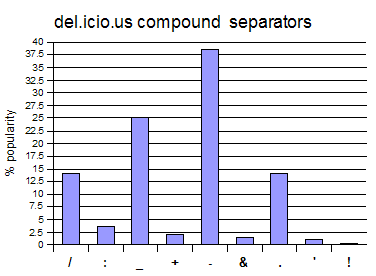
28% of del.icio.us tags were either misspelt, from a language not available via the software used, encoded in a manner that was not understood by the dictionary software, or compound words consisting of more than two words or a mixture of languages.
-
Compound words often contained numbers
-
many users attempted to make compound words without simply concatenating words together, but by putting a symbol or a piece of punctuation inside the tag to represent a space.
-
In his article on tag literacy, Ulises Ali Mejias suggests a number of tag selection "best practices" [14].
-
"think specific and general at the same time" and that personal tags are fine as long as more generic tags are also used. The consensus among those in the folksonomy community is that extra tags are always better.
-
Tagging could be improved by providing users with a set of helpful heuristics that promote good tag selection, such as a checklist of questions that could be applied to the object being tagged, in order to direct the tagger to various salient characteristics. Another idea that could be implemented is to introduce structure within tags.
-
Single-word tags lose the information that would generally be encoded in the word order of a phrase. This is particularly seen in English, with the dissociation of adjectives from noun.
-
With regard to compound words, private conventions are chosen by individuals for indicating relationships within an otherwise flat namespace, but these indications are applied for personal use, are not standard and cannot therefore be leveraged to any common advantage.
The commonness of compound tags, including tags that concatenate more than two words, may suggest that users miss the richness of the sentence structure.
-
concatenations of words, which are very difficult to parse usefully
-
the various individuals who supply and use tags are geographically and culturally diverse. The strength of a folksonomic approach is often described to be its openness, the ability of any given user to describe the world as he or she sees it.
-
that they are trying to serve two masters at once; the personal collection, and the collective collection.
-
Amy Gahran of Contentious observes that "A folksonomy merges, diverges, and evolves much the way language does, through usage and interaction" [23]. This is one of folksonomy's great strengths.
-
-
18 Jun 09
-
16 Jun 09
-

-
10 Jun 09
-
21 May 09
-
18 May 09
 Dave Bradley
Problems with folksonmies
-
13 May 09
-
01 May 09
-
11 Mar 09
-
14 Feb 09
-
13 Feb 09
-
10 Feb 09
-
07 Feb 09
 Nancy McKeand
Still, possibly the real problem with folksonomies in not their chaotic tags but that they are trying to serve two masters at once; the personal collection, and the collective collection.
-
03 Feb 09
-
02 Feb 09
-
A folksonomy is a type of distributed classification system. It is usually created by a group of individuals, typically the resource users. Users add tags to online items, such as images, videos, bookmarks and text. These tags are then shared and sometimes refined.
-
So what exactly are tags? A simple definition would be to say that tags are keywords, category names, or metadata. In essence, a tag is simply a freely chosen set of textual keywords. However, because tags are not created by information specialists, they do not at present follow any ubiquitous formal guidelines. This means that items can be categorised with any word that defines a relationship between the online resource and a concept in the user's mind. Any number of words might be chosen, some of which are obvious representations, others making less sense outside the tag author's context.
-
- Educating users to add "better" tags
- Improving the systems to allow "better" tags to be added
- Misspelt tags (e.g., libary, libray)
- Badly encoded tags, such as unlikely compound word groupings (e.g.,TimBernersLee)
- Tags that do not follow convention in issues such as case and number; singular versus plural form (e.g., apple, apples)
- Personal tags that are without meaning to the wider community (e.g., mydog)
- Single-use tags that appear only once in the database. (e.g., billybobsdog)
Improving Tag Literacy
Given that there is already a movement towards convergence of tags, how can we foster this trend? At the moment there are two key ways in which the metadata created in folksonomies could be improved to aid searching:
Educating users
Currently most users don't give much thought to the way they tag resources, and bad or "sloppy" tags are ten-a-penny in folksonomies. The main casualties are usually enumerated as follows:
In order for folksonomies to offer much more in the way of social value, many feel that tag creation needs to becomes a lot more proficient; but are the problems really those described above?
-
-
Methods for improving tags
-
- using plurals rather than singulars
- using lower case,
- grouping words using an underscore,
- following tag conventions started by others and
- adding synonyms.
t the moment, although there are no standard guidelines on good tag selection practices, those in the folksonomy community have offered many ideas. Ways in which tags may be improved are presented frequently on blogs and folksonomy discussion sites. In his article on tag literacy, Ulises Ali Mejias suggests a number of tag selection "best practices" [14]. These include:
-
Folksonomies are popularly related to the anthropological study of "folk taxonomies", a favoured study of cognitive anthropologists in the 1960s, but the significance of this snippet of information is often eclipsed by today's perception of folksonomies as a popular mechanism for creating user-populated search databases. Briefly revisiting the origins of the term is useful, if only to situate the discussions presented here with respect to their antecedents.
A folk taxonomy is most easily defined by contrast to a scientific taxonomy, a naming system to be applied objectively, independently of social matters. Scientific taxonomies, such as the Linnaean taxonomic system, are to be applied independently of personal feeling on the matter. The emergence of the "folk taxonomy" recognised common names as worthy of mention, serving useful functions within a social and cultural context, and the study of folk taxonomies remained popular for some time. However, few generalisable results were extracted from this work, and the work tended to focus on artificially simplified and often trivial semantic domains [20]. It was eventually re-framed as a stage in the study of knowledge structures, consensus and understanding within groups.
Later work from a number of domains provides some insight into the problem domain, but the field is complex, encompassing culture, language and thought. On some details agreement has been reached; people do appear to think in terms of domains [21], and dialect is an indicator of social class, educational level and age.
The subset of a language used in a certain setting (the situated nature of vocabulary choice and manner of speech) is both fascinating and confounding. In internet terms, this is most commonly encountered in the form of "speech communities", groups of people who share a certain set of vocabulary or jargon.
-
-
26 Jan 09
-
20 Jan 09
-
<!-- Abstract or TOC goes here --> <!-- Story goes next --> 1. Introduction
A folksonomy is a type of distributed classification system. It is usually created by a group of individuals, typically the resource users. Users add tags to online items, such as images, videos, bookmarks and text. These tags are then shared and sometimes refined. A general review of social bookmarking tools, one popular use area of folksonomies, was given in the April edition of D-Lib [1]. In the article the authors elaborate on the approach taken by social classification systems and the motivators behind tagging. They write, "...tags are just one kind of metadata and are not a replacement for formal classification systems such as Dublin Core, MODS, etc.... Rather, they are a supplemental means to organise information and order search results."
In this article we look at what makes folksonomies work. We agree with the premise that tags are no replacement for formal systems, but we see this as being the core quality that makes folksonomy tagging so useful. We begin by looking at the issue of "sloppy tags", a problem to which critics of folksonomies are keen to allude, and ask if there are ways the folksonomy community could offset such problems and create systems that are conducive to searching, sorting and classifying. We then go on to question this "tidying up" approach and its underlying assumptions, highlighting issues surrounding removal of low-quality, redundant or nonsense metadata, and the potential risks of tidying too neatly and thereby losing the very openness that has made folksonomies so popular.
-
-
19 Jan 09
-
18 Jan 09
 Tania Sheko
Probably the major flaw of current folksonomy systems – and the number one gripe
for those happier with more formal classification systems – is that the tagging
terms used in those systems are imprecise.tagging folksonomy metadata tags folksonomies research web2.0 article
-
05 Jan 09
-
16 Dec 08
-
30 Nov 08
-
28 Nov 08
 Silvana Gregorio
article on folksonomies - original research
-
23 Nov 08
-
06 Nov 08
-
24 Oct 08
-
19 Oct 08
-
19 Sep 08
-
12 Sep 08
-
Optimisation of user tag input, to improve their quality for the purposes of later reuse as searchable keywords, would increase the perceived value of the folksonomic tag approach.
-
-
11 Sep 08
-
09 Sep 08
-
10 Aug 08
-
06 Aug 08
-
09 Jul 08
-
Methods for improving tags
-
- using plurals rather than singulars
- using lower case,
- grouping words using an underscore,
- following tag conventions started by others and
- adding synonyms.
To succeed, attempting to improve tag literacy (or tag etiquette) in the folksonomy world involves two processes. Firstly, the community needs to be ready to set rules and agree upon a set of standards for tags. Secondly, users need to be made aware of and agree to follow these rules.
At the moment, although there are no standard guidelines on good tag selection practices, those in the folksonomy community have offered many ideas. Ways in which tags may be improved are presented frequently on blogs and folksonomy discussion sites. In his article on tag literacy, Ulises Ali Mejias suggests a number of tag selection "best practices" [14]. These include:
-
-
04 Jul 08
-
02 Jul 08
-
27 Jun 08
 Paul Beaufait
D-Lib Magazine - see, in particular, part 4. Improving Tag Literacy
-
26 Jun 08


Page Comments
Would you like to comment?
Join Diigo for a free account, or sign in if you are already a member.