


To read Shirky's papers.
This link has been bookmarked by 1010 people and liked by 1 people. It was first bookmarked on 02 Mar 2006, by Wade Ren.
-
27 Dec 20
-
09 Jun 19
-
25 Jan 18
-
1) server-side software aimed specifically at managing links with, crucially, a strong, social networking flavour, and 2) an unabashedly open and unstructured approach to tagging, or user classification, of those links.
-
-
22 Apr 17
-
This is the user's web now, which means it's my web and I can make the rules.
-
-
10 Jan 17
-
03 Sep 15
-
30 Aug 15
-
25 Jul 15
-
17 Jan 15
-
15 Apr 14
-
15 Mar 14
 James Smallwood
This paper reviews some current initiatives, as of early 2005, in providing public link management applications on the Web – utilities that are often referred to under the general moniker of 'social bookmarking tools'. There are a couple of things going o
-
18 Feb 14
-
01 Feb 14
-
02 Jan 14
-
24 Jul 13
-
11 Jun 13
-
25 May 13
-
18 Apr 13
-
Social bookmarking tools also share this characteristic: the more they are used, the more value accrues to the system itself and thereby to all who participate in it.
-
This is very much a 'bottom-up' (or personal) approach compared with the traditional 'top-down' (or organizational) structured means of classification.
This unstructured (or better, free structured) approach to classification with users assigning their own labels is variously referred to as a 'folksonomy'
-
-
09 Apr 13
-
11 Feb 13
-
13 Dec 12
-
24 Sep 12
-
17 Sep 12

-
21 Aug 12
-
18 Apr 12
-
10 Apr 12
 Maria Tannant
Article on Social Bookmarking Tools
written in 2005 by Tony Hammond, Timo Hannay, Ben Lund, and Joanna Scott
This paper thus first recaps a brief history of bookmarks, then discusses the current interest in tagging, moves on to look at certain social issues, and finally considers some of the feature sets offered by the new bookmarking tools-
they represent a user's own personal library placed on public record
-
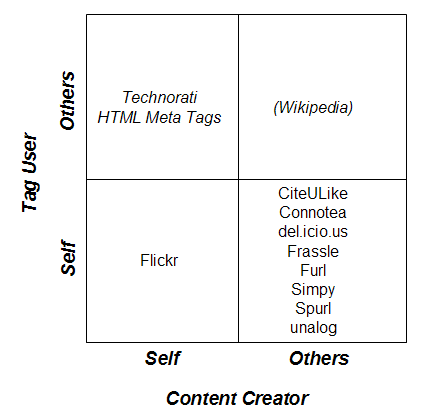
There is a range from a 'selfish' tagging discipline, where the users are primarily tagging their own content for their own retrieval purposes, right through to a more 'altruistic' tagging discipline, where the user is tagging others' content for yet others to retrieve.
-
-
09 Apr 12
-
lower-left quadrant ('selfish') represented by Flickr, which is mainly concerned with users tagging their own content for their own retrieval purposes
-
to the upper-right quadrant ('altruistic') represented by Wikipedia,
-
This ability to sort out the wheat from the chaff is an important win over a web-based search engine. Search engines, at this point, tend to index and search a global space – not my local space. My space comprises the documents I am interested in and the documents of other users that I want to follow.
-
-
28 Mar 12
-
19 Mar 12
-
'architecture of participation
-
the more they are used, the more value accrues to the system itself and thereby to all who participate in it.
-
'folksonomy'
-
a free tagging approach to classification is a jumbled, hit-and-miss affair, and any system that it may throw up must be discovered, or learned, after the event.
-
natural tendency towards the convergence of tags.
-
following elements are usually present in varying degrees
-
- Personal user accounts (groups sometimes provided)
- Mechanism for entering links, titles and descriptions
- Browser bookmarklets to facilitate entry [n18]
- Classification by 'open' or 'free' tagging
- Search by tag or user (Boolean combinations sometimes allowed)
- Querying of links based on popularity, users, tags, etc.
- RSS feeds
- Extensions such as browser plug-ins
-
-
24 Feb 12
-
Where do links begin? Links are as old as the Web itself [n2]. Indeed, links are the stuff of the Web [n3]. But the idea of organizing and managing links systematically rather than just listing them on a given web page seems to have emerged with the earliest graphical browsers, and, in particular, with the foremost browser of its time, Mosaic [n4], the granddaddy of all modern browsers. The simple discipline of presenting link directories arranged on a menu page in nested list form harks back to earlier, more rigid information systems such as Gopher [n5]. The Web, however, was supposed to be different with nodes of information connected in a truly open, free-form manner rather than being accessible only by navigating a strict, pre-determined path hierarchy within a single authority domain. Mosaic developed a feature called Hotlists, which, while still hierarchical and aping the common file system paradigm of folders and files, at least allowed for links to be easily recorded and for ready access to any recorded link from any page within the browser. By the time the initial development crew had decamped from NCSA [n6] to set up a commercial operation [n7] and built the new, line-in-the-sand Netscape browser, this feature had become reincarnated as Bookmarks.
-
the new link managers tend to use dynamic categorization systems whereby the user annotates links with whatever terms seem most relevant. Links are generally annotated with 'tags', which are free-form labels assigned by the user and not drawn from any controlled vocabulary. This is very much a 'bottom-up' (or personal) approach compared with the traditional 'top-down' (or organizational) structured means of classification.
This unstructured (or better, free structured) approach to classification with users assigning their own labels is variously referred to as a 'folksonomy' [n10], 'folk classification', 'ethnoclassification' [n11], 'distributed classification', or 'social classification'. Other terms that arise are 'open tagging', 'free tagging', and 'faceted hierarchy'. Following Adam Mathes in his paper 'Folksonomies – Cooperative Classification and Communication Through Shared Metadata' [21] we would generally incline to the term 'social classification', or even 'distributed classification', as this, to our minds, most closely describes the nature of the activity, although we must concede that the word 'folksonomy' has gained considerable currency and there is little getting away from it.
-
There are many reasons for tagging of content on the Web. Figure 3 aims to provide an overview of the motivators for tagging [n14]. There is a range from a 'selfish' tagging discipline, where the users are primarily tagging their own content for their own retrieval purposes, right through to a more 'altruistic' tagging discipline, where the user is tagging others' content for yet others to retrieve.
-
-
18 Nov 11
 Lauren Robertson
A detailed explanation of what social bookmarking is and how it came about. Good for teachers who want to understand social bookmarking before employing it in their classrooms. By understanding what social bookmarking is, teachers who are hesitant to try a new technology out will feel more comfortable in their understanding of its educational merit.
-
10 Nov 11
-
Architectures of Participation
-
well-defined and pre-declared schemas ranging from simple controlled vocabularies to taxonomies to thesauri to full-blown ontologies
-
'folksonomy' [n10], 'folk classification', 'ethnoclassification
-
distributed classification', or 'social classification'
-
-
19 Oct 11
-
28 Sep 11
-

-
27 Sep 11
-
 Carrie Green
2005--but does a good job of providing scholarly background.
web2.0 folksonomies socialbookmarking scholarlyarticle tagging
-
21 Sep 11
-
15 Sep 11
-
14 Sep 11
-
13 Sep 11
-
13 Jul 11
-
24 Jun 11
-
21 May 11
 Chantal Gendron
Article qui présente une revue générale de différents outils qui peuvent être utilisés pour faire du bookmarking.
Auteur: Tony Hammond, Timo Hannay, Ben Lund et Joanna Scott -
01 May 11
-
Matt Biddulph in an XML.com article last year [2], in which he reviews one of the better known social bookmarking tools, del.icio.us [3], declares that the "del.icio.us-space has three major axes: users, tags, and URLs". We fully support that assessment but choose to present this deconstruction in a reverse order. This paper thus first recaps a brief history of bookmarks, then discusses the current interest in tagging, moves on to look at certain social issues, and finally considers some of the feature sets offered by the new bookmarking tools. A general review of a number of common social bookmarking tools is presented in the annex.
-
Tag Soup
Traditional means of organizing information elements have generally relied on well-defined and pre-declared schemas ranging from simple controlled vocabularies to taxonomies to thesauri to full-blown ontologies [20]. This orderly approach to cataloguing allows for both the validation and quality control of known terms to be registered within an information system. By contrast, the new link managers tend to use dynamic categorization systems whereby the user annotates links with whatever terms seem most relevant. Links are generally annotated with 'tags', which are free-form labels assigned by the user and not drawn from any controlled vocabulary. This is very much a 'bottom-up' (or personal) approach compared with the traditional 'top-down' (or organizational) structured means of classification.
-
-
20 Apr 11
 Nicole Noel
"This paper reviews some current initiatives, as of early 2005, in providing public link management applications on the Web – utilities that are often referred to under the general moniker of 'social bookmarking tools'. There are a couple of things going on here: 1) server-side software aimed specifically at managing links with, crucially, a strong, social networking flavour, and 2) an unabashedly open and unstructured approach to tagging, or user classification, of those links. "
-
15 Apr 11
 nas zach
Social Bookmarking Tools (I): A General Review
-
06 Apr 11

-
02 Apr 11
-
13 Mar 11
-
20 Feb 11
-
07 Feb 11
 Janos Haits
D-Lib Magazine/ April 2005
Volume 11 Number 4 ISSN 1082-9873
Social Bookmarking Tools (I)
A General Reviewsocialbookmarking social bookmarking tagging folksonomy web2.0 tools tags
-
04 Feb 11
-
03 Feb 11
-
RSS feeds
-
-
02 Feb 11
-
es in a Burni
-
-
-
"This is the user's web now, which means it's my web and I can make the rules." Reinvention is revolution – it brings us always back to beginnings.
-
-
-
the Web is old, the Web is new, the Web is all, the Web is you
-
unstructured approach
-
documents
-
search engines were now able to provide a dynamic bookmarking service
-
free structured
-
regional bookmarking
-
de.lirio.us
-
Tools
-
-
-
But these web-based directories would soon struggle against the ever encroaching advance of the search engine.
-
The online auctioneer eBay [13] is a classic example of this 'network effect' of users coming together for the benefit of all,
-
-
-
These would become the social link managers, with links not randomly discovered or crawled by robots and spiders, but registered, tagged and rated by users for their own benefit, and made available to other users
-
-
-
Adware and spyware are already corrupting users' browsing experiences.
-
-
-
, wikis, newsfeeds, social networks, and bookmarking tools (the subject of this paper), the claim that Shelley Powers makes in a Burningbird blog entry [1] seems apposite:
-
"This is the user's web now, which means it's my web and I can make the rules." Reinvention is revolution – it brings us always back to beginnings.
-
ready access to any recorded link from any page within the browser
-
These would become the social link managers, with links not randomly discovered or crawled by robots and spiders, but registered, tagged and rated by users for their own benefit, and made available to other users
-
ability to sort out the wheat from the chaff is an important win over a web-based search engine
-
Through the use of such linking syntaxes and more fully evolved APIs, along with RSS as a channel for syndicating rich metadata, some of these social bookmarking tools may be well suited to participate in the general service autodiscovery space described by Dan Chudnov and Jeremy Frumpkin in their informal paper 'Service Autodiscovery for Rapid Information Movement' [33].
-
-
-
"the Web is old, the Web is new, the Web is all, the Web is you",
-
1) server-side software aimed specifically at managing links with, crucially, a strong, social networking flavour, and 2) an unabashedly open and unstructured approach to tagging, or user classification, of those links.
-
del.icio.us [3], declares that the "del.icio.us-space has three major axes: users, tags, and URLs"
-
JavaScript
-
-
-
This paper thus first recaps a brief history of bookmarks, then discusses the current interest in tagging, moves on to look at certain social issues, and finally considers some of the feature sets offered by the new bookmarking tools. A general review of a number of common social bookmarking tools is presented in the annex.
-
There is a range from a 'selfish' tagging discipline, where the users are primarily tagging their own content for their own retrieval purposes, right through to a more 'altruistic' tagging discipline, where the user is tagging others' content for yet others to retrieve.
-
As a simple demonstration of the way in which social bookmarking tools might benefit academic research, we show here how Connotea can be used by readers of this paper, and of its companion [4], to access the reference lists, to share other relevant links, and to trade comments on them and on the papers themselves.
-
-
-
More importantly, why not make these personal 'link playlists' available to oneself and to others from whatever browser or computer one happens to be using at the time?
-
But if absolute privacy is important, then it's certainly best to stay away from these tools (and, indeed, possibly the Web as a whole).
-
-
-
We are here going to remind you of hyperlinks in all their glory, sell you on the idea of bookmarking hyperlinks, point you at other folks who are doing the same, and tell you why this is a good thing.
-
This paper reviews some current initiatives, as of early 2005, in providing public link management applications on the Web – utilities that are often referred to under the general moniker of 'social bookmarking tools'.
-
This provision of rich, structured metadata means that the user is provided with an accurate third-party identification of a document, which could be used to retrieve that document, but is also free to search on user-supplied terms so that documents of interest (or rather, references to documents) can be made discoverable and aggregated with other similar descriptions either recorded by the user or by other users.
-
foremost browser of its time, Mosaic
-
The Web, however, was supposed to be different with nodes of information connected in a truly open, free-form manner rather than being accessible only by navigating a strict, pre-determined path hierarchy within a single authority domain.
-
-
This was to be called Internet Explorer and included a similar link manager that was dubbed Favorites.
-
they soon grew to become unwieldy in terms of needing to be managed within the confines of a simple, hierarchical structure.
-
'bookmarklet'
-
The possibilities are endless, and they provide an effective means of extending a browser's functionality while remaining simple to install and use.
-
The result of this approach is that the best applications become more useful for all participants the more that people make use of them
-
folk classification', 'ethnoclassification' [n11], 'distributed classification', or 'social classification'. Other terms that arise are 'open tagging', 'free tagging', and 'faceted hierarchy'.
-
'folksonomy'
-
upsides and downsides
-
Rather, this is an altogether different – and, we would argue, complementary – form of classification.
-
Compared to the traditional top-down approach, folksonomy data is much noisier but also more flexible, more abundant and far cheaper. Bear in mind also that the terms used are, by definition, the very terms that real users might be expected to use in future when searching for this information.
-
There is a range from a 'selfish' tagging discipline, where the users are primarily tagging their own content for their own retrieval purposes, right through to a more 'altruistic' tagging discipline, where the user is tagging others' content for yet others to retrieve.
-
'Phonetags',
-
This ability to sort out the wheat from the chaff is an important win over a web-based search engine.
-
Almost without exception these social bookmarking tools are feature-rich, providing search on both users and tags (with Boolean operators), comments (and comment trails), simple linking syntaxes, and APIs (application programming interfaces) for posting to and from these tools (and to other tools such as blogs). Invariably the 'glue' technology used is RSS.
-
These approaches create a series of shared spaces that have the potential to become 'living' resources that maintain and extend the relevance of each paper beyond its initial publication. We are intrigued to see how this experiment might be taken forward by D-Lib Magazine readers.
-
-
-
tags are just one kind of metadata and are not a replacement for formal classification systems such as Dublin Core, MODS, etc. [n15]. Rather, they are a supplemental means to organize information and order search results.
-
- Classification by 'open' or 'free' tagging
- Search by tag or user (Boolean combinations sometimes allowed)
- Querying of links based on popularity, users, tags, etc.
-
-
-
This is very much a 'bottom-up' (or personal) approach compared with the traditional 'top-down' (or organizational) structured means of classification.
-
how Connotea can be used by readers of this paper, and of its companion [4], to access the reference lists, to share other relevant links, and to trade comments on them and on the papers themselves.
-
-
01 Feb 11
-
A further issue to consider is tag spamming. E-mail has been severely impacted by spamming.
-
-
-
Another important aspect on the social axis is user privacy. By publicizing their bookmarks, users are opening up to other users on the Web their own sphere of interests.
-
-
-
social link managers
-
flat namespace,
-
ags are just one kind of metadata
-
-
25 Dec 10
-
17 Dec 10
-
08 Dec 10
-
04 Nov 10
-
01 Nov 10
-
unstructured (or better, free structured) approach to classification with users assigning their own labels is variously referred to as a 'folksonomy
-
-
02 Oct 10
-
-
24 Aug 10
-
22 Aug 10
-
20 Aug 10
-
20 Jul 10

-
01 Jun 10
-
28 May 10
-
19 May 10
-
08 May 10

-
30 Apr 10
-
24 Apr 10
 Roger Guedes
Hammond, T; Hannay, T; Lund, B; Scott, J.
Artigo da revista D-Lib Magazine. V. 11, N. 4, April 2005-
This, of course, has its upsides and downsides.
-
Add Sticky Note
-
-
-
09 Apr 10

-
08 Apr 10

-
07 Apr 10
-
03 Apr 10
-
Tools
CiteULike
CiteULike is a bookmarking tool for academic links. Authored by Richard Cameron at Manchester University as a web-based time-saver for managing citations, it emerged quietly in November '04 and has quickly garnered interest within its target community. The site remains privately run, and it has yet to be seen what its long-term plans will be.Initially CiteULike allowed users to bookmark papers from specific websites that held academic content, and from which CiteULike was able to collect citation metadata. This restriction has since been lifted to allow bookmarking of any site, although the focus remains almost exclusively academic. CiteULike offers a number of features specifically for the academic community including importing references from desktop reference management software.
Connotea
Connotea is Nature Publishing Group's entrée into this new genre of information service. Conceived independently of CiteULike as a kind of scientific del.icio.us, Connotea was developed as an experimental service by NPG's New Technology department, with Ben Lund as project lead, and seeks to provide the best of both worlds. Connotea was soft-launched a few days before Christmas '04 and as of April '05, the database was tracking over 4400 bookmarks posted by more than 2000 users. Early promotion of the service was waived pending the development of certain key features to give it a maturity and reliability.Connotea is also equipped to function as a citation manager and currently supports retrieval of metadata elements from a number of sites including PubMed, HubMed, Amazon.com, Nature.com, and D-Lib Magazine. Further development in this area is planned. A companion paper [4] reports in detail on Connotea as a case study in implementing a social bookmarking tool.
del.icio.us
Perhaps the best known currently of all such tools is del.icio.us. There are some 50k users at the time of writing. This is very much a personal, out-of-hours effort by Joshua Schachter without any immediate intention of developing a business model [n19]. Developed initially as a simple web page listing links with annotations, Schachter then decided to make these available on a web server so that friends and others could also make use of these bookmarks. From there, it was but a small step to hosting others' lists, and so the social bookmarking tool del.icio.us was born.del.icio.us has attracted a great deal of interest from external developers: Foxylicious [55], a Firefox extension, and Cocoal.icio.us [56], a Cocoa del.icio.us client for Mac OS X, are typical of the many extensions to be found for del.icio.us.
-
-
03 Mar 10
-
11 Feb 10
-
We are here going to remind you of hyperlinks in all their glory, sell you on the idea of bookmarking hyperlinks, point you at other folks who are doing the same, and tell you why this is a good thing. Just as long as those hyperlinks (or let's call them plain old links) are managed, tagged, commented upon, and published onto the Web, they represent a user's own personal library placed on public record, which – when aggregated with other personal libraries – allows for rich, social networking opportunities.
-
Mosaic developed a feature called Hotlists, which, while still hierarchical and aping the common file system paradigm of folders and files, at least allowed for links to be easily recorded and for ready access to any recorded link from any page within the browser. By the time the initial development crew had decamped from NCSA [n6] to set up a commercial operation [n7] and built the new, line-in-the-sand Netscape browser, this feature had become reincarnated as Bookmarks.
-
Meanwhile, Microsoft, finall
-
Links are generally annotated with 'tags', which are free-form labels assigned by the user and not drawn from any controlled vocabulary. This is very much a 'bottom-up' (or personal) approach compared with the traditional 'top-down' (or organizational) structured means of classification.
-
We note there have been some attempts to introduce structure within tags. Some users have adopted private conventions to indicate hierarchy (or other structural relationships) within an otherwise flat namespace, but these indications are just intended for personal use and cannot as yet be leveraged to any common advantage. Another approach that has been discussed (and, in the case of del.icio.us even implemented as 'tag bundles') is the tagging of tags, which could result in the creation of hierarchical folksonomies. This is an area that is worth tracking – there are no rules as yet.
-
Compared to the traditional top-down approach, folksonomy data is much noisier but also more flexible, more abundant and far cheaper. Bear in mind also that the terms used are, by definition, the very terms that real users might be expected to use in future when searching for this information. As Clay Shirky has pointed out [26], folksonomies move us from a 'binary' in-or-out classification system to an 'analogue' one in which items can exist in multiple categories, each weighted by relative popularity.
-
-
03 Feb 10
-
22 Jan 10
-
08 Jan 10
-
We are here going to remind you of hyperlinks in all their glory, sell you on the idea of bookmarking hyperlinks, point you at other folks who are doing the same, and tell you why this is a good thing. Just as long as those hyperlinks (or let's call them plain old links) are managed, tagged, commented upon, and published onto the Web, they represent a user's own personal library placed on public record, which – when aggregated with other personal libraries – allows for rich, social networking opportunities. Why spill any ink (digital or not) in rewriting what someone else has already written about instead of just pointing at the original story and adding the merest of titles, descriptions and tags for future reference? More importantly, why not make these personal 'link playlists' available to oneself and to others from whatever browser or computer one happens to be using at the time?
This paper reviews some current initiatives, as of early 2005, in providing public link management applications on the Web – utilities that are often referred to under the general moniker of 'social bookmarking tools'. There are a couple of things going on here: 1) server-side software aimed specifically at managing links with, crucially, a strong, social networking flavour, and 2) an unabashedly open and unstructured approach to tagging, or user classification, of those links.
-
Matt Biddulph in an XML.com article last year [2], in which he reviews one of the better known social bookmarking tools, del.icio.us [3], declares that the "del.icio.us-space has three major axes: users, tags, and URLs". We fully support that assessment but choose to present this deconstruction in a reverse order. This paper thus first recaps a brief history of bookmarks, then discusses the current interest in tagging, moves on to look at certain social issues, and finally considers some of the feature sets offered by the new bookmarking tools. A general review of a number of common social bookmarking tools is presented in the annex.
-
Where do links begin? Links are as old as the Web itself [n2]. Indeed, links are the stuff of the Web [n3]. But the idea of organizing and managing links systematically rather than just listing them on a given web page seems to have emerged with the earliest graphical browsers, and, in particular, with the foremost browser of its time, Mosaic [n4], the granddaddy of all modern browsers.
-
This unstructured (or better, free structured) approach to classification with users assigning their own labels is variously referred to as a 'folksonomy' [n10], 'folk classification', 'ethnoclassification' [n11], 'distributed classification', or 'social classification'. Other terms that arise are 'open tagging', 'free tagging', and 'faceted hierarchy'. Following Adam Mathes in his paper 'Folksonomies – Cooperative Classification and Communication Through Shared Metadata' [21] we would generally incline to the term 'social classification', or even 'distributed classification', as this, to our minds, most closely describes the nature of the activity, although we must concede that the word 'folksonomy' has gained considerable currency and there is little getting away from it.
-
Compared to the traditional top-down approach, folksonomy data is much noisier but also more flexible, more abundant and far cheaper. Bear in mind also that the terms used are, by definition, the very terms that real users might be expected to use in future when searching for this information
-
The Social Axis
The third axis of Matt Biddulph's deconstruction (which was mentioned in the Introduction of this paper) is the user axis and how users can (and do) make use of these tools, which has both a local dimension and a global dimension. As Liz Lawley has blogged on Many 2 Many [31]:
"Flickr and del.icio.us work so well for me not because they aggregate the world's tags, but because they allow me to aggregate my social network's tags, links, and photos. [...] I don't want to see "research" resources from a molecular biologist, but I do want to see them from a sociologist studying online social networks."
This ability to sort out the wheat from the chaff is an important win over a web-based search engine. Search engines, at this point, tend to index and search a global space – not my local space. My space comprises the documents I am interested in and the documents of other users that I want to follow.
-
A further issue to consider is tag spamming. E-mail has been severely impacted by spamming. Blog comments and trackbacks are similarly vulnerable to attack. Adware and spyware are already corrupting users' browsing experiences. There is no question but that spamming of these new social tools can and will occur – it almost goes with the territory that social forums will foster such 'parasites' and some instances have been noted already. So far, however, it does not seem to have been a major problem, largely because spam has been drowned out by legitimate use.
-
A further issue to consider is tag spamming. E-mail has been severely impacted by spamming. Blog comments and trackbacks are similarly vulnerable to attack. Adware and spyware are already corrupting users' browsing experiences. There is no question but that spamming of these new social tools can and will occur – it almost goes with the territory that social forums will foster such 'parasites' and some instances have been noted already. So far, however, it does not seem to have been a major problem, largely because spam has been drowned out by legitimate use. But obviously, continuing vigilance must play a part, and robust defences may need to be put in place should this start to become problematic.
-
As a simple demonstration of the way in which social bookmarking tools might benefit academic research, we show here how Connotea can be used by readers of this paper, and of its companion [4], to access the reference lists, to share other relevant links, and to trade comments on them and on the papers themselves.
-
Here we choose to focus on a small number of social bookmarking tools that either have a strong public following (such as del.icio.us [3] and Flickr [25]), are known within the library community (such as Furl [48]) or have an academic focus (such as CiteULike [49], Connotea [6] and unalog [50]). We also add Frassle [51], Simpy [52] and Spurl.net [53] because these tools, while competing within the same space as the aforementioned, are also thriving examples. Figure 6 shows a lay-of-the-land overview of both the reviewed tools and some of the others with regard to a general or scholarly disposition, as well as with regard to whether links or web pages are being hosted.
-


Public Stiky Notes
Page Comments
1) server-side software aimed specifically at managing links with, crucially, a strong, social networking flavour, and
2) an unabashedly open and unstructured approach to tagging, or user classification, of those links.
Would you like to comment?
Join Diigo for a free account, or sign in if you are already a member.