


Les rôles types identifiés:
- Local Expert
- Answer People
- Conversationalists
- Fans
- Discussion Artists
- Flame Warrior
- Trolls (Personnes qui aiment lancer des polémiques)
This link has been bookmarked by 81 people . It was first bookmarked on 27 Jun 2007, by Jeremy Price.
-
30 Jan 12
-
29 Nov 11
-
27 Sep 11
-
08 Jul 11
-
03 Jan 11
 Alexander Semenov
Visualizing the Signatures of Social Roles in Online Discussion Groups
-
structural signatures
-
structural signatures
-
When people systematically participate in a particular manner, they can be seen as playing a social role. For instance, those that systematically express appreciation or affiliation can be understood to play the social role of a fan.
-
An answer person is a participant in an online discussion group whose primary mode of interaction is the provision of helpful, informative responses to other group members’ questions.
-
The distinctive structural features associated with a social role can be thought of as “structural signatures” (Faust and Skvoretz 2002; Skvoretz and Faust 2002)
-
More generally, an answer person’s apparent altruism provides an important explanatory challenge for models of collective action (Olson 1971; Ostrom 1991), raising the possibility that people may be contributing to public goods for social goods like status (Gilbert 1990; Weber 2004; Welser 2006).
-
structural signatures
-
Exploring these images led to the identification of additional roles including “question person” and “discussion person” who contribute initial turn
-
s that elicit brief replies or who typically reply to threads initiated by others with large numbers of additional messages
-
izruchi (1993) compared the relative ability of measures of cohesion and structural equivalence to predict a corporation’s political donation activity
-
Sack 200
-
Rather than using off-the-shelf metrics, for example, the many forms of centrality measures, the work of prominent network researchers suggests that metrics should be purpose built to reveal the social process or social structure of interest
-
-
09 Oct 10
 Carla Casilli
Social roles in online discussion forums can be described by patterned characteristics of communication between network members which we conceive of as ‘structural signatures.' This paper uses visualization methods to reveal these structural signatures an
academic analysis research collaboration communication identity networks visualization socialnetworks science microsoft society social Delicious
-
23 Aug 10
 Christian Hauschke
"Social roles in online discussion forums can be described by patterned characteristics of communication between network members which we conceive of as ‘structural signatures.' This paper uses visualization methods to reveal these structural signatures a
-
22 Jan 10
-
21 Dec 09
 Gordon Ross
Social roles in online discussion forums can be described by patterned characteristics of communication between network members which we conceive of as ‘structural signatures.' This paper uses visualization methods to reveal these structural signatures an
-
18 Jun 09

-
14 Jan 09
-
01 Jan 09
 lgsiigo
Visualizing the Signatures of Social Roles in Online Discussion Groups
visualization science research social metrics socialnetworking sna socialnetworks taxonomy sociology shortcut:social socialnetwork
-
04 Dec 08
 pete mec
Social roles in online discussion forums can be described by patterned characteristics of communication between network members which we conceive of as ‘structural signatures.' This paper uses visualization methods to reveal these structural signatures an
web2.0 visualization sociology socialnetworks socialnetworking socialsoftware
-
02 Dec 08
 Antoine SAVARD
Identifier et comprendre les rôles dans un groupe social numérique
-
29 Nov 08
 Yassine EL Hassani
Identifier et comprendre les rôles dans un groupe social numérique
-
answer people
-
Answer people are individuals whose dominant behavior is to respond to questions posed by other users
-
are disproportionately tied to relative isolates, have few intense ties and have few triangles in their local networks
-
role behavior
-
OLS regression
-
identification of role behavior in online discussion settings and consider how the development of a taxonomy of author types could be extended to a taxonomy of newsgroups in particular and discussion systems in general.
-
People contribute to these conversations for a variety of reasons: for debate, to express appreciation or affiliation, to build a sense of community, to provide and receive social support, to collect information, and to provide answers to questions. When people systematically participate in a particular manner, they can be seen as playing a social role.
-
role of a fan
-
we should be able to recognize the roles that people play by measuring behavioral and structural “signatures”
-
Golder 2003; Viegas and Smith 2004; Turner, Fisher, Smith, and Welser 2005
-
the creation of valuable online resources
-
Wenger, McDermott, and Snyder 2002
-
altruism
-
contributing to public goods for social goods like status
-
we use visualizations of networks of reply connections and the behavioral histories of contributions to develop and extend intuitions about distinctive structural features of the answer person role
-
First, answer people tend to be disproportionately connected to alters with low degree. That is, they reply to relative isolates, authors who themselves answer few, if any, others. Second, their local (degree one) networks tend to have small proportions of three-cycles (i.e. their neighbors are not neighbors of each other) and they seldom send multiple messages to the same recipient (few intense ties). Finally, answer people tend to reply to discussion threads initiated by others and typically only contribute one or two messages per thread.
-
Social roles are a foundational concept in social analysis, but one that lacks a clear definition and method for their identification based on objective measures
-
finding roles in online data will be helpful for users and organizers of online forums who may be able to use these techniques to build reputation systems which identify helpful or deleterious users.
-
Add Sticky NoteThere are many important social roles in online discussion groups: local experts, answer people, conversationalists, fans, discussion artists, flame warriors, and trolls
-
-
Add Sticky NoteThe best answer people will provide prompt, accurate, and thorough help. Participants who enact this role are an important source of the value found in online discussion groups. They offer this help to potential strangers without direct compensation or expectation of reciprocity and, often, without thanks.
-
Rappel sur l'importance du rôle d'Answer People et de leur motivations
-
-
structural signature' to refer to distinctive attributes that define types of networks
-
Add Sticky NoteHaythornthwaite and Hagar
-
Reference
-
-
Add Sticky NoteThe people who earn good reputations may well be those who are skilled at boosting their reputation scores and not those who are most helpful
-
Les systemes de réputation basés sur la notation de commentaires sont détournés. Rrésultat : Les contributeurs qui ont une excellente réputation ne sont pas ceux qui apportent le plus d'aide et de contenu de valeur
-
-
Add Sticky Notechallenge is to develop the ability to identify groups with good information and identify valuable contributors without inspecting every message in a collection.
-
Rappel de l'enjeu : identifier les contributeurs de valeurs sans devoir inspecter tous les messages
-
-
Add Sticky Noteplayful banter, story-telling, bragging, confrontation, announcement and promotion of events, products, or services.
-
Formes d'échanges :
Playful Banter : Badinage
Story-Telling
Bragging : Vantardise
Confrontation
Promotion ou annonce d'évenement
-
-
Typology of Social Roles in Usenet
-
-
18 Nov 08

-
10 Nov 08

-
27 Oct 08

-
The central premise of this paper is that we should be able to recognize the roles that people play by measuring behavioral and structural “signatures” of their participation.
-
he answer person is a well recognized social role in online discussion spaces (Golder 2003; Viegas and Smith 2004; Turner, Fisher, Smith, and Welser 2005). Substantively, they are important because answer people collectively donate vast amounts of valuable advice to those who ask questions, resulting in the creation of valuable online resources.
-
We identify a structural signature for answer people with three features based on the local network attributes and the types of threads to which answer people tend to contribute. First, answer people tend to be disproportionately connected to alters with low degree. That is, they reply to relative isolates, authors who themselves answer few, if any, others. Second, their local (degree one) networks tend to have small proportions of three-cycles (i.e. their neighbors are not neighbors of each other) and they seldom send multiple messages to the same recipient (few intense ties). Finally, answer people tend to reply to discussion threads initiated by others and typically only contribute one or two messages per thread.
-
a major research challenge is to develop the ability to identify groups with good information and identify valuable contributors without inspecting every message in a collection.
-
-
18 Oct 08
-
Developing methods for finding roles in online data is especially important because such data are increasingly available and often has multiple dimensions that can be leveraged simultaneously, allowing relative accuracy of the different methods to be compared.
-
online settings are ideal for studying roles because they allow researchers to simultaneously bring network structure, behavioral patterns, and the meaning of interactions (via content analysis) to bear on the task of accurately identifying roles.
-
important social roles in online discussion groups: local experts, answer people, conversationalists, fans, discussion artists, flame warriors, and trolls
-
Networks and Structural Signatures of Social Roles. In general, network studies of roles are premised on the notion that structural similarity indicates a class of similar actors which may correspond to social roles (White, Boorman and Breiger 1976; Winship 1988). In particular, the family of equivalence methods is often used to break a population of actors into classes based on graph-wide measures, and relationships among these classes are used to identify roles (Wasserman and Faust 1994). However, we are less concerned with assigning all actors to different classes than we are in identifying general structural features that are associated with one particular role. Therefore we use degree one ego-centric network data and visualization to identify structural attributes associated with the answer person role.
A handful of network studies provide helpful models for our techniques. Mizruchi (1993) compared the relative ability of measures of cohesion and structural equivalence to predict a corporation’s political donation activity. Although the explanatory power of the models was limited, this study is important because it tested the adequacy of the equivalencies. Ronald Burt’s inquiry into structural holes emphasizes how metrics based on local network measures can identify important types of social actors at the edge of structural holes (1992, 2004). Erickson’s work on bridge-playing teams highlighted the relevance of structural characteristics to the role of a prestigious player (1984). Our research follows these by testing structural indicators against reliable measures of role behavior like the content of their messages.
-
[3] The qualitative coding of authorlines limits this study because of possibility of bias in the measurement process. We minimized this bias by coding author lines while obscuring the author’s identity and answering behavior, however some familiarity was unavoidable due to distinctiveness of extreme examples in the authorlines. Subsequent work will replace hand coding with direct measurement of variables on which the authorlines visualization is based. Unfortunately those variables are not available for these data at this time, but we are adapting the database to make this possible for future work.
-
-
03 Oct 08
 Scott Drummond
Heavy academic stuff on social roles in discussion forums. Delicious!
-
28 Jul 08
-
26 Mar 08
-
16 Mar 08
 Markus Weinmann
Visualizing the Signatures of Social Roles in Online Discussion Groups
-
21 Feb 08
-
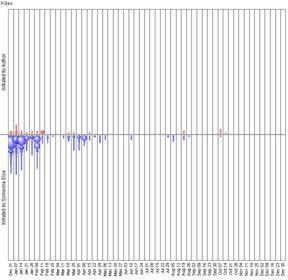
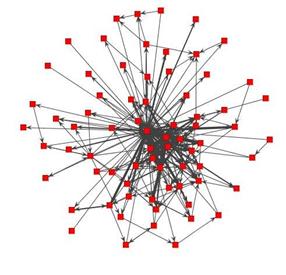

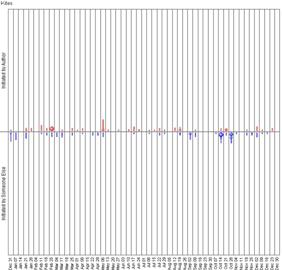
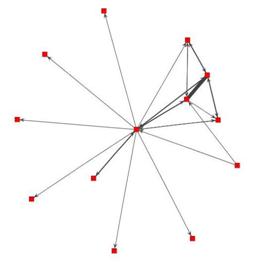
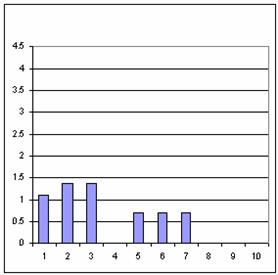
Figure 7b: Contributor to Kites who degree distribution is similar to the answer person pattern
-
-
23 Oct 07
-
11 Oct 07
 Giovanni Boccia Artieri
Come funziona una comunità online? Cosa la tiene in vita e le dà anima? Quali ruoli assumono in essa i singoli partecipanti?
-
08 Oct 07
 avivajazz jazzaviva
This paper uses visualization methods to reveal structural signatures that reveal social roles, and regression analysis to confirm the relationship between these signatures and their associated roles in online groups.
-
05 Oct 07
-
12 Sep 07
-
27 Aug 07
-
10 Aug 07
-
09 Aug 07
 Martin Ferro-Thomsen
Abstract: Social roles in online discussion forums can be described by patterned characteristics of communication between network members which we conceive of as ‘structural signatures.' This paper uses visualization methods to reveal these structural s
visualization social research community socialnetworking networking sociology articles
-
24 Jul 07
-
20 Jul 07
-
12 Jul 07
-
 Scott Leslie
exciting stuff; when we can build these kinds of meta-analysis tools right into the discussion (and other) platforms we use, we can then start to use them to intervene in pedagogically interesting ways; in a small way, this is what stats analysis and vani
-
10 Jul 07

-
09 Jul 07
-
06 Jul 07
-
05 Jul 07

-
 Gabriela Grosseck
Visualizing the Signatures of Social Roles in Online Discussion Groups
-
04 Jul 07
 Nancy White
Visualizing the Signatures of Social Roles in Online Discussion Groups
Howard T. Welser, htw3@cornell.edu *
Cornell University
Eric Gleave
University of Washington
Microsoft Research
Danyel Fisher and Marc Smith
Microsoft Research -

-
 Tony Hirst
"Social roles in online discussion forums can be described by patterned characteristics of communication between network members which we conceive of as ‘structural signatures.' ...visualization methods ... reveal these structural signatures "
social network structure online discussion feedthru forum conference toprint environment visualisation analysis ouclusters for:jjn1
-
02 Jul 07
-
 Anne Helmond
Visualizing the Signatures of Social Roles in Online Discussion Groups
-
01 Jul 07
-
 Rudy Garns
JoSS: Journal of Social Structure | This paper uses visualization methods to reveal these structural signatures and regression analysis to confirm the relationship between these signatures and their associated roles in Usenet newsgroups.
-
-
Visualizing the Signatures of Social Roles in Online Discussion Groups
-
-
30 Jun 07
-
27 Jun 07
-
26 Jun 07
-
23 Jun 07
-
22 Jun 07


Public Stiky Notes
- Local Expert
- Answer People
- Conversationalists
- Fans
- Discussion Artists
- Flame Warrior
- Trolls (Personnes qui aiment lancer des polémiques)
Playful Banter : Badinage
Story-Telling
Bragging : Vantardise
Confrontation
Promotion ou annonce d'évenement
Page Comments
Would you like to comment?
Join Diigo for a free account, or sign in if you are already a member.