
This link has been bookmarked by 1364 people . It was first bookmarked on 02 Mar 2006, by yc c.
-
03 Sep 15
-
30 Aug 15
-
08 May 15
-
18 Apr 15
 Nombulelo Kasana
Web 2.0 describes World Wide Web sites that emphasize user-generated content, usability, and interoperability.
-
22 Mar 15
-
20 Mar 15
-
referring to an early stage of the World Wide Web's evolution.
-
content creators were few in Web 1.0
-
Static pages
-
Pages built using Server Side Includes or CGI
-
Online guestbooks
-
HTML forms sent via email
-
-
04 Mar 15
-
- arch
- Findi
-
-
03 Mar 15

-
-
-
it does not refer to an update to any technical specification, but rather to cumulative changes in the way Web pages are made and used.
-
A Web 2.0 site may allow users to interact and collaborate with each other in a social media dialogue as creators of user-generated content in a virtual community, in contrast to Web sites where people are limited to the passive viewing of content.
-
World Wide Web inventor Sir Tim Berners-Lee, who describes the term as jargon.[5] His original vision of the Web was "a collaborative medium, a place where we [could] all meet and read and write".[6][7]
-
-
09 Dec 14
-
-
Web 2.0 describes World Wide Web sites that use technology beyond the static pages of earlier Web sites. The term was coined in 1999 by Darcy DiNucci and was popularized by Tim O'Reilly at the O'Reilly Media Web 2.0 conference in late 2004.[1][2] Although Web 2.0 suggests a new version of the World Wide Web, it does not refer to an update to any technical specification, but rather to cumulative changes in the way Web pages are made and used.
-
collab
-
orate with each o
-
ther in a social media dialogue as creators of user-generated content in a virtual community, in contrast to Web sites where people are limited to the passive viewing of content. Examples of Web 2.0 include social
-
-
08 Dec 14
-
sites that use technology beyond the static pages of earlier Web sites.
-
a new version of the World Wide Web
-
-
02 Dec 14
-
Web 2.0 describes World Wide Web sites that use technology beyond the static pages of earlier Web sites. The term was coined in 1999 by Darcy DiNucci and was popularized by Tim O'Reilly at the O'Reilly Media Web 2.0 conference in late 2004.[1][2] Although Web 2.0 suggests a new version of the World Wide Web, it does not refer to an update to any technical specification, but rather to cumulative changes in the way Web pages are made and used.
-
-
14 Nov 14

-
Web 2.0 describes World Wide Web sites that use technology beyond the static pages of earlier Web sites. The term was coined in 1999 by Darcy DiNucci and was popularized by Tim O'Reilly at the O'Reilly Media Web 2.0 conference in late 2004.[1][2] Although Web 2.0 suggests a new version of the World Wide Web, it does not refer to an update to any technical specification, but rather to cumulative changes in the way Web pages are made and used.
-
-
-
- Static pages instead of dynamic HTML.[11]
- Content served from the server's filesystem instead of a RDBMS.
- The use of HTML 3.2-era elements such as Framing (World Wide Web)s[citation needed] and tables to position and align elements on a page. These were often used in combination with spacer GIFs.[citation needed]
- Proprietary HTML extensions, such as the <blink> and <marquee> tags, introduced during the first browser war.[citation needed]
- Online guestbooks.[citation needed]
- GIF buttons, graphics typically 88x31 pixels in size promoting web browsers, operating systems, text editors and various other products.[12]
- HTML forms sent via email. Support for server side scripting was rare on shared servers during this period. To provide a feedback mechanism for web site visitors, mailto forms were used. A user would fill in a form, and upon clicking the form's submit button, their email client would launch and attempt to send an email containing the form's details.[13]
Characteristics[edit]
Some design elements of a Web 1.0 site include:
-
-
-
move from personal websites to blogs and blog site aggregation, from publishing to participation, from web content as the outcome of large up-front investment to an ongoing and interactive process, and from content management systems to links based on tagging
-
allow users to do more than just retrieve information
-
-
13 Nov 14
 kakathyhy
details information about web2.0
-
technology beyond the static pages of earlier Web sites
-
-
-
Web 1.0 is a retronym referring to an early stage of the World Wide Web's evolution.
-
The term Web 2.0 did not resurface until 2002
-
-
10 Nov 14
-
09 Nov 14

-
08 Nov 14
-
- Folksonomy- free classification of information; allows users to collectively classify and find information (e.g. Tagging)
- Rich User Experience- dynamic content; responsive to user input
- User Participation - information flows two ways between site owner and site user by means of evaluation, review, and commenting. Site users add content for others to see
- Long tail- services offered on demand basis; profit is realized through monthly service subscriptions more than one-time purchases of goods over the network[citation needed]
- Software as a service - Web 2.0 sites developed API to allow automated usage, such as by an app or mashup
- Mass Participation - Universal web access leads to differentiation of concerns from the traditional internet userbase.
The key features of Web 2.0 [28] include:
-
- Folksonomy- free classification of information; allows users to collectively classify and find information (e.g. Tagging)
- Rich User Experience- dynamic content; responsive to user input
- User Participation - information flows two ways between site owner and site user by means of evaluation, review, and commenting. Site users add content for others to see
- Long tail- services offered on demand basis; profit is realized through monthly service subscriptions more than one-time purchases of goods over the network[citation needed]
- Software as a service - Web 2.0 sites developed API to allow automated usage, such as by an app or mashup
- Mass Participation - Universal web access leads to differentiation of concerns from the traditional internet userbase.
The key features of Web 2.0 [28] include:
-
-
07 Nov 14

-
A Web 2.0 site may allow users to interact and collaborate with each other in a social media dialogue as creators of user-generated content in a virtual community
-
-
06 Nov 14
-
Tim O'Reilly at the O'R
-
h Web 2.0 suggests a new versio
-
-
05 Nov 14
-
25 Oct 14
-
18 Sep 14
-
Whether Web 2.0 is substantively different from prior Web technologies has been challenged by World Wide Web inventor Sir Tim Berners-Lee, who describes the term as jargon.[4] His original vision of the Web was "a collaborative medium, a place where we [could] all meet and read and write".[5][6]
-
-
16 Sep 14

-
15 Sep 14
-
01 Aug 14
-
01 Jul 14
-
28 May 14
-
13 May 14
-
Web 2.0 describes World Wide Web sites that use technology beyond the static pages of earlier Web sites.
-
Web 2.0 suggests a new version of the World Wide Web
-
social media dialogue
-
Web 2.0 site may allow users to interact and collaborate with each other
-
as creators of user-generated content in a virtual community, in contrast to Web sites where people are limited to the passive viewing of content.
-
Instead of merely 'reading', a user is invited to 'write' as well,
-
Web 2.0 include social networking sites, user created Web sites, self-publishing platforms, tagging, and social bookmarking.
-
-
05 May 14
-
Web 2.0 describes World Wide Web sites that use technology beyond the static pages of earlier Web sites.
-
t does not refer to an update to any technical specification, but rather to cumulative changes in the way Web pages are made and used.
-
Web 2.0 site may allow users to interact and collaborate with each other in a social media dialogue as creators of user-generated content in a virtual community, in contrast to Web sites where people are limited to the passive viewing of content.
-
social networking sites, blogs, wikis, folksonomies, video sharing sites, hosted services, Web applications, and mashups.[3]
-
Web 2.0 sites allow users to do more than just retrieve information
-
This has been called "network as platform" computing
-
user created Web sites, self-publishing platforms, tagging, and social bookmarking. Users can provide the data that is on a Web 2.0 site and exercise some control over that data.
-
Some scholars have put forth cloud computing as an example of Web 2.0 because cloud computing is simply an implication of computing on the Internet
-
alls Web 2.0 the "participatory Web"[17] and regards the Web-as-information-source as Web 1.0.
-
also increases the incidence of "spamming" and "trolling" by unscrupulous or misanthropic users
-
the characteristics of Web 2.0 are: rich user experience, user participation, dynamic content, metadata, Web standards, and scalability. Further characteristics, such as openness, freedom[20] and collective intelligence[21] by way of user participation, can also be viewed as essential attributes of Web 2.0.
-
-
-
beyond the static pages of earlier Web sites
-
cumulative changes in the way Web pages are made and used.
-
interact and collaborate
-
-
do more than just retrieve information
-
contribute
-
to the content available to everyone in a user friendly way.
-
'write' as well,
-
exercise some control over that data.
-
that encourages users to add value to the application as they use it.
-
cloud computing
-
"participatory Web"
-
Web-as-information-source as Web 1.0.
-
-
29 Apr 14
-
beyond the static pages
-
cumulative changes
-
interact
-
collaborate
-
social media
-
-
-
technical specification,
-
interact
-
-
28 Apr 14
-
A Web 2.0 site may allow users to interact and collaborate with each other in a social media dialogue as creators of user-generated content in a virtual community, i
-
Examples of Web 2.0 include social networking sites, blogs, wikis, folksonomies, video sharing sites, hosted services, Web applications, and mashups.[3]
-
he most commonly used in Web 2.0 is its ability to play audio and video files
-
-
25 Apr 14
-
Web 2.0
-
-
23 Apr 14

-
"Fragmented Future",
-
January 1999 by Darcy DiNucci, a consultant on electronic information design
-
The Web will be understood not as screenfuls of text and graphics but as a transport mechanism, the ether through which interactivity happens.
-
a user is invited to 'write' as well, or contribute to the content available to everyone in a user friendly way.
-
network as platform"
-
This has been called "
-
storage facilities
-
omputing
-
exercise some control over that data
-
add value to the application as they use it.
-
loud computing is simply an implication of computing on the Internet.
-
-
18 Apr 14
-
13 Apr 14
-
19 Mar 14
-
Web 2.0 describes World Wide Web sites that use technology beyond the static pages of earlier Web sites. The term was coined in 1999 by Darcy DiNucci and was popularized by Tim O'Reilly at the O'Reilly Media Web 2.0 conference in late 2004
-
place where we [could] all meet and read and write".
-

-
-
15 Mar 14
-
Web 2.0 describes World Wide Web sites that use technology beyond the static pages of earlier Web sites. The term was coined in 1999 by Darcy DiNucci and was popularized by Tim O'Reilly at the O'Reilly Media Web 2.0 conference in late 2004.[1][2] Although Web 2.0 suggests a new version of the World Wide Web, it does not refer to an update to any technical specification, but rather to cumulative changes in the way Web pages are made and used.
-

-

-
-
12 Mar 14
 Alex Parker
definition of web 2.0
-
05 Mar 14
-
Web 2.0 describes World Wide Web sites that use technology beyond the static pages of earlier Web sites. The term was coined in 1999 by Darcy DiNucci and was popularized by Tim O'Reilly at the O'Reilly Media Web 2.0 conference in late 2004.[1][2] Although Web 2.0 suggests a new version of the World Wide Web, it does not refer to an update to any technical specification, but rather to cumulative changes in the way Web pages are made and used.
-
-
03 Mar 14
-
23 Feb 14
-
A Web 2.0 site may allow users to interact and collaborate with each other in a social media dialogue as creators of user-generated content in a virtual community, in contrast to Web sites where people are limited to the passive viewing of content.
-
-
16 Feb 14
 Marion Galinos
Diigo Bookmarking/Tagging Assignment - Web site 1
Web2.0 wikipedia web 2.0 reference wiki technology definition
-
14 Feb 14
-

-
Web 2.0 describes World Wide Web sites that use technology beyond the static pages of earlier Web sites. The term was coined in 1999 by Darcy DiNucci and was popularized by Tim O'Reilly at the O'Reilly Media Web 2.0 conference in late 2004.[1][2] Although Web 2.0 suggests a new version of the World Wide Web, it does not refer to an update to any technical specification, but rather to cumulative changes in the way Web pages are made and used.
-
-
13 Feb 14

-
-
This control is the preparation students will need to be successful as learning expands beyond the classroom."[43]
-
opportunity to share what they learn with peers
-
shifts in the way education is provided for students
-
expected to collaborate
-
Laura Rochette implemented the use of blogs in her American History class and noted that in addition to an overall improvement in quality, the use of the blogs as an assignment demonstrated synthesis level activity from her students.
-
-
06 Feb 14
-
Web 2.0 describes web sites that use technology beyond the static pages of earlier web sites. The term was coined in 1999 by Darcy DiNucci
-
A Web 2.0 site may allow users to interact and collaborate with each other in a social media dialogue as creators of user-generated content in a virtual community, in contrast to websites where people are limited to the passive viewing of content
-
-
05 Feb 14
 Jarrett Brooks
The term "Web 2.0" was first used in January 1999 by Darcy DiNucci, a consultant on electronic information design (information architecture). In her article, "Fragmented Future"
-
A Web 2.0 site may allow users to interact and collaborate with each other in a social media dialogue as creators of user-generated content in a virtual community, in contrast to websites where people are limited to the passive viewing of content
-
The term Web 2.0 was initially championed by bloggers and by technology journalists,
-
-
03 Feb 14
-
Web 2.0 describes web sites that use technology beyond the static pages of earlier web sites. The term was coined in 1999 by Darcy DiNucci and was popularized by Tim O'Reilly at the O'Reilly Media Web 2.0 conference in late 2004.[1][2] Although Web 2.0 suggests a new version of the World Wide Web, it does not refer to an update to any technical specification, but rather to cumulative changes in the way web pages are made and used.
-
-
-
Web 2.0 describes web sites that use technology beyond the static pages of earlier web sites. The term was coined in 1999 by Darcy DiNucci and was popularized by Tim O'Reilly at the O'Reilly Media Web 2.0 conference in late 2004.[1][2] Although Web 2.0 suggests a new version of the World Wide Web, it does not refer to an update to any technical specification, but rather to cumulative changes in the way web pages are made and used.
-
-
27 Jan 14

-
20 Jan 14
-
Examples of Web 2.0 include social networking sites, blogs, wikis, folksonomies, video sharing sites, hosted services, web applications, and mashups.[3]
-
-
16 Jan 14
-
rich user experience, user participation, dynamic content, metadata, web standards, and scalability. Further characteristics, such as openness, freedom[20] and collective intelligence[21] by way of user participation, can also be viewed as essential attributes of Web 2.0.
-
-
12 Jan 14

-
12 Dec 13
-
The unique aspect of this migration, they argued, is that "customers are building your business for you".[12] They argued that the activities of users generating content (in the form of ideas, text, videos, or pictures) could be "harnessed" to create value.
-
-
09 Dec 13
-
Web 2.0 and philanthropy
-
Web 2.0 in social work
-
The social work profession is embracing Web 2.0 technologies.
-
This online publication continues to explore the application of Web 2.0 technology within the social work community.
-
Both students and professionals had begun chronicling their career development as well as sharing information from their respective practice areas.
-
the social work community and the under utilization of advanced technologies in social work organizations.
-
-
06 Dec 13
-
lthough Web 2.0 suggests a new version of the World Wide Web,
-
allow users to interact and collaborate with each other in a social media dialogue
-
social networking sites, blogs, wikis, folksonomies, video sharing sites, hosted services, web applications, and mashups.
-
Web 2.0 websites allow users to do more than just retrieve information.
-
"Web 1.0", they provide the user with more user-interface, software and storage facilities, all through their browser.
-
Web 2.0 offers all users the same freedom to contribute.
-
he characteristics of Web 2.0 are: rich user experience, user participation, dynamic content, metadata, web standards, and scalability. Further characteristics, such as openness, freedom[20] and collective intelligence[21] by way of user participation, can also be viewed as essential attributes of Web 2.0.
-
-
04 Dec 13
-
Web 2.0 describes web sites that use technology beyond the static pages of earlier web sites.
-
-
28 Nov 13
-
22 Nov 13
-
21 Nov 13
-
11 Nov 13
-
The term was coined in 1999 by Darcy DiNucci and was popularized by Tim O'Reilly at the O'Reilly Media Web 2.0 conference in late 2004
-
A Web 2.0 site may allow users to interact and collaborate with each other in a social media dialogue as creators of user-generated content in a virtual community
-
Instead of merely 'reading', a user is invited to 'write' as well, or contribute to the content available to everyone in a user friendly way.
-
-
possibility for serious debate and collaboration, it also increases the incidence of "spamming" and "trolling" by unscrupulous or misanthropic users.
-
-
-
cumulative changes
-
allow users to interact
-
-

-
Web 2.0 describes web sites that use technology beyond the static pages of earlier web sites.
-
Web 2.0 describes web sites that use technology beyond the static pages of earlier web sites.
-
Major features of Web 2.0 include social networking sites, user created web sites, self-publishing platforms, tagging, and social bookmarking
-
important part of Web 2.0 is the Social web, which is a fundamental shift in the way people communicate.
-
For marketers, Web 2.0 offers an opportunity to engage consumers
-
-
-
The term was coined in 1999 by Darcy DiNucci
-
Web 2.0 describes web sites that use technology beyond the static pages of earlier web sites.
-
cumulative changes
-
Although Web 2.0 suggests a new version of the World Wide Web
-
Web 2.0 site may allow users to interact and collaborate with each other in a social media dialogue as creators of user-generated content in a virtual community
-
people are limited to the passive viewing of content.
-
Web 2.0 include social networking sites, blogs, wikis, folksonomies, video sharing sites, hosted services, web applications, and mashups.
-
more user-interface, software and storage facilities
-
Web 2.0 websites allow users to do more than just retrieve information
-
social networking sites, user created web sites, self-publishing platforms, tagging, and social bookmarking.
-
"network as platform" computing
-
exercise some control over that data.
-
cloud computing as an example of Web 2.0
-
freedom to contribute.
-
it also increases the incidence of "spamming" and "trolling"
-
openness, freedom[
-
A rich user experience
-
-
 Anshul Narang
"Folksonomy; free classification of information"
-
Web 2.0 describes web sites that use technology beyond the static pages of earlier web sites. The term was coined in 1999 by Darcy DiNucci and was popularized by Tim O'Reilly at the O'Reilly Media Web 2.0 conference in late 2004.
-
Web 2.0 websites allow users to do more than just retrieve information. By increasing what was already possible in "Web 1.0", they provide the user with more user-interface, software and storage facilities, all through their browser
-
- Folksonomy; free classification of information
- A rich user experience - pages are dynamic and respond to user input by design.
- A user as a contributor - information flows two ways between site owner and site user by means of evaluation, review and commenting.
- Long tail - profit is realized through monthly service subscriptions more than one-time purchases of goods over the network.
- User participation - site users add content for others to see.
- Basic trust - contributions are available for the world to use, reuse, or re-purpose.
- Dispersion - digital resources and services are sought more than physical goods.
- Mass participation
-
-
-
describes web sites that use technology beyond the static pages of earlier web sites.
-
-
-
The term was coined in 1999 by Darcy DiNucci
-
A Web 2.0 site may allow users to interact and collaborate with each other in a social media
-
they provide the user with more user-interface, software and storage facilities, all through their browser.
-
Major features of Web 2.0 include social networking sites, user created web sites, self-publishing platforms, tagging, and social bookmarking.
-
-
08 Nov 13
-
Although Web 2.0 suggests a new version of the World Wide Web, it does not refer to an update to any technical specification,
-
A Web 2.0 site may allow users to interact and collaborate with each other in a social media dialogue as creators of user-generated content in a virtual community,
-
Web 2.0 websites allow users to do more than just retrieve information.
-
Users can provide the data that is on a Web 2.0 site and exercise some control over that data
-
this opens the possibility for serious debate and collaboration,
-
increases the incidence of "spamming" and "trolling" by unscrupulous or misanthropi
-
Web 2.0 offers all users the same freedom to contribute
-
c users.
-
-
-
in contrast to websites where people are limited to the passive viewing
-
Web 2.0 websites allow users to do more than just retrieve information
-
-
06 Nov 13
-
Web 2.0 describes web sites that use technology beyond the static pages of earlier web sites. The term was coined in 1999 by Darcy DiNucci and was popularized by Tim O'Reilly at the O'Reilly Media Web 2.0 conference in late 2004.[1][2] Although Web 2.0 suggests a new version of the World Wide Web, it does not refer to an update to any technical specification, but rather to cumulative changes in the way web pages are made and used.
A Web 2.0 site may allow users to interact and collaborate with each other in a social media dialogue as creators of user-generated content in a virtual community, in contrast to websites where people are limited to the passive viewing of content. Examples of Web 2.0 include social networking sites, blogs, wikis, folksonomies, video sharing sites, hosted services, web applications, and mashups.[3]
Whether Web 2.0 is substantively different from prior web technologies has been challenged by World Wide Web inventor Sir Tim Berners-Lee, who describes the term as jargon.[4] His original vision of the Web was "a collaborative medium, a place where we [could] all meet and read and write".[5][6]
-
-
18 Oct 13
-
14 Oct 13
-
Web 2.0 describes web sites that use technology beyond the static pages of earlier web sites.
-
A Web 2.0 site may allow users to interact and collaborate with each other in a social media dialogue as creators of user-generated content in a virtual community, in contrast to websites where people are limited to the passive viewing of content. Examples of Web 2.0 include social networking sites, blogs, wikis, folksonomies, video sharing sites, hosted services, web applications, and mashups.
-
-
03 Oct 13
-
30 Sep 13
-
22 Sep 13

-
21 Sep 13
-
20 Sep 13
-
changes in the way web pages are made and used.
-
-
-
Although Web 2.0 suggests a new version of the World Wide Web, it does not refer to an update to any technical specification, but rather to cumulative changes in the way web pages are made and used.
-
A Web 2.0 site may allow users to interact and collaborate with each other in a social media dialogue as creators of user-generated content in a virtual community, in contrast to websites where people are limited to the passive viewing of content
-
Examples of Web 2.0 include social networking sites, blogs, wikis, folksonomies, video sharing sites, hosted services, web applications, and mashups
-
Whether Web 2.0 is substantively different from prior web technologies has been challenged by World Wide Web inventor Sir Tim Berners-Lee, who describes the term as jargon.[4] His original vision of the Web was "a collaborative medium, a place where we [could] all meet and read and write"
-
-
-
18 Sep 13
-
15 Sep 13
-
12 Sep 13
-
10 Sep 13

-
08 Sep 13
 kimberly jones
Description of what Web 2.0 consists of and it's functions.
-
21 Aug 13
-
19 Aug 13
-
in contrast to websites where people are limited to the passive viewing
-
interact and collaborate with each other
-


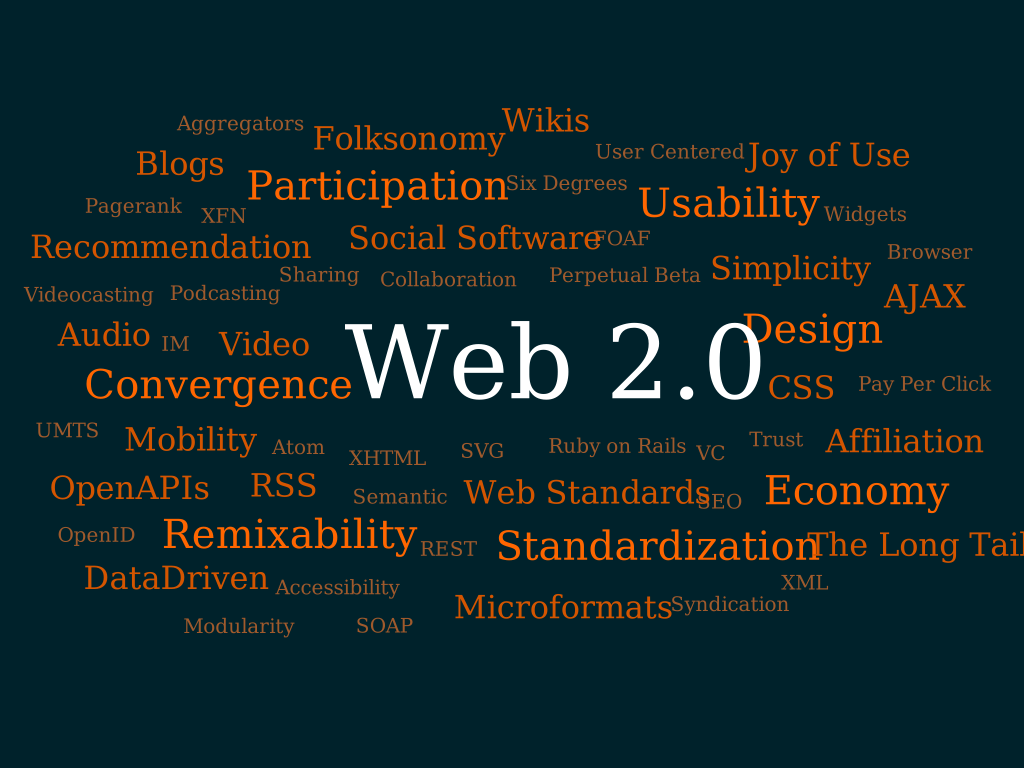
Public Stiky Notes
I can show you how to do this with an application called Wordle.
(Message for training purposes.)
people can edit these information
and might even give wrong info just for fun
Its the best resource for Educational Technology
funny, achmed.
Page Comments
Would you like to comment?
Join Diigo for a free account, or sign in if you are already a member.