
This link has been bookmarked by 60 people . It was first bookmarked on 23 Apr 2006, by Maggie Tsai.
-
21 May 14
-
It was reported that his oppressors in the English corrupted monarchy, judiciary, banks, and corporate colonists were directly responsible for these dismissals, terminations, retaliations, business sabotages, and threats to throw him into debtors prison
-
-
12 Jan 14
-
Thomas Paine (February 9, 1737 [O.S. January 29, 1736][Note 1][Note 2][Note 3] – June 8, 1809) was an English-American political activist, author, political theorist and revolutionary. As the author of two highly influential pamphlets at the start of the American Revolution, he inspired the Patriots in 1776 to declare independence from Britain.[1] His ideas reflected Enlightenment-era rhetoric of transnational human rights.[2] He has been called "a corsetmaker by trade, a journalist by profession, and a propagandist by inclination".[3]
-
Paine lived in France for most of the 1790s, becoming deeply involved in the French Revolution. He wrote the Rights of Man (1791), in part a defence of the French Revolution against its critics. His attacks on British writer Edmund Burke led to a trial and conviction in absentia in 1792 for the crime of seditious libel. In 1792, despite not being able to speak French, he was elected to the French National Convention. The Girondists regarded him as an ally. Consequently, the Montagnards, especially Robespierre, regarded him as an enemy.
-
In December 1793, he was arrested and imprisoned in Paris, then released in 1794. He became notorious because of his pamphlet The Age of Reason (1793–94), in which he advocated deism, promoted reason and freethinking, and argued against institutionalized religion in general and Christian doctrine in particular.
-
In 1802, he returned to America where he died on June 8, 1809. Only six people attended his funeral as he had been ostracized for his ridicule of Christianity.[5]
-
-
14 Dec 13
-
08 Dec 13
-
Thomas Paine (February 9, 1737 [O.S. January 29, 1736][Note 1][Note 2][Note 3] – June 8, 1809) was an English-American political activist, author, political theorist and revolutionary. As the author of two highly influential pamphlets at the start of the American Revolution, he inspired the Patriots in 1776 to declare independence from Britain.[1] His ideas reflected Enlightenment era rhetoric of transnational human rights.[2] He has been called "a corsetmaker by trade, a journalist by profession, and a propagandist by inclination".[3]
Born in Thetford, England, in the county of Norfolk, Paine emigrated to the British American colonies in 1774 with the help of Benjamin Franklin, arriving just in time to participate in the American Revolution. His principal contributions were the powerful, widely read pamphlet Common Sense (1776), the all-time best-selling American book that advocated colonial America's independence from the Kingdom of Great Britain, and The American Crisis (1776–83), a pro-revolutionary pamphlet series. Common Sense was so influential that John Adams said, "Without the pen of the author of Common Sense, the sword of Washington would have been raised in vain."[4]
Paine lived in France for most of the 1790s, becoming deeply involved in the French Revolution. He wrote the Rights of Man (1791), in part a defence of the French Revolution against its critics. His attacks on British writer Edmund Burke led to a trial and conviction in absentia in 1792 for the crime of seditious libel. In 1792, despite not being able to speak French, he was elected to the French National Convention. The Girondists regarded him as an ally. Consequently, the Montagnards, especially Robespierre, regarded him as an enemy.
-
In December 1793, he was arrested and imprisoned in Paris, then released in 1794. He became notorious because of his pamphlet The Age of Reason (1793–94), in which he advocated deism, promoted reason and freethinking, and argued against institutionalized religion in general and Christian doctrine in particular. He also wrote the pamphlet Agrarian Justice (1795), discussing the origins of property, and introduced the concept of a guaranteed minimum income. In 1802, he returned to America where he died on June 8, 1809. Only six people attended his funeral as he had been ostracized for his ridicule of Christianity.[5]
-
-
Paine wrote Rights of Man, an abstract political tract critical of monarchies and European social institutions.
-
Paine was an enthusiastic supporter of the French Revolution, and was granted, along with Alexander Hamilton, George Washington, Benjamin Franklin and others, honorary French citizenship. Despite his inability to speak French, he was elected to the National Convention, representing the district of Pas-de-Calais.[42]
-
Napoleon claimed he slept with a copy of Rights of Man under his pillow and went so far as to say to Paine that "a statue of gold should be erected to you in every city in the universe
-
1797 wrote two essays, one of which was pointedly named Observations on the Construction and Operation of Navies with a Plan for an Invasion of England and the Final Overthrow of the English Government,[51] in which he promoted the idea to finance 1,000 gunboats to carry a French invading army across the English Channel.
-
The Age of Reason gave ample excuse for the religiously devout to dislike him, and the Federalists attacked him for his ideas of government stated in Common Sense, for his association with the French Revolution, and for his friendship with President Jefferson.
-
-
21 Nov 13
-
For other people of the same name, see Thomas Paine (disambiguation).
Thomas Paine 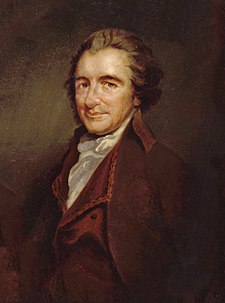
Oil painting by Auguste Millière (1880)Born February 9, 1737[Note 1]
Thetford, Norfolk, Great BritainDied June 8, 1809(1809-06-08) (aged 72)
New York City, New York, U.S.Era 18th-century philosophy Religion Deism School Enlightenment, Liberalism, Radicalism, Republicanism Main interests Politics, ethics, religion Signature 
Thomas Pai
-
ne (February 9, 1737 [O.S. January 29, 1736][Note 1][Note 2][Note 3] – June 8, 1809) was an English-American political activist, author, political theorist and revolutionary. As the author of two highly influential pamphlets at the start of the American Revolution, he inspired the Patriots in 1776 to declare independence from Britain.[1] His ideas reflected Enlightenment era rhetoric of transnational human rights.[2] He has been called "a corsetmaker by trade, a journalist by profession, and a prop
-
agandist by inclination".[3]
-
-
07 Sep 13
-
Common Sense was so influential that John Adams said, "Without the pen of the author of Common Sense, the sword of Washington would have been raised in vain."[5]
-
spreading the idea of republicanism, bolstering enthusiasm for separation from Britain, and encouraging recruitment for the Continental Army. Paine provided a new and convincing argument for independence by advocating a complete break with history. Common Sense is oriented to the future in a way that compels the reader to make an immediate choice. It offers a solution for Americans disgusted with and alarmed at the threat of tyranny.[23]
-
Paine was not, on the whole, expressing original ideas in Common Sense, but rather employing rhetoric as a means to arouse resentment of the Crown. To achieve these ends, he pioneered a style of political writing suited to the democratic society he envisioned, with Common Sense serving as a primary example. Part of Paine's work was to render complex ideas intelligible to average readers of the day, with clear, concise writing unlike the formal, learned style favored by many of Paine's contemporaries.
-
Paine's great contribution was in initiating a public debate about independence, which had previously been rather muted.
-
that ordinary people can indeed make sound judgments on major political issues, and that there exists a body of popular wisdom that is readily apparent to anyone.
-
Paine also used a notion of "common sense" favored by philosophes in the Continental Enlightenment. They held that common sense could refute the claims of traditional institutions. Thus Paine used "common sense" as a weapon to delegitimize the monarchy and overturn prevailing conventional wisdom.
-
He calls the Revolutionary generation "the children of the twice-born",[32] because in their childhood they had experienced the Great Awakening, which, for the first time, had tied Americans together, transcending denominational and ethnic boundaries and giving them a sense of patriotism.[33][34]
-
-
02 Apr 13
-
The Age of Reason critique on institutionalized religion resulted in only a brief upsurge in deistic thought in America, but Paine was derided by the public and abandoned by his friends.
-
-
19 Nov 12
-
Paine was born on January 29, 1737
-
-
20 Sep 12
-
09 Jan 12

-
03 Jan 12
-
07 Dec 11

-
20 Oct 11
-
14 Sep 11
-
His principal contributions were the powerful, widely read pamphlet Common Sense (1776), the all-time best-selling American book that advocated colonial America's independence from the Kingdom of Great Britain
-
-
16 May 11
-
10 Oct 10
-
01 Oct 10
 Margit Nahra
has a good reproduction of an oil painting portrait of Paine that could be used as a hook
-
29 Sep 10
-
30 Aug 10
-
10 Aug 10
-
30 May 10
-
23 Apr 10
-
15 Apr 10
-
22 Mar 10
-
18 Aug 09
-
29 Mar 09
-
21 Jan 09
-
31 Dec 08

-
09 Oct 08
-
06 Oct 08
-
05 Oct 08
 Christopher Bales
Thomas Paine (January 29, 1737 – June 8, 1809) was an English pamphleteer, revolutionary, radical, inventor, and intellectual. He lived and worked in Britain until age 37, when he emigrated to the British American colonies, in time to participate in the American Revolution. His principal contribution was the powerful, widely-read pamphlet Common Sense (1776), advocating colonial America's independence from the Kingdom of Great Britain, and of The American Crisis (1776–1783), a pro-revolutionary pamphlet series.
-
27 Sep 08
 evgeny yauhenio
Thomas Paine (29 January 1737 – 8 June 1809) was an English pamphleteer, revolutionary, radical, inventor, and intellectual. He lived and worked in Britain until age 37, when he emigrated to the British American colonies, in time to participate in the American Revolution. His principal contribution was the powerful, widely-read pamphlet Common Sense (1776), advocating colonial America's independence from the Kingdom of Great Britain, and of The American Crisis (1776–1783), a pro-revolutionary pamphlet series.
Later, he greatly influenced the French Revolution. He wrote the Rights of Man (1791), a guide to Enlightenment ideas. Despite not speaking French, he was elected to the French National Convention in 1792. The Girondists regarded him an ally, so, the Montagnards, especially Robespierre, regarded him an enemy. In December of 1793, he was arrested and imprisoned in Paris, then released in 1794. He became notorious because of The Age of Reason (1793–94), the book advocating deism and arguing against Christian doctrines. In France, he also wrote the pamphlet Agrarian Justice (1795), discussing the origins of property, and introduced the concept of a guaranteed minimum income.
He remained in France during the early Napoleonic era, but condemned Napoleon's dictatorship, calling him "the completest charlatan that ever existed".[1] In 1802, he returned to America at President Thomas Jefferson's invitation. -
26 Jul 08
-
I do not believe in the creed professed by the Jewish church, by the Roman church, by the Greek church, by the Turkish church, by the Protestant church, nor by any church that I know of. My own mind is my own church.
All national institutions of churches, whether Jewish, Christian or Turkish, appear to me no other than human inventions, set up to terrify and enslave mankind, and monopolize power and profit.
-
-
31 Jan 08
-
19 Mar 07
-
- I do not believe in the creed professed by the Jewish church, by the Roman church, by the Greek church, by the Turkish church, by the Protestant church, nor by any church that I know of. My own mind is my own church.
-
-
23 Apr 06
-
Thomas Paine (January 29, 1737 – June 8, 1809), intellectual, scholar, revolutionary, deist and idealist. A radical pamphleteer, Paine anticipated and helped foment the American Revolution through his powerful writings, most notably Common Sense, an incendiary pamphlet advocating independence from Great Britain.
-


Would you like to comment?
Join Diigo for a free account, or sign in if you are already a member.