
This link has been bookmarked by 690 people . It was first bookmarked on 04 Aug 2006, by Michel de Bree.
-
31 Dec 17
-
04 Jun 15
-
01 Jun 15
-
01 May 15
-
the idea of moving planned tasks and projects out of the mind by recording them externally and then breaking them into actionable work items.
-
control and perspective.
-
The goal of the control processes in GTD is to get everything out of one's head
-
six "horizons of focus".
-
an individual can free up mental space to begin moving up to the next level of focus
-
his in turn determines the priority of the individual tasks and commitments gathered during the workflow process
-
he perspective gained from these reviews should drive one's priorities.
-
During a weekly review, determine the context for the tasks and put them on the appropriate lists
-
GTD is based on storing, tracking and retrieving the information related to the things that need to get done
-
The human brain's "reminder system" is inefficient
-
the "next actions" stored by context in the "trusted system" act as an external support which ensures that we are presented with the right reminders at the right time.
-
GTD relies on external memories
-
capture, clarify, organize, reflect, and engage
-
Older editions use the names collect, process, organize, plan, and do
-
clarified and organized by answering "What is it?" questions
-
eight oval end points
-
a context-based single-step task list
-
project planning occurs. Multi-step projects are assigned a desired outcome and a single "next action."
-
Finally, the tasks on the appropriate context-based task list are worked on unless the calendar dictates otherwise
-
-
31 Mar 15
-
15 Feb 15
 Pavel Kuchar
"
"-
Unlike some theories, which focus on top-down goal-setting, GTD works in the opposite direction. Allen argues that it is often difficult for individuals to focus on big picture goals if they cannot sufficiently control the day-to-day tasks that they frequently must face. By developing a system that clarifies and defines the regular workday, an individual can free up mental space to begin moving up to the next level of focus.
-
-
26 Jan 15
-
a system that clarifies and defines the regular workday, an individual can free up mental space to begin moving up to the next level of focus
-
The human brain's "reminder system" is inefficient and seldom reminds us of what we need to do at the time and place when we can do it.
-
the "next actions" stored by context in the "trusted system" act as an external support which ensures that we are presented with the right reminders at the right time
-
-
Once all the material is collected in an inbox, each item is processed and organized by answering "What is it?" questions as showed
-
collect, process, organize, plan, do
-
As a results, items end up in one of the eight oval end points in the diagram (trash, someday/maybe list, reference filing system, task to create a project plan, done in under two minutes, delegated "waiting for" list, a context-based single-step task list, or on the calendar).
-
Next, project planning occurs. Multi-step projects are assigned a desired outcome and a single "next action." Finally, the tasks on the appropriate context-based task list are worked on unless the calendar dictates otherwise.
-
Common Tools and Software" page that David Allen maintains
-
-
20 Oct 14
-
the "next actions" stored by context in the "trusted system" act as an external support which ensures that we are presented with the right reminders at the right time.
-
-
02 Oct 14
-
23 Sep 14
-
05 Sep 14
-
Allen creates analogies between the six levels of focus
-
-
23 Jun 14
-
05 May 14
-
GTD is based on storing, tracking and retrieving the information related to the things that need to get done
-
llen argues that it is often difficult for individuals to focus on big picture goals if they cannot sufficiently control the day-to-day tasks that they frequently must face
-
uring a weekly review, determine the context for the tasks and put them on the appropriate lists
-
Mental blocks we encounter are caused by insufficient 'front-end' planning
-
GTD is based on storing, tracking and retrieving the information related to the things that need to get done
-
The human brain's "reminder system" is inefficient and seldom reminds us of what we need to do at the time and place when we can do it. Consequently, the "next actions" stored by context in the "trusted system" act as an external support which ensures that we are presented with the right reminders at the right time. As GTD relies on external memories, it can be seen as an application of the theories of distributed cognition or the exten
-
While GTD material is technologically neutral and advises people to start with a paper-based system,[9] many task management tools claim to implement GTD methodology.[10]
-
-
17 Mar 14
-
04 Mar 14
-
17 Feb 14
-
08 Jan 14
 carlo mosca
Gettring Thinks Done GTD is a time management method
gtd productivity timemanagement management lifehacks organization wikipedia howto
-
This article is about the action management system by David Allen. For other uses, see Getting Things Done (disambiguation).
Getting Things Done: The Art of Stress-Free Productivity 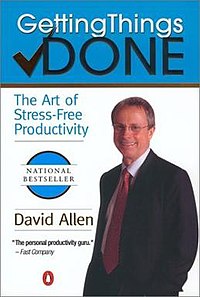
Getting Things Done: The Art of Stress-Free Productivity coverAuthor David Allen Subject Business Publisher Penguin Publication date 2002 Pages 267 pp ISBN ISBN 978-0-14-200028-1
Reprint EditionOCLC Number 51540420 Getting Things Done is a time-management method, described in a book of the same title by productivity consultant David Allen. It is often referred to as GTD.
The GTD method rests on the idea of moving planned tasks and projects out of the mind by recording them externally and then breaking them into actionable work items. This allows one to focus attention on taking action on tasks, instead of on recalling them.
-
-
15 Nov 13
-
09 Oct 13
-
23 Sep 13
-
10 Sep 13
-
20 Aug 13
-
-
10 Jul 13
-
31 May 13
-
23 May 13
-
22 Apr 13
-
28 Mar 13
-
02 Mar 13
-
16 Feb 13
-
28 Jan 13
-
22 Jan 13
-
described in a book of the same title by productivity consultant David Allen
-
The GTD method rests on the idea of moving planned tasks and projects out of the mind by recording them externally and then breaking them into actionable work items.
-
-
28 Dec 12
-
18 Oct 12
 Seth Battis
Getting Things Done is a book by productivity consultant David Allen that describes the method/procedure that he created with the same title name, often referred to simply as GTD.
The Getting Things Done method rests on the idea that a person needs to move tasks out of the mind by recording them externally, so the mind is free from the job of remembering the tasks that need to be completed. One can then concentrate on performing the tasks, instead of remembering.GTD (Getting Things Done) David Allen productivity session2 information management todo PLG (Professional Learning Group)
-
04 Sep 12
-
07 Jun 12
-
task priorities play a central role. The Allen approach uses two key elements — control and perspective.
-
a workflow process to control over all the tasks and commitments
-
"6 different levels of focus" to provide a useful perspective.
-
A weekly review is done on different levels
-
During a weekly review, determine the context for the tasks and puts them on the appropriate lists. An example of grouping together similar tasks would be making a list of outstanding telephone calls, or the tasks / errands to perform while downtown. Context lists can be defined by the set of tools available or by the presence of individuals or groups for whom one has items to discuss or present.
-
storing, tracking and retrieving the information related to the things that need to get done.
-
. Consequently, the "next actions" stored by context in the "trusted system" act as an external support which ensures that we are presented with the right reminders at the right time. GTD relies on external memories, it can be seen as an application of the theories of distributed cognition or the extended mind.[1]
-
-
14 May 12
-
26 Apr 12
-
31 Mar 12
-
04 Mar 12

-
18 Feb 12
-
28 Jan 12
-
23 Jan 12
-
22 Jan 12

-
28 Dec 11
-
30 Nov 11
-
10 Nov 11

-
It is most practical, according to Allen, to do this thinking in advance, generating a series of actions which we can later undertake without any further planning.
-
"reminder system" is inefficient and seldom reminds us of what we need to do at the time and place when we can do it. Consequently, the "next actions" stored by context in the "trusted system" act as an external support which ensures that we are presented with the right reminders at the right time. Since GTD relies on external memories, it can be seen as an application of the scientific theories of distributed cognition or the extended mind.[1]
-
-
19 Oct 11
-
21 Sep 11
-
Getting Things Done (GTD) is an organizational method created by productivity consultant David Allen, described in a book of the same name.
The Getting Things Done method rests on the principle that a person needs to move tasks out of the mind by recording them externally. That way, the mind is freed from the job of remembering everything that needs to be done, and can concentrate on actually performing those tasks.
-
-
08 Sep 11
-
method rests on the principle that a person needs to move tasks out of the mind by recording them externally. That way, the mind is freed from the job of remembering everything that needs to be done, and can concentrate
-
-
29 Aug 11
-
27 Jul 11
-
17 Jul 11
-
19 Jun 11
-
-
Allen's approach uses two key elements — control and perspective.
-
proposes a workflow process
-
to gain control over all the tasks and commitments
-
and "6 different levels of focus"
-
to provide them with useful perspective.
-
suggests that the perspective gained from these reviews should drive one's priorities
-
focused on different levels
-
author advocates a weekly review
-
which can in turn determine the priority of the individual tasks and commitments gathered during the workflow process
-
user determines the context for the tasks and puts them on the appropriate lists
-
Context lists can be defined by the set of tools available or by the presence of individuals or groups for whom one has items to discuss or present.
-
many of the mental blocks we encounter are caused by insufficient 'front-end' planning
-
GTD is based on making it easy to store, track and retrieve all information related to the things that need to get done
-
-
02 Jun 11
-
30 May 11
 Martin Fritz
Getting Things Done - David Allens Selbstorganisationssystem in der Wikipedia
gtd neuemedienarbeit arbeit ordnung plan web2.0 media systeme wikipedia software imported_from_delicious imported_from_delicious_2016
-
25 May 11
-
18 Apr 11

-
12 Apr 11
-
17 Feb 11
-
09 Feb 11
-
The Getting Things Done method rests on the principle that a person needs to move tasks out of the mind by recording them externally. That way, the mind is freed from the job of remembering everything that needs to be done, and can concentrate on actually performing those tasks.
-
In traditional time management, priorities usually play a central role. In contrast, Allen's approach uses two key elements — control and perspective. He proposes a workflow process to gain control over all the tasks and commitments that one needs or wants to get done, and "6 different levels of focus" to provide them with useful perspective.
-
GTD is based on making it easy to store, track and retrieve all information related to the things that need to get done. Allen suggests that many of the mental blocks we encounter are caused by insufficient 'front-end' planning. It is most practical, according to Allen, to do this thinking in advance, generating a series of actions which we can later undertake without any further planning.
-
Since GTD relies on external memories, it can be seen as an application of the scientific theories of distributed cognition or the extended mind.[1]
-
In 2005, Wired called GTD "A new cult for the info age",[2] describing the enthusiasm for this methodology among information technology and knowledge workers as a kind of cult following. Allen's ideas have also been popularized through the Internet, especially via blogs such as Lifehacker,[3] 43 Folders,[4] and The Simple Dollar.
-
In 2007, Time Magazine called Getting Things Done the self-help business book of its time.
-
TiddlyWiki has long been used as a personal productivity tool geared towards Allen's GTD methodology.
-
-
23 Jan 11
-
16 Jan 11

-
13 Jan 11
-
07 Jan 11
-
06 Jan 11
-
09 Dec 10
-
21 Nov 10
-
20 Nov 10
-
16 Nov 10
-
31 Oct 10
-
22 Oct 10
-
21 Oct 10
-
18 Oct 10
-
16 Oct 10
-
Getting Things Done
-
-
10 Oct 10
-
27 Sep 10
-
12 Sep 10
-
03 Sep 10
 erica_hurley
The Getting Things Done method rests on the principle that a person needs to move tasks out of the mind by recording them externally. That way, the mind is freed from the job of remembering everything that needs to be done, and can concentrate on actually performing those tasks.
-
06 Aug 10
-
27 Jul 10
-
Getting Things Done is an organizational method created by David Allen, described in a book of the same name.
-
-
19 Jul 10
-
11 Jul 10
-
In traditional time management, priorities usually play a central role. In contrast, Allen's approach uses two key elements — control and perspective. He proposes a workflow process to gain control over all the tasks and commitments that one needs or wants to get done, and "6 different levels of focus" to provide them with useful perspective.
The author advocates a weekly review focused on different levels, and suggests that the perspective gained from these reviews should drive one's priorities, which can in turn determine the priority of the individual tasks and commitments gathered during the workflow process. During a weekly review, the user determines the context for the tasks and puts them on the appropriate lists. An example of grouping together similar tasks would be making a list of outstanding telephone calls, or errands to perform while downtown. Context lists can be defined by the set of tools available or by the presence of individuals or groups for whom one has items to discuss or present.
GTD is based on making it easy to store, track and retrieve all information related to the things that need to get done. Allen suggests that many of the mental blocks we encounter are caused by insufficient 'front-end' planning. It is most practical, according to Allen, to do this thinking in advance, generating a series of actions which we can later undertake without any further planning. The human brain's "reminder system" is inefficient and seldom reminds us of what we need to do at the time and place when we can do it. Consequently, the "next actions" stored by context in the "trusted system" act as an external support which ensures that we are presented with the right reminders at the right time. Since GTD relies on external memories, it can be seen as an application of the scientific theories of distributed cognition or the extended mind.[1]
-
-
15 Jun 10
-
06 May 10
-
29 Apr 10
-
24 Apr 10
-
23 Apr 10
-
19 Apr 10
-
19 Mar 10
-
25 Feb 10
-
21 Feb 10
-
- Collect
- Process
- Organize
- Review
- Do
-
- Start at the top.
- Deal with one item at a time.
- Never put anything back into 'in'.
- If an item requires action:
-
- Do it (if it takes less than two minutes), OR
- Delegate it, OR
- Defer it.
- If an item does not require action:
-
- File it for reference, OR
- Throw it away, OR
- Incubate it for possible action later.
-
- Next actions — For every item requiring attention, decide what is the next action that can be physically taken on that item. For example, if the item is, "Write project report", the next action might be, "Email Fred for meeting minutes", or, "Call Mary to ask about report requirements". Though there may be many steps and actions required to complete the item, there will always be something that needs to be done first, and this step should be recorded in the next actions list. Preferably, these steps are organized by the context in which they can be done, such as "in the office", "by the phone", or "at the store".
- Projects — Every open loop in one's life or work which requires more than one physical action to achieve becomes a project. These projects are tracked and periodically reviewed to make sure that every project has a next action associated with it, and thus can be moved forward.
- Waiting for — When an action has been delegated to someone else, or when one is waiting for some external event before a project can be moved forward, this is tracked in the system and periodically checked to see if action is due, or a reminder needs to be sent.
- Someday/Maybe — Things to be done at some point, but not right now. Examples might be "learn Thai", or, "take diving holiday".
-
-
17 Feb 10
-
02 Feb 10
-
31 Jan 10

-
08 Jan 10
-
02 Jan 10
-
23 Dec 09


Page Comments
Would you like to comment?
Join Diigo for a free account, or sign in if you are already a member.