
This link has been bookmarked by 203 people . It was first bookmarked on 20 Dec 2006, by fooj.
-
06 Jul 15
-
20 Feb 15
-
19 Oct 13
 Ed Dodds
David Armano is Global Strategy Director: Key Accounts at Edelman Digital. This is his personal digital property where he shares insights, ideas and opinions on integrated marketing and digital communications.
-
04 Oct 13
-
23 Aug 13
-
20 Jun 13
-
19 Apr 13
-
28 Jan 13
-
01 Dec 12
-
13 Jun 12
-
22 May 12
-
10 May 12
-
27 Feb 12
-
24 Feb 12
-
02 Feb 12
-
02 Jan 12
-
19 Nov 11
-
01 Nov 11
 Dainius G
David Armano's personal blog: Logic+Emotion exists at the intersection of business, design + the social web.
import_from_delicious blog marketing advertising creativity innovation social culture
-
17 Sep 11
 leLaissezFaire
Here's @armano's blog. http://t.co/zfkZqQjE Here's my mini-blog. http://t.co/yTWWVBzn Compare and contrast for yourself.
-
22 Jun 11
 Maguar Guar
To:
-
13 Jun 11
 jesse soininen
"On the heels of our influence panel at Mesh 2011, Klout has introduced a new feature they call "+K". A simple way to think of it is a like button for influence which connects someone to a topic which you choose. The move by Klout to add this feature signifies a broader effort which impacts conversations on the subject matter of digital influence—that influence is meaningless unless you have context such as what subject(s) people and organizations are credible in. As I said in a recent piece on a related issue, topical influence is what counts."
David Armano visualization data statistics infographics graphics design storytelling emerging media technology information webdesign inspiration creativity innovation socialmedia social
-
04 Jun 11
-
04 Apr 11
-
07 Mar 11
-
06 Jan 11
-
30 Dec 10
-
24 Nov 10
-
18 Oct 10
-
27 Sep 10
-
18 Sep 10
-
Today's corporate ambassadors can be anyone and the really good ones build bridges to multiple kinds of valued stakeholders
-
So how does one manage corporate ambassadorship in a networked economy? While I'm still growing here myself, I have a few thoughts:
-
1. Co-Brand
-
Be generous with your equity
-
2. Share
-
3. Work
-
4. Represent
-
5. Engage
-
-
15 Sep 10
-
27 Aug 10
 Caleb Storkey
David Armano's personal blog: Logic+Emotion exists at the intersection of business, design + the social web.
consultancy blog marketing design advertising innovation blogs web2.0 socialmedia creativity
-
24 Aug 10
-
21 Aug 10
-
17 Jun 10
-
14 Jun 10
 Audrey Klammer
David Armano's personal blog: Logic+Emotion exists at the intersection of business, design + the social web.
-
11 Jun 10
-
07 May 10
 Marc-Alexandre Gagnon
There are few real experts in this field. This is clearly one of them.
armano emotion media advertising reference blog blogs research branding social business socialmedia creative trends creativity usability david ux design web web2.0 digital webdesign experience graphics innovation ideas inspiration marketing interactive
-
05 May 10

-
27 Apr 10
-
When I visited Dell several years ago, it was clear that the company had leapfrogged others in the social space because they were not afraid to take risks and implemented “pilot programs”. Pilot programs are small, manageable initiatives where progress can be made rapidly and leveraged as proof points while gathering data. Today, you can be assured that Dell is looking to scale and integrate social into their entire business model and this will likely be an ongoing process which requires a good deal of incremental change.
-
My experience in the workforce has been that people don’t naturally share what they know and that even if they wanted to, IT departments have struggled with finding the silver bullet of technology that allows them to. In contrast, the external social networks allow us to share knowledge like crazy. In my estimation, platforms such as Slideshare, blogging and Wikis have actually changed how people view knowledge sharing. Instead of being rewarded for hoarding what you know, participants are rewarded with visibility and accolades.
-
consider the above chart from Forrester. It estimates that the highest increases in spending will be in the areas of social media and mobile technology. Why? Because attention has shifted from broadcast to networks and this trend isn’t going to reverse itself any time soon. If you accept this as a viable thesis, then making the case for investing in infrastructure or “social business planning” shouldn’t seem very far fetched.
-
-
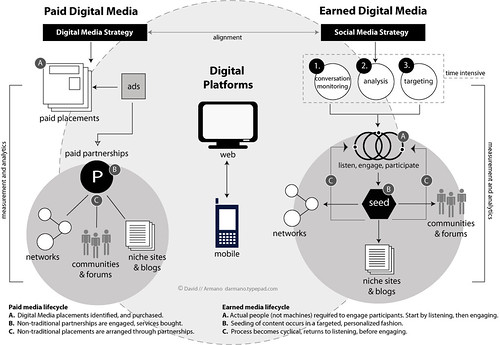
A "media" model composed of paid, owned and earned efforts is nothing new—however it’s useful to think about this landscape in tandem with the different ways we interact and engage which are enabled through technology. There are essentially three forms of digital engagement which can often overlap (engagement in a single initiative can include all three types) but each form can tend to dominate the experience.
-
Earned media nearly always takes place on off domain properties such as forums, blogs, social networks and also mainstream publications. Media is typically earned through word of mouth or unpaid but highly visible results in both search engines and social media referrals. Earned media can also be amplified through outreach initiatives. The core distinction for media which is earned is the absence of overt payment to the property owner for the results.
-
-
-
When there is so much noise, we seek a dense type of signal that is apart from the frey.
-
-
03 Apr 10
-
25 Mar 10
-
19 Mar 10

-
11 Mar 10
-
17 Feb 10
-
12 Feb 10
-
20 Jan 10
-
02 Dec 09
-
02 Nov 09
-
22 Oct 09
-
27 Sep 09
-
04 Sep 09
-
29 Aug 09
-
19 Aug 09
 Rene Lonngren
"David Armano is a senior partner at Dachis Corp. This is my personal blog where I share thoughts + opinions that are solely my own. Logic+Emotion exists at the intersection of business, design + the social web"
-
07 Aug 09
-
06 Aug 09

-
09 Jul 09
-
30 Jun 09
-
22 Jun 09
-
08 Jun 09
-
24 May 09
-
22 May 09

-
21 May 09
-
11 May 09

-
10 May 09
-
23 Apr 09
-
22 Apr 09
-
14 Apr 09
-
11 Apr 09
-
10 Apr 09

-

-
08 Apr 09
 Eddy Badrina
Quoted: Logic+Emotion sits at the intersection of Marketing 2.0, Brand Engagement and Experience Design—where passive consumers are transformed into active participants.
imported Bookmarks business media blog marketing design advertising creativity innovation
-
02 Apr 09
 Marie Perez
David Armano is VP of Experience Design with Critical Mass.
This is his personal blog where he shares thoughts + opinions that are
solely his own. Logic+Emotion exists at the intersection of business +
experience design—where passive consumers becoBlog ExperienceDesign UX Business Marketing Advertising Branding
-
01 Apr 09
-
27 Mar 09
-
11 Mar 09
-
05 Mar 09
 christopher frame
Logic+Emotion sits at the intersection of Marketing 2.0, Brand Engagement and Experience Design—where passive consumers are transformed into active participants.
-
02 Mar 09
 antxon benito
David Armano is VP of Experience Design with Critical Mass. This is his personal blog where he shares thoughts + opinions that are solely his own. Logic+Emotion exists at the intersection of business + experience design—where passive consumers become act
-
20 Jan 09
-
12 Jan 09

-
08 Jan 09
-
05 Jan 09
-
04 Jan 09
-
26 Dec 08
-
15 Dec 08
-
09 Dec 08
-
25 Nov 08
-
19 Nov 08
-
14 Nov 08
-
31 Oct 08
 Are Halland
David Armano is VP of Experience Design with Critical Mass. This is his personal blog
-
28 Oct 08
-
10 Oct 08
 Sam Carrington
David Armano's blog
webdesign web2.0 usability trends socialmedia social ux reference web
-
20 Sep 08
-
05 Sep 08
 Dave Linabury
Logic+Emotion sits at the intersection of Marketing 2.0, Brand Engagement and Experience Design—where passive consumers are transformed into active participants.
Daily blogs marketing design creativity advertising innovation
-
04 Sep 08


Page Comments
Venham Conhecer a Nova Temporada da http://www.jogando.net/mu/ na versão Season6, com muitas Novidades, Eventos, Itens e Muito mais, para os jogadores do http://www.jogando.net/mu/
Super - 10.000x
Pvp 15.000x
Very Easy - 5.000x
Hard 100 x
Extreme 10x
War 1000x
Novo Sever: Phoenix Ep.3 3.000x (32k stats) Acumulativo
Algumas Novidades:
-> Castle Siege, agora o GM da guild vencedora ganha SET exclusivo.
-> Fique logado e ganhe golds, Free ganha 1 GOLD por minuto e VIP 2 GOLDs.
-> Novo mapa Karutan com novos MOBs, drops exclusivos e muita XP.
-> Ganhe Chaos Castle e receba itens ancients.
-> Novo char Range Fighter
-> Novos PVPs
-> Novo Vip Premium
-> Novos Mapas
-> Novos rankings será implantado
-> Nova skin no forum com novas opções.
-> Novas Asas, Ring e Pendats 5 Socket
-> Novos Kits Fusion V2, Shield Pv3, Kit Mysthical e ItensSupremo Diamond v2 (raro) Apenas 100 será vendidos
-> Novos Sets especial de Time de Futebol com o melhor preço
-> Vem ai, 6° MegaUltraSuperHiper Evento de Castle Siege Premiado com mais de 21.000 Jcash + Troféus e Medalhas.
Confira tambem nosso Site de Animes: http://animescloud.com/
-> Curte Animes, então faça uma visita, cadastre-se e divulgue aos seus contatos,..... !!!
>> CADASTRE-SE E GANHE 5 DIAS DE VIP <<
ENTRE JÁ NO SITE : www.jogando.net/mu/index.php?s=cadastrar
By: xXxEmOxXx
Would you like to comment?
Join Diigo for a free account, or sign in if you are already a member.