
This link has been bookmarked by 34 people . It was first bookmarked on 13 Jun 2008, by someone privately.
-
07 Oct 17
 Mr Maher
Title says it all - this is quick and has data to boot. The trick teachers would be having the date is this article on-hand and in their short-term memory ready to use when a student says that they can multi-task.
-
25 Sep 16
-
23 Jun 15
-
22 May 12
 Jason Rhode
The brain cannot multitask: http://t.co/xOfhXxyS #telw12 (via @dwicksspu) #edt6060 #edtechtrends
-
21 May 12

-
28 Apr 12
-
23 Apr 12
-
 Adrienne Michetti
The brain cannot multitask: http://t.co/iQjelR2e #multitasking
-
01 Apr 12
 Carey Pohanka
What John Medina (Brain Rules) says about multitasking. http://t.co/k2sOg8ik
-
17 Mar 12
-
31 Mar 11
 E.J. Sorensen
John Medina's blog highlights how our brains cannot multitask.
-
29 Sep 10

-
Multitasking, when it comes to paying attention, is a myth. The brain naturally focuses on concepts sequentially, one at a time. At first that might sound confusing; at one level the brain does multitask. You can walk and talk at the same time. Your brain controls your heartbeat while you read a book. Pianists can play a piece with left hand and right hand simultaneously. Surely this is multitasking. But I am talking about the brain’s ability to pay attention. It is the resource you forcibly deploy while trying to listen to a boring lecture at school. It is the activity that collapses as your brain wanders during a tedious presentation at work. This attentional ability is not capable of multitasking.
-
To put it bluntly, research shows that we can’t multitask. We are biologically incapable of processing attention-rich inputs simultaneously
-
-
29 Aug 10
-
31 May 10
 Jimmy Baikovicius
This attentional ability is not capable of multitasking. a person who is interrupted takes 50 percent longer to accomplish a task. Not only that, he or she makes up to 50 percent more errors.
multitasking brain research concentration productivity management attention brainrules for:@twitter
-
19 Jan 10
-
09 Dec 09
-
15 Aug 09
-
13 Aug 09
-
12 Aug 09
 Howard Rheingold
Multitasking, when it comes to paying attention, is a myth. The brain naturally focuses on concepts sequentially, one at a time. At first that might sound confusing; at one level the brain does multitask. You can walk and talk at the same time. Your brain controls your heartbeat while you read a book. Pianists can play a piece with left hand and right hand simultaneously. Surely this is multitasking. But I am talking about the brain’s ability to pay attention. It is the resource you forcibly deploy while trying to listen to a boring lecture at school. It is the activity that collapses as your brain wanders during a tedious presentation at work. This attentional ability is not capable of multitasking.
-
Multitasking, when it comes to paying attention, is a myth. The brain naturally focuses on concepts sequentially, one at a time.
-
To put it bluntly, research shows that we can’t multitask. We are biologically incapable of processing attention-rich inputs simultaneously.
-
Here’s why this matters: Studies show that a person who is interrupted takes 50 percent longer to accomplish a task. Not only that, he or she makes up to 50 percent more errors.
-
-
31 Jul 09
 Yassine EL Hassani
Idées clés : L'homme n'est pas multi tache.
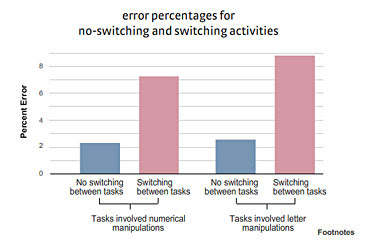
Le multitasking génère 50% d'erreurs en + et 50% de délais en + (cf. graphique)
Passer d'une tache néeccite l'activation de 4 taches par le cerveau
Les personnes qui affirment être multi taches ont simplement une meilleures mémoire que les autres : ils sont capables de retrouver plus rapidement le fil de ce qu'ils faisaient avant la rupture de la tache
Il a tout de même dans cet articles des affirmations contestables ou pas suffisament fouillées et nuancées-
Multitasking, when it comes to paying attention, is a myth. The brain naturally focuses on concepts sequentially, one at a time.
-
Pianists can play a piece with left hand and right hand simultaneously. Surely this is multitasking. But I am talking about the brain’s ability to pay attention.
-
attentional ability is not capable of multitasking.
-
e can’t multitask. We are biologically incapable of processing attention-rich inputs simultaneously
-
people find themselves losing track of previous progress and needing to “start over,” perhaps muttering things like “Now where was I?” each time they switch tasks.
-
The best you can say is that people who appear to be good at multitasking actually have good working memories, capable of paying attention to several inputs one at a time.
-
Studies show that a person who is interrupted takes 50 percent longer to accomplish a task. Not only that, he or she makes up to 50 percent more errors.
-
-
-
06 Jan 09
-
04 Jan 09
-
03 Jan 09
 Bertrand Duperrin
Multitasking, when it comes to paying attention, is a myth. The brain naturally focuses on concepts sequentially, one at a time. At first that might sound confusing; at one level the brain does multitask. You can walk and talk at the same time. Your brain controls your heartbeat while you read a book. Pianists can play a piece with left hand and right hand simultaneously. Surely this is multitasking. But I am talking about the brain’s ability to pay attention. It is the resource you forcibly deploy while trying to listen to a boring lecture at school. It is the activity that collapses as your brain wanders during a tedious presentation at work. This attentional ability is not capable of multitasking.
-
18 Sep 08

-
We are biologically incapable of processing attention-rich inputs simultaneously.
-
Studies show that a person who is interrupted takes 50 percent longer to accomplish a task. Not only that, he or she makes up to 50 percent more errors.
-
-
13 Jun 08
-
24 May 08


Would you like to comment?
Join Diigo for a free account, or sign in if you are already a member.