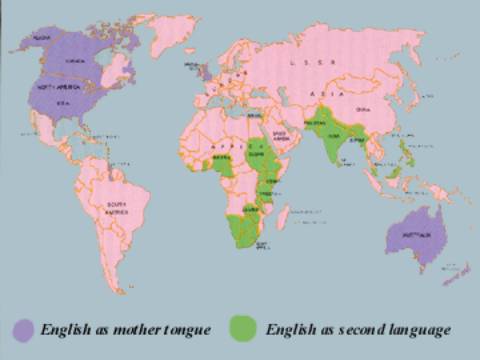
"During the medieval and early modern periods the influence of English spread throughout the British Isles, and from the early seventeenth century onwards its influence began to be felt throughout the world.
The complex processes of exploration, colonization and overseas trade that characterized Britain’s external relations for several centuries became agents for change in the English language. This wasn’t simply through the acquisition of loanwords deriving from languages from every corner of the world, which in many cases only entered English via the languages of other trading and imperial nations such as Spain, Portugal and the Netherlands, but through the gradual development of new varieties of English, each with their own nuances of vocabulary and grammar and their own distinct pronunciations.
More recently still, English has become a lingua franca, a global language, regularly used and understood by many nations for whom English is not their first language. The eventual effects on the English language of both of these developments can only be guessed at today, but there can be little doubt that they will be as important as anything that has happened to English in the past sixteen hundred years."