Skip to main contentdfsdf

Clay Burell

Qingshilu 清實錄 (www.chinaknowledge.de)

"大清聖祖仁皇帝(康熙)實錄 三百卷 Da-Qing Shengzu Ren Huangdi shilu 1661-1722 (Kangxi), ed. 1741"

Shared by Clay Burell, Clay Burell added annotation, 1 save total

  • 大清聖祖仁皇帝(康熙)實錄 三百卷  Da-Qing Shengzu Ren Huangdi shilu  1661-1722 (Kangxi), ed. 1741
Will Richardson
  • Over the last 25 years in Udaipur, we have seen the Shikshantar movement organically evolve into a powerful incubator and weaver for radical educational experiments in Udaipur and around the world.
Will Richardson
  • And the fraying of the social contract is getting worse. Americans express less and less trust in many institutions. Substantial majorities of people say that government, business leaders and the media are purposefully misleading them. In striking contrast to older generations, majorities of younger people say they do not believe that “the American dream” is achievable anymore. The health insurance industry likes to cite polls that show overall satisfaction, but those numbers go down when people get sick and learn what their insurer is and is not willing to do for them.

    Things are much better now than in the 19th century. But there is a similarity to the trajectory and the mood, to the expression of deep powerlessness and alienation.

    Now, however, the country is awash in powerful guns. And some of the new technologies that will be deployed to help preserve order can cut both ways. Thompson’s killer apparently knew exactly where to find his target and at exactly what time. No evidence has emerged that he had access to digital tracking data, but that information is out there on the market. How long before easily built artificial-intelligence-powered drones equipped with facial recognition cameras, rather than hooded men with backpacks, seek targets in cities and towns?

Clay Burell
  • large amounts of Chinese ceramics and Indian rouletted ware remains, also the ruins of stupa at the foot of Bukit Seguntang.
  • Hindu-Buddhist statuary

4 more annotations...

Clay Burell
  • 3. Diction


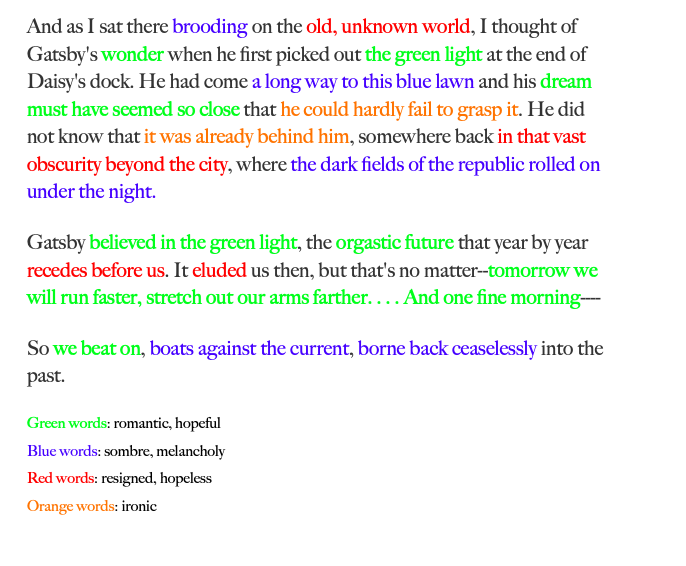
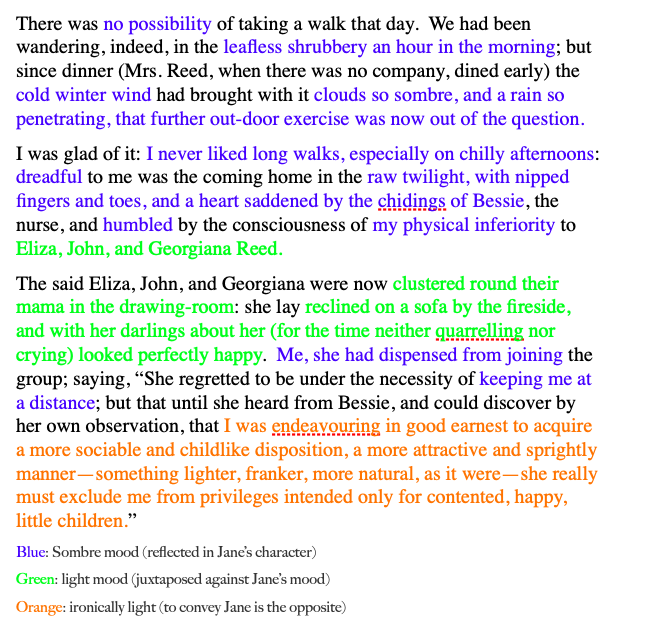
    You’ll often hear that “diction” is just a fancy term for “word choice.” While this is true, it’s also reductive, and it doesn’t capture the full importance of select words in your story. Diction is one of the most important literary devices in prose, as every prose writer will use it.


    Diction is best demonstrated through analyzing a passage of prose, so to see diction in action, let’s take apart the closing paragraphs of The Great Gatsby. 


    literary devices in the great gatsby

6 more annotations...

Clay Burell
    • How to Create Conflict in a Story


      A great story builds conflict and tension in every line. Characters should always be pursuing something they desire and can’t have, whether because of external circumstances or their own internal flaws. As you write and edit your fiction, keep these 5 tips in mind for creating conflict in a story.


      1. Focus on motivation. What drives each character? Why do they get out of bed each morning? What goals do they pursue? Even small, simple goals, like “wanting a vase” or “being thirsty,” can lead to surprising conflicts.
      2.  
      3. Think about fatal flaws. Most characters have some internal problem that prevents them from achieving their goals (hamartia). This problem sits in the character’s blindspot: they don’t realize they have this problem until it’s (almost) too late. What flaw does your protagonist have, and why can’t they acknowledge it?
      4.  
      5. Link flaws to contexts. Often, a character’s flaws are the result of their upbringing and sociopolitical context. The narrator in “The Yellow Wallpaper,” for example, cannot advocate for herself because of society’s sexism. Considering context adds more depth to each character.
      6.  
      7. Let your characters make mistakes. Characters should not be perfect, and an author rarely agrees with every decision a character makes. A character’s fatal flaw should force them to make bad decisions. These bad decisions build tension and bring us towards the climax.
      8.  
      9. Create relationships between internal and external conflict. Internal and external conflict are usually related to one another. In “Sticks,” for example, the narrator’s father is an unkind, miserly control freak (internal) who cannot communicate his feelings (internal, fatal flaw) and thus pushes away everyone he loves (external).
      10.  
       

Clay Burell
  • How to Write Dialogue in a Story: 4 DOs of Dialogue Writing
    • 1. How to Write Dialogue in a Story: Differentiate Each Character


      Each character will have their own style of speaking, and will emphasize different things when they talk.


      Your characters’ dialogue should be like thumbprints, because no two people are alike. Each character will have their own style of speaking, and will emphasize different things when they talk. You can make each character unique by altering the following elements of dialogue style:


      • Sentence length: Some people are verbose and loquacious, others terse and stoic.
      •  
      • Dialogue Punctuation: Do your characters let their sentences linger… or do they ask a lot of questions? Are they really excited all the time?! Or do they interrupt themselves frequently—always remembering something they forgot to mention—struggling to put their complex thoughts into words?
      •  
      • Adjectives/adverbs: Characters that are expressive and verbose tend to use a lot of adjectives and adverbs, whereas characters that are quiet or less expressive might stick to their nouns and verbs.
      •  
      • Spellings and pronunciation: Do your characters omit certain vowels? Do they lisp? The way you write a line of dialogue might reveal a character’s dialect, and adding consistent quirks to a character’s speech will certainly make them more memorable.
      •  
      • Repetitions and emphasis: Do your characters have any catchphrases? Do they use any words or phrases as crutches? Maybe they emphasize words periodically, or have a strange cadence as they speak. We tend to repeat certain words and phrases in our own everyday vocabularies; repetition is also a useful device for writing dialogue in a story.
      •  
       

      You’ve already seen character differentiation from the previous quotes in this article. In this scene from The Catcher in the Rye, notice how differently Holden Caulfield speaks from the young woman he’s talking to—and just how much characterization is implied in their divergent voices:


      “You don’t come from New York, do you?” I said finally. That’s all I could think of.


      “Hollywood,” she said. Then she got up and went over to where she’d put her dress down, on the bed. “Ya got a hanger? I don’t want to get my dress all wrinkly. It’s brand-clean.”


      “Sure,” I said right away. I was only too glad to get up and do something.


      Aside from these two characters being different from one another, Holden speak differently than characters in other works of fiction. Can you imagine Holden Caulfield being Romeo in R&J? He’d say something stupid, like “Juliet’s family are all phonies, but the funny thing is you can’t help but fall half in love with her.”

6 more annotations...

Clay Burell
  • What does “Show, don’t tell” mean? At its root, it means that rather than asserting something for the reader to accept, your writing transmits something for the reader to experience. The writer accomplishes this through a mix of vivid imagery, descriptive verbs, and immersive details.
  • Tell, don’t show: The monster was terrifying.
     
    Show, don’t tell: The towering thing was constantly morphing, tumbling over itself as it drew toward her.

5 more annotations...

Show more items

Diigo is about better ways to research, share and collaborate on information. Learn more »

Join Diigo