
This link has been bookmarked by 173 people . It was first bookmarked on 02 Mar 2006, by Francisca Munoz.
-
16 Mar 12
-
triple
-
triple
-
-
28 Feb 12
-
15 Feb 12
 Robert Verdes
The Resource Description Framework (RDF) is a language for representing information about resources in the World Wide Web. This Primer is designed to provide the reader with the basic knowledge required to effectively use RDF. It introduces the basic concepts of RDF and describes its XML syntax. It describes how to define RDF vocabularies using the RDF Vocabulary Description Language, and gives an overview of some deployed RDF applications. It also describes the content and purpose of other RDF specification documents.
-
information about resources
-
particularly intended for representing metadata
-
title, author, and modification date
-
copyright and licensing information
-
However, by generalizing the concept of a "Web resource", RDF can also be used to represent information about things that can be identified on the Web, even when they cannot be directly retrieved on the Web.
-
availability schedule
-
items available from on-line shopping facilities
-
RDF provides a common framework for expressing this information
-
The ability to exchange information between different applications means that the information may be made available to applications other than those for which it was originally created.
-
describing
-
identifying
-
suitable for processing by machines
-
a system of machine-processable identifiers
-
a machine-processable language
-
All URIs share the property that different persons or organizations can independently create them
-
To be more precise, RDF uses URI references [URIS].
-
Literals may not be used as subjects or predicates in RDF statements.
-
what is fundamental to RDF is the graph model of the statements
-
RDF refers to a set of URIrefs (particularly a set intended for a specific purpose) as a vocabulary
-
a common namespace URIref will be chosen for all terms in a vocabulary, typically a URIref under the control of whoever is defining the vocabulary.
-
For instance,
-
http://www.example.org/terms/for terms it uses in its business -
RDF uses this same approach to define its own vocabulary of terms with special meanings in RDF. The URIrefs in this RDF vocabulary all begin with
http://www.w3.org/1999/02/22-rdf-syntax-ns#, conventionally associated with the QName prefixrdf:. The RDF Vocabulary Description Language (described in Section 5) defines an additional set of terms having URIrefs that begin withhttp://www.w3.org/2000/01/rdf-schema#, conventionally associated with the QName prefixrdfs:. -
http://www.example.org/staffid/to identify its employees -
The RDF model only recognizes full URIrefs; it does not "look inside" URIrefs or use any knowledge about their structure. In particular, RDF does not assume there is any relationship between URIrefs just because they have a common leading prefix
-
Moreover, there is nothing that says that URIrefs with different leading prefixes cannot be considered part of the same vocabulary.
-
sometimes an organization will use a vocabulary's namespace URIref as the URL of a Web resource that provides further information about that vocabulary.
-
RDF imposes no restrictions on how many statements using a given URIref as predicate can appear in a graph to describe the same resource.
-
the advantages of using URIrefs as RDF's basic way of identifying things.
-
instead of identifying the creator of the Web page by the character string "John Smith", he has been assigned a URIref
-
the creator of the page is not the character string "John Smith", or any one of the thousands of people named John Smith, but the particular John Smith associated with that URIref (whoever created the URIref defines the association)
-
Moreover, since there is a URIref to refer to John Smith, he is a full-fledged resource, and additional information can be recorded about him, simply by adding additional RDF statements with John's URIref as the subject.
-
RDF uses URIrefs as predicates in RDF statements.
-
Using URIrefs to identify properties is important for a number of reasons.
-
it distinguishes the properties one person may use from different properties someone else may use that would otherwise be identified by the same character string
-
For instance, in the example in Figure 4, example.org uses "name" to mean someone's full name written out as a character string literal (e.g., "John Smith"), but someone else may intend "name" to mean something different (e.g., the name of a variable in a piece of program text). A program encountering "name" as a property identifier on the Web (or merging data from multiple sources) would not necessarily be able to distinguish these uses.
-
Also, using URIrefs to identify properties enables the properties to be treated as resources themselves. Since properties are resources, additional information can be recorded about them (e.g., the English description of what example.org means by "name"), simply by adding additional RDF statements with the property's URIref as the subject.
-
RDF's use of URIrefs does not solve all identification problems because, for example, people can still use different URIrefs to refer to the same thing.
-
However, even when synonyms are created, the fact that these different URIrefs are used in the commonly-accessible "Web space" provides the opportunity both to identify equivalences among these different references, and to migrate toward the use of common references.
-
it is important to distinguish between any meaning that RDF itself associates with terms (such as
dc:creatorin the previous example) used in RDF statements and additional, externally-defined meaning that people (or programs written by those people) might associate with those terms. -
Moreover, based on their understanding of a given vocabulary, people can write RDF applications to behave in accordance with the special meanings assigned to URIrefs from that vocabulary, even though that meaning will not be accessible to RDF applications not written in that way.
-
suppose John's address needed to be recorded as a structure consisting of separate street, city, state, and postal code values
-
information like this is represented in RDF by considering the aggregate thing to be described (like John Smith's address) as a resource, and then making statements about that new resource.
-
This way of representing structured information in RDF can involve generating numerous "intermediate" URIrefs such as
exaddressid:85740to represent aggregate concepts such as John's address. Such concepts may never need to be referred to directly from outside a particular graph, and hence may not require "universal" identifiers. -
This blank node serves its purpose in the drawing without needing a URIref, since the node itself provides the necessary connectivity between the various other parts of the graph.
-
triples use blank node identifiers, having the form
_:name, to indicate the presence of blank nodes. -
In a triples representation of a graph, each distinct blank node in the graph is given a different blank node identifier.
-
Unlike URIrefs and literals, blank node identifiers are not considered to be actual parts of the RDF graph
-
Blank node identifiers also have significance only within the triples representing a single graph
-
If it is expected that a node in a graph will need to be referenced from outside the graph, a URIref should be assigned to identify it.
-
blank node identifiers may not be used as predicates in triples
-
an important aspect of RDF: RDF directly represents only binary relationships
-
Blank nodes also provide a way to more accurately make statements about resources that may not have URIs, but that are described in terms of relationships with other resources that do have URIs.
-
For example, when making statements about a person, say Jane Smith, it may seem natural to use a URI based on that person's email address as her URI, e.g.,
mailto:jane@example.org. However, this approach can cause problems. For example, it may be necessary to record information both about Jane's mailbox (e.g., the server it is on) as well as about Jane herself (e.g., her current physical address), and using a URIref for Jane based on her email address makes it difficult to know whether it is Jane or her mailbox that is being described. The same problem exists when a company's Web page URL, sayhttp://www.example.com/, is used as the URI of the company itself. Once again, it may be necessary to record information about the Web page itself (e.g., who created it and when) as well as about the company, and usinghttp://www.example.com/as an identifier for both makes it difficult to know which of these is the actual subject. -
When Jane herself does not have a URI, a blank node provides a more accurate way of modeling this situation. Jane can be represented by a blank node, and that blank node used as the subject of a statement with
exterms:mailboxas the property and the URIrefmailto:jane@example.orgas its value. The blank node could also be described with anrdf:typeproperty having a value ofexterms:Person(types are discussed in more detail in the following sections), anexterms:nameproperty having a value of"Jane Smith", and any other descriptive information that might be useful, -
the blank node can be read as "there is a resource".
-
In practice, using blank nodes instead of URIrefs in these cases does not change the way this kind of information is handled very much.
-
Using a blank node to represent this "someone" is just a more accurate way to represent the real world situation.
-
some RDF-based schema languages allow specifying that certain properties are unique identifiers of the resources they describe.
-
Using blank nodes in this way can also help avoid the use of literals in what might be inappropriate situations.
-
Finally, the example above giving Jane's age as 26 illustrates the fact that sometimes the value of a property may appear to be simple, but actually may be more complex. In this case, Jane's age is actually 26 years, but the units information (years) is not explicitly given. Such information is often omitted in contexts where it can be safely assumed that anyone accessing the property value will understand the units being used. However, in the wider context of the Web, it is generally not safe to make this assumption.
-
The common practice in programming languages or database systems is to provide this additional information about how to interpret a literal by associating a datatype with the literal
-
An RDF typed literal is formed by pairing a string with a URIref that identifies a particular datatype. This results in a single literal node in the RDF graph with the pair as the literal. The value represented by the typed literal is the value that the specified datatype associates with the specified string.
-
The datatypes used in typed literals are defined externally to RDF, and identified by their datatype URIs.
-
RDF typed literals simply provide a way to explicitly indicate, for a given literal, what datatype should be used to interpret it.
-
There is one exception: RDF defines a built-in datatype with the URIref
rdf:XMLLiteralto represent XML content as a literal value. -
Type conversions would still be required when moving information between systems having different sets of datatypes
-
RDF datatype concepts are based on a conceptual framework from XML Schema datatypes [XML-SCHEMA2], as described in RDF Concepts and Abstract Syntax [RDF-CONCEPTS]. This conceptual framework defines a datatype as consisting of:
-
A set of values, called the value space,
-
A set of character strings, called the lexical space,
-
A lexical-to-value mapping
-
Not all datatypes are suitable for use in RDF. For a datatype to be suitable for use in RDF, it must conform to the conceptual framework just described.
-
For example,
xsd:durationdoes not have a well-defined value space, andxsd:QNamerequires an enclosing XML document context. Lists of the XML Schema datatypes that are currently considered suitable and unsuitable for use in RDF are given in [RDF-SEMANTICS]. -
the actual interpretation of a typed literal appearing in an RDF graph (e.g., determining the value it denotes) must be performed by software that is written to correctly process not only RDF, but the typed literal's datatype as well.
-
even when a URIref does identify a datatype, RDF itself does not define the validity of pairing that datatype with a particular literal. This validity can only be determined by software written to correctly process that particular datatype.
-
RDF draws upon ideas from knowledge representation, artificial intelligence, and data management, including Conceptual Graphs, logic-based knowledge representation, frames, and relational databases. Some possible sources of background information on these subjects include [SOWA], [CG], [KIF], [HAYES], [LUGER], and [GRAY].
-
rdf:about="http://www.example.org/index.html"
-
rdf:resource="http://www.example.org/staffid/85740"
-
Specifically, a statement with a blank node as its subject can be written in RDF/XML using an
rdf:Descriptionelement with anrdf:nodeIDattribute instead of anrdf:aboutattribute. Similarly, a statement with a blank node as its object can be written using a property element with anrdf:nodeIDattribute instead of anrdf:resourceattribute. -
rdf:nodeID="abc"
-
rdf:nodeID="abc"
-
rdf:datatype= "http://www.w3.org/2001/XMLSchema#date"
-
XML entities can be used in RDF/XML to improve readability in such cases, by providing an additional abbreviation facility for URIrefs. Essentially, an XML entity declaration associates a name with a string of characters. When the entity name is referenced elsewhere within an XML document, XML processors replace the reference with the corresponding string. For example, the
ENTITYdeclaration (specified as part of aDOCTYPEdeclaration at the beginning of the RDF/XML document): -
<!DOCTYPE rdf:RDF [<!ENTITY xsd "http://www.w3.org/2001/XMLSchema#">]>
-
"&xsd;date"
-
Although RDF does not specify or control how URIrefs are assigned to resources, sometimes it is desirable to achieve the effect of assigning URIrefs to resources that are part of an organized group of resources.
-
An important difference from previous examples is that, in line 5, the
rdf:Descriptionelement has anrdf:IDattribute instead of anrdf:aboutattribute. Usingrdf:IDspecifies a fragment identifier, given by the value of therdf:IDattribute (item10245in this case, which might be the catalog number assigned by example.com), as an abbreviation of the complete URIref of the resource being described. The fragment identifieritem10245will be interpreted relative to a base URI, in this case, the URI of the containing catalog document. The full URIref for the tent is formed by taking the base URI (of the catalog), and appending the character "#" (to indicate that what follows is a fragment identifier) and thenitem10245to it, giving the absolute URIrefhttp://www.example.com/2002/04/products#item10245. -
it defines a name which must be unique relative to the current base URI
-
Any other RDF/XML within this catalog could refer to the tent by using either the absolute URIref
http://www.example.com/2002/04/products#item10245, or the relative URIref#item10245 -
the URIref of the tent could also be given by specifying
rdf:about="#item10245"in the catalog entry (i.e., by specifying the relative URIref directly) instead ofrdf:ID="item10245" -
However, using
rdf:IDprovides an additional check when assigning a set of distinct names -
RDF located outside the catalog could refer to this tent by using the full URIref
-
the effect of assigning URIrefs to resources in RDF can be achieved by combining a process (external to RDF) that identifies a single document (the catalog in this case) as the source for descriptions of those resources, with the use of relative URIrefs in descriptions of those resources within that document.
-
basic architectural principles of the Web, which is that anyone should be able to freely add information about an existing resource, using any vocabulary they please
-
relative URIrefs such as
#item10245will be interpreted relative to a base URI. By default, this base URI would be the URI of the resource in which the relative URIref is used. However, in some cases it is desirable to be able to explicitly specify this base URI. -
RDF/XML supports XML Base [XML-BASE], which allows an XML document to specify a base URI other than the URI of the document itself.
-
xml:base="http://www.example.com/2002/04/products"
-
This idea of things being classified into different kinds or categories is similar to the programming language concept of objects having different types or classes. RDF supports this concept by providing a predefined property,
rdf:type. -
<rdf:type rdf:resource="http://www.example.com/terms/Tent"/>
-
If example.com had described these classes as part of the product catalog itself, the relative URIref
#Tentcould have been used to refer to it. -
Such resources are called typed nodes in the graph, or typed node elements in the RDF/XML.
-
RDF/XML provides a special abbreviation for describing these typed nodes.
-
<exterms:Tent rdf:ID="item10245">
-
Since a resource may be described as an instance of more than one class, a resource may have more than one
rdf:typeproperty. -
rdf:Bagrdf:Seqrdf:Alt
-
The members of the container can be described by defining a container membership property
-
rdf:_n
-
t is important to understand that while these types of containers are described using predefined RDF types and properties, any special meanings associated with these containers, e.g., that the members of an Alt container are alternative values, are only intended meanings.
-
RDF/XML provides
rdf:lias a convenience element to avoid having to explicitly number each membership property. -
Since no URIref is specified, the Bag is a blank node.
-
Alt containers are frequently used in conjunction with language tagging. (RDF/XML permits the use of the
xml:langattribute defined in [XML] to indicate that the element content is in a specified language. -
Sometimes there are clear alternatives to using these RDF container types. For example, a relationship between a particular resource and a group of other resources could be indicated by making the first resource the subject of multiple statements using the same property.
-
The choice of which to use in a given situation should be made with this in mind.
-
Consider as an example the relationship between a writer and her publications, as in the sentence:
Sue has written "Anthology of Time", "Zoological Reasoning", and "Gravitational Reflections".
-
On the other hand, the sentence:
The resolution was approved by the Rules Committee, having members Fred, Wilma, and Dino.
says that the committee as a whole approved the resolution; it does not necessarily state that each committee member individually voted in favor of the resolution
-
it is important to understand that the statements are not constructing containers, as in a programming language data structure. Instead, the statements are describing containers (groups of things) that presumably exist.
-
RDF imposes no "well-formedness" conditions on the use of the container vocabulary
-
RDF applications that require containers to be "well-formed" should be written to check that the container vocabulary is being used appropriately, in order to be fully robust.
-
A limitation of the containers described in Section 4.1 is that there is no way to close them, i.e., to say "these are all the members of the container".
-
RDF provides support for describing groups containing only the specified members, in the form of RDF collections.
-
properties
rdf:firstandrdf:rest -
type
rdf:List -
resource
rdf:nil -
each member of the collection, such as
s:Amy, is the object of anrdf:firstproperty whose subject is a resource (a blank node in this example) that represents a list. This list resource is linked to the rest of the list by anrdf:restproperty. The end of the list is indicated by therdf:restproperty having as its object the resourcerdf:nil -
Each of the blank nodes forming this list structure is implicitly of type
rdf:List(that is, each of these nodes implicitly has anrdf:typeproperty whose value is the predefined typerdf:List), -
The RDF Schema language [RDF-VOCABULARY] defines the properties
rdf:firstandrdf:restas having subjects of typerdf:List, so the information about these nodes being lists can generally be inferred, rather than the correspondingrdf:typetriples being written out all the time. -
RDF/XML provides a special notation to make it easy to describe collections
-
RDF/XML provides a special notation to make it easy to describe collections using graphs of this form.
-
rdf:parseType="Collection"
-
RDF imposes no "well-formedness" conditions on the use of the collection vocabulary
-
As a result, RDF applications that require collections to be well-formed should be written to check that the collection vocabulary is being used appropriately, in order to be fully robust. In addition, languages such as OWL [OWL], which can define additional constraints on the structure of RDF graphs, can rule out some of these cases.
-
RDF provides a built-in vocabulary intended for describing RDF statements. A description of a statement using this vocabulary is called a reification of the statement.
-
type
rdf:Statement, and the propertiesrdf:subject,rdf:predicate, andrdf:object. -
care is needed in using it, because it is easy to imagine that the vocabulary defines some things that are not actually defined.
-
The conventional use of the RDF reification vocabulary always involves describing a statement using four statements in this pattern; the four statements are sometimes referred to as a "reification quad" for this reason.
-
exproducts:triple12345 dc:creator exstaff:85740 .
-
rdf:IDcan also be used in a property element to automatically produce a reification of the triple that the property element generates -
rdf:ID="triple12345"
-
care is needed when using the RDF reification vocabulary
-
conventions
-
assumptions
-
The lack of a built-in means for assigning URIrefs to statements does not mean that "provenance" information of this kind cannot be expressed in RDF, just that it cannot be done using only the meaning RDF associates with the reification vocabulary.
-
For example, if an RDF document (say, a Web page) has a URI, statements could be made about the resource identified by that URI and, based on some application-dependent understanding of how those statements should be interpreted, an application could act as if those statements "distribute" over (apply equally to) all the statements in the document. Also, if some mechanism exists (outside of RDF) to assign URIs to individual RDF statements, then statements could certainly be made about those individual statements, using their URIs to identify them. However, in these cases, it would also not be strictly necessary to use the reification vocabulary in the conventional way.
-
in some cases one of the parts of the structured value is often thought of as the "main" value, with the other parts of the relation providing additional contextual or other information that qualifies the main value.
-
In the RDF model a qualified property value of this kind can be considered as simply another kind of structured value.
-
RDF provides a predefined
rdf:valueproperty to describe the main value (if there is one) of a structured value. -
rdf:parseType="Resource"
-
rdf:value
-
An
rdf:parseType="Resource"attribute is used to indicate that the contents of an element are to be interpreted as the description of a new (blank node) resource, without actually having to write a nestedrdf:Descriptionelement. In this case, therdf:parseType="Resource"attribute used in theexterms:weightproperty element indicates that a blank node is to be created as the value of theexterms:weightproperty, and that the enclosed elements (rdf:valueandexterms:units) describe properties of that blank node. -
There is no need to use
rdf:valuefor these purposes ( -
rdf:valueis simply provided as a convenience for use in these commonly-occurring situations. -
Sometimes the value of a property needs to be a fragment of XML, or text that might contain XML markup.
-
Giving an element the attribute
rdf:parseType="Literal"indicates that the contents of the element are to be interpreted as an XML fragment. -
rdf:parseType="Literal"
-
Contextual attributes, such as
xml:langandxml:baseare not inherited from the RDF/XML document, and, if required, must, as shown in the example, be explicitly specified in the XML fragment. -
RDF user communities also need the ability to define the vocabularies (terms) they intend to use in those statements, specifically, to indicate that they are describing specific kinds or classes of resources, and will use specific properties in describing those resources.
-
such classes and properties are described as an RDF vocabulary, using extensions to RDF provided by the RDF Vocabulary Description Language 1.0: RDF Schema [RDF-VOCABULARY], referred to here as RDF Schema.
-
it provides the facilities needed to describe such classes and properties, and to indicate which classes and properties are expected to be used together
-
RDF Schema provides a type system for RDF
-
RDF Schema allows resources to be defined as instances of one or more classes. In addition, it allows classes to be organized in a hierarchical fashion;
-
RDF class and property descriptions do not create a straightjacket into which information must be forced
-
rdfs: -
A class in RDF Schema corresponds to the generic concept of a Type or Category, somewhat like the notion of a class in object-oriented programming languages such as Java.
-
rdfs:Resource
-
rdfs:subClassOf
-
rdf:type
-
rdfs:Class
-
The resources that belong to a class are called its instances.
-
rdf:type rdfs:Class
-
rdf:type ex:MotorVehicle
-
a common convention that class names are written with an initial uppercase letter, while property and instance names are written with an initial lowercase letter
-
eparate vocabularies for classes of things, and instances of things
-
rdfs:subClassOf ex:MotorVehicle
-
RDF software written to understand the RDF Schema vocabulary can infer the additional information that
exthings:companyVanis also an instance ofex:MotorVehicle -
RDF itself does not define the special meaning of terms from the RDF Schema vocabulary such as
rdfs:subClassOf. -
The
rdfs:subClassOfproperty is transitive. -
A class may be a subclass of more than one class (for example,
ex:MiniVanmay be a subclass of bothex:Vanandex:PassengerVehicle). -
RDF Schema defines both the subjects and objects of statements that use the
rdfs:subClassOfproperty to be resources of typerdfs:Class -
xml:base="http://example.org/schemas/vehicles">
-
rdf:IDis useful here because it both abbreviates the URIrefs, and also provides an additional check that the value of therdf:IDattribute is unique against the current base URI -
Relative URIrefs based on these names can then be used in other class definitions within the same schema (e.g., as
#MotorVehicleis used in the description of the other classes). -
xmlns:ex="http://example.org/schemas/vehicles#"
-
In addition to describing the specific classes of things they want to describe, user communities also need to be able to describe specific properties that characterize those classes of things
-
RDF Schema properties
rdfs:domain,rdfs:range, andrdfs:subPropertyOf -
RDF class
rdf:Property -
rdf:type rdf:Property
-
RDF Schema also provides vocabulary for describing how properties and classes are intended to be used together in RDF data.
-
The
rdfs:rangeproperty is used to indicate that the values of a particular property are instances of a designated class. -
rdfs:range ex:Person
-
If
ex:hasMotherhas more than one range property, say one specifyingex:Personas its range, and another specifyingex:Femaleas its range, this says that the values of theex:hasMotherproperty are resources that are instances of all of the classes specified as the ranges, i.e., that any value ofex:hasMotheris both aex:Femaleand aex:Person. -
The
rdfs:rangeproperty can also be used to indicate that the value of a property is given by a typed literal -
rdfs:range xsd:integer
-
it is often useful to explicitly state that a given URIref identifies a datatype. This can be done using the RDF Schema class
rdfs:Datatype. -
rdf:type rdfs:Datatype
-
The
rdfs:domainproperty is used to indicate that a particular property applies to a designated class. -
rdfs:domain ex:Book
-
RDF statements using the
ex:authorproperty have instances ofex:Bookas subjects. -
If
exterms:weighthas more than one domain property, say one specifyingex:Bookas the domain and another one specifyingex:MotorVehicleas the domain, this says that any resource that has aexterms:weightproperty is an instance of all of the classes specified as the domains, i.e., that any resource that has aexterms:weightproperty is both aex:Bookand aex:MotorVehicle(illustrating the need for care in specifying domains and ranges). -
RDF Schema provides a way to specialize properties as well as classes. This specialization relationship between two properties is described using the predefined
rdfs:subPropertyOfproperty. -
rdfs:subPropertyOf ex:driver
-
The meaning of this
rdfs:subPropertyOfrelationship is that if an instanceexstaff:fredis anex:primaryDriverof the instanceex:companyVan, then RDF Schema definesexstaff:fredas also being anex:driverofex:companyVan. -
A property may be a subproperty of zero, one or more properties.
-
All RDF Schema
rdfs:rangeandrdfs:domainproperties that apply to an RDF property also apply to each of its subproperties. -
In RDF, on the other hand, property descriptions are, by default, independent of class definitions, and have, by default, global scope
-
Another result of the global scope of RDF property descriptions is that it is not possible in an RDF schema to define a specific property as having locally-different ranges depending on the class of the resource it is applied to. For example
-
However, while such locally-different ranges cannot be defined in RDF Schema, they can be defined in some of the richer schema languages discussed in Section 5.5.
-
Another important difference is that RDF Schema descriptions are not necessarily prescriptive in the way programming language type declarations typically are.
-
For example, if a programming language declares a class
Bookwith anauthorattribute having values of typePerson, this is usually interpreted as a group of constraints. The language will not allow the creation of an instance ofBookwithout anauthorattribute, and it will not allow an instance ofBookwith anauthorattribute that does not have aPersonas its value. Moreover, ifauthoris the only attribute defined for classBook, the language will not allow an instance ofBookwith some other attribute.RDF Schema, on the other hand, provides schema information as additional descriptions of resources, but does not prescribe how these descriptions should be used by an application. For example, suppose an RDF schema states that an
ex:authorproperty has anrdfs:rangeof classex:Person. This is simply an RDF statement that RDF statements containingex:authorproperties have instances ofex:Personas objects. -
One application might interpret this statement as specifying part of a template for RDF data it is creating, and use it to ensure that any
ex:authorproperty has a value of the indicated (ex:Person) class. That is, this application interprets the schema description as a constraint in the same way that a programming language might. However, another application might interpret this statement as providing additional information about data it is receiving, information which may not be provided explicitly in the original data. For example, this second application might receive some RDF data that includes anex:authorproperty whose value is a resource of unspecified class, and use this schema-provided statement to conclude that the resource must be an instance of classex:Person. A third application might receive some RDF data that includes anex:authorproperty whose value is a resource of classex:Corporation, and use this schema information as the basis of a warning that "there may be an inconsistency here, but on the other hand there may not be". Somewhere else there may be a declaration that resolves the apparent inconsistency (e.g., a declaration to the effect that "a Corporation is a (legal) Person"). -
In other words, statements in an RDF schema are always descriptions
-
the
rdfs:commentproperty can be used to provide a human-readable description of a resource. -
rdfs:labelproperty -
rdfs:comment
-
rdfs:commentproperty -
rdfs:seeAlsoproperty -
rdfs:isDefinedByproperty -
- cardinality constraints on properties, e.g., that a Person has exactly one biological father.
- specifying that a given property (such as
ex:hasAncestor) is transitive, e.g., that if Aex:hasAncestorB, and Bex:hasAncestorC, then Aex:hasAncestorC. - specifying that a given property is a unique identifier (or key) for instances of a particular class.
- specifying that two different classes (having different URIrefs) actually represent the same class.
- specifying that two different instances (having different URIrefs) actually represent the same individual.
- specifying constraints on the range or cardinality of a property that depend on the class of resource to which a property is applied, e.g., being able to say that for a soccer team the
ex:hasPlayersproperty has 11 values, while for a basketball team the same property should have only 5 values. - the ability to describe new classes in terms of combinations (e.g., unions and intersections) of other classes, or to say that two classes are disjoint (i.e., that no resource is an instance of both classes).
RDF Schema provides basic capabilities for describing RDF vocabularies, but additional capabilities are also possible, and can be useful. These capabilities may be provided through further development of RDF Schema, or in other languages based on RDF. Other richer schema capabilities that have been identified as useful (but that are not provided by RDF Schema) include:
The additional capabilities mentioned above, in addition to others, are the targets of ontology languages such as DAML+OIL [DAML+OIL] and OWL [OWL].
-
The Dublin Core is a set of "elements" (properties) for describing documents (and hence, for recording metadata).
-
The Dublin Core metadata set is intended to be suitable for use by resource discovery tools on the Internet, such as the "Webcrawlers" employed by popular World Wide Web search engines. In addition, the Dublin Core is meant to be sufficiently simple to be understood and used by the wide range of authors and casual publishers who contribute information to the Internet. Dublin Core elements have become widely used in documenting Internet resources
-
Also, as a matter of interest, accessing http://purl.org/dc/elements/1.1/ (the namespace URI used to identify the Dublin Core vocabulary in this example) in a Web browser (as of the current writing) will retrieve an RDF Schema declaration for [DC].
-
omputer languages and file formats do not always make explicit provision for embedding metadata with the data it describes. In many cases, the metadata has to be specified as a separate resource and explicitly linked to the data
-
However, applications and languages are increasingly making explicit provision for embedding metadata directly with the data. For example, the W3C's Scalable Vector Graphics language [SVG] (another XML-based language) provides an explicit
metadataelement for recording metadata along with other SVG data. -
PRISM: Publishing Requirements for Industry Standard Metadata [PRISM] is a metadata specification developed in the publishing industry. Magazine publishers and their vendors formed the PRISM Working Group to identify the industry's needs for metadata and define a specification to meet them. Publishers want to use existing content in many ways in order to get a greater return on the investment made in creating it. Converting magazine articles to HTML for posting on the Web is one example. Licensing it to aggregators like LexisNexis is another. All of these are "first uses" of the content; typically they all go live at the time the magazine hits the stands. The publishers also want their content to be "evergreen". It might be used in new issues, such as in a retrospective article. It could be used by other divisions in the company, such as in a book compiled from the magazine's photos, recipes, etc. Another use is to license it to outsiders, such as in a reprint of a product review, or in a retrospective produced by a different publisher. This overall goal requires a metadata approach that emphasizes discovery, rights tracking, and end-to-end metadata.
-
To assist discovery, PRISM provides properties to describe the topics, formats, genre, origin, and contexts of a resource. It also provides means for categorizing resources using multiple subject description taxonomies.
-
PRISM provides elements for basic tracking of such rights. A separate vocabulary defined in the PRISM specification supports description of places, times, and industries where content may or may not be used.
-
An important feature of the PRISM specification is its use of other existing specifications. Rather than create an entirely new thing, the group decided to use existing specifications as much as possible, and only define new things where needed. For this reason, the PRISM specification uses XML, RDF, Dublin Core, and well as various ISO formats and vocabularies.
-
PRISM also augments the Dublin Core to allow more detailed descriptions. The augmentations are defined as three new vocabularies, generally cited using the prefixes
prism:,pcv:, andprl:. -
Best practice is to code the articles with subject terms from a "controlled vocabulary". The vocabulary should provide as many synonyms as possible for its terms in the vocabulary.
-
No one person or organization controls who makes URIs or how they can be used.
-
People sometimes use RDF together with a convention that, when a URIref is used to identify an RDF resource, a page containing descriptive information about that resource will be placed on the Web "at" that URI
-
-
05 Feb 12
-
Literals may not be used as subjects or predicates in RDF statements
-
In drawing RDF graphs, nodes that are URIrefs are shown as ellipses, while nodes that are literals are shown as boxes.
-
-
30 Jan 12
-
19 Jan 12
-
12 Sep 11
-
24 Jul 11
-
12 Jul 11
 Phelim Bradley
This is what User:Phelimb thinks of this glossary item. Although he accepts that it is the "same as" the Primary Glossary item his format etc differs in some way. User may also differ in which url best describes the data. Any user may add [[www.phel.im|ex
uniqueID:RDF item_license:CC-BY-NC-SA item_from_www.dlib.indiana.edu_~jenlrile_ glossary_item delicious
-
05 Jul 11
-
09 May 11
-
representing inf
-
-
20 Apr 11
-
This Primer is designed to provide the reader with the basic knowledge required to effectively use RDF.
-
The Resource Description Framework (RDF) is a language for representing information about resources in the World Wide Web. It is particularly intended for representing metadata about Web resources, such as the title, author, and modification date of a Web page, copyright and licensing information about a Web document, or the availability schedule for some shared resource.
-
RDF is intended for situations in which this information needs to be processed by applications, rather than being only displayed to people.
-
- What does RDF look like?
- What information can RDF represent?
- How is RDF information created, accessed, and processed?
- How can existing information be combined with RDF?
This Primer is intended to provide an introduction to RDF and describe some existing RDF applications, to help information system designers and application developers understand the features of RDF and how to use them. In particular, the Primer is intended to answer such questions as:
-
RDF is about making machine-processable statements.
-
a system of machine-processable identifiers for identifying a subject, predicate, or object in a statement without any possibility of confusion
-
a machine-processable language
-
The Web provides a more general form of identifier for these purposes, called the Uniform Resource Identifier (URI). URLs are a particular kind of URI.
-
RDF uses URIs as the basis of its mechanism for identifying the subjects, predicates, and objects in statements.
-
To be more precise, RDF uses URI references [URIS]. A URI reference (or URIref) is a URI, together with an optional fragment identifier at the end. For example, the URI reference
http://www.example.org/index.html#section2consists of the URIhttp://www.example.org/index.htmland (separated by the "#" character) the fragment identifierSection2. -
To represent RDF statements in a machine-processable way, RDF uses the Extensible Markup Language [XML].
-
In drawing RDF graphs, nodes that are URIrefs are shown as ellipses, while nodes that are literals are shown as boxes.
-
-
08 Dec 10
-
04 Dec 10
-
03 Dec 10
-
- classes are disjoint (i.e., that no resource is an instance of both classes).
The additional capabilities mentioned above, in addition to others, are the targets of ontology languages such as DAML+OIL [DAML+OIL] and OWL [OWL]. Both these languages are based on RDF and RDF Schema (and both currently provide all the additional capabilities mentioned above). The intent of such languages is to provide additional machine-processable semantics for resources, that is, to make the machine representations of resources more closely resemble their intended real world counterparts. While such capabilities are not necessarily needed to build useful applications using RDF (see Section 6 for a description of a number of existing RDF applications), the development of such languages is a very active subject of work as part of the development of the Semantic Web.
-
-
27 Nov 10
-
11 Nov 10
 Janos Haits
Resource Description Framework (RDF) is a language for representing information about resources in the World Wide Web. This Primer is designed to provide the reader with the basic knowledge required to effectively use RDF. It introduces the basic concepts of RDF and describes its XML syntax. It describes how to define RDF vocabularies using the RDF Vocabulary Description Language, and gives an overview of some deployed RDF applications. It also describes the content and purpose of other RDF specification documents.
rdf primer w3c semanticweb metadata semantic xml web3.0 semweb web
-
08 Sep 10
-
14 Jul 10
-
17 Jun 10

-
14 Jun 10
-
19 May 10
-
4.1 RDF Containers
-
A Bag (a resource having type
rdf:Bag) -
where there is no significance in the order of the members.
-
Sequence or Seq
-
where the order of the members is significant.
-
Alternative or Alt
-
a group of resources or literals that are alternatives (typically for a single value of a property)
-
The element name
rdf:liwas chosen to be mnemonic with the term "list item" from HTML
-
-
05 May 10
-
20 Apr 10
-
prefix
rdf:, namespace URI:http://www.w3.org/1999/02/22-rdf-syntax-ns#
prefixrdfs:, namespace URI:http://www.w3.org/2000/01/rdf-schema#
prefixdc:, namespace URI:http://purl.org/dc/elements/1.1/
prefixowl:, namespace URI:http://www.w3.org/2002/07/owl#
prefixex:, namespace URI:http://www.example.org/(orhttp://www.example.com/)
prefixxsd:, namespace URI:http://www.w3.org/2001/XMLSchema#Obvious variations on the "example" prefix
ex:will also be used as needed in the examples, for instance,
prefixexterms:, namespace URI:http://www.example.org/terms/(for terms used by an example organization),
prefixexstaff:, namespace URI:http://www.example.org/staffid/(for the example organization's staff identifiers),
prefixex2:, namespace URI:http://www.domain2.example.org/(for a second example organization), and so on.
-
-
08 Feb 10
-
04 Jan 10
-
24 Nov 09
-
12 Nov 09
-
12 Oct 09
-
24 Sep 09
-
10 Aug 09
 Thieme Hennis
RDF primer: introduction to the semantic web and the RDF standard for web resources.
-
The Resource Description Framework (RDF) is a language for representing information about resources in the World Wide Web. It is particularly intended for representing metadata about Web resources, such as the title, author, and modification date of a Web page, copyright and licensing information about a Web document, or the availability schedule for some shared resource.
-
RDF is intended for situations in which this information needs to be processed by applications, rather than being only displayed to people. RDF provides a common framework for expressing this information so it can be exchanged between applications without loss of meaning. Since it is a common framework, application designers can leverage the availability of common RDF parsers and processing tools. The ability to exchange information between different applications means that the information may be made available to applications other than those for which it was originally created.
-
-
03 Aug 09
-
29 May 09
-
24 May 09
-
19 May 09
-
08 Apr 09
-
07 Apr 09
 Joe Nicholls
The Resource Description Framework (RDF) is a language for representing information about resources in the World Wide Web. This Primer is designed to provide the reader with the basic knowledge required to effectively use RDF. It introduces the basic conc
-
03 Apr 09
-
01 Apr 09
-
25 Mar 09
-
13 Mar 09
-
09 Feb 09
-
05 Feb 09
-
29 Dec 08
-
09 Dec 08
-
predicate
-
-
04 Nov 08
-
18 Oct 08
-
-
Since RDF uses URIrefs instead of words to name things in statements, RDF refers to a set of URIrefs (particularly a set intended for a specific purpose) as a vocabulary.
-
Using common URI prefixes provides a convenient way to organize the URIrefs for a related set of terms. However, this is just a convention. The RDF model only recognizes full URIrefs; it does not "look inside" URIrefs or use any knowledge about their structure. In particular, RDF does not assume there is any relationship between URIrefs just because they have a common leading prefix (see Appendix A for further discussion). Moreover, there is nothing that says that URIrefs with different leading prefixes cannot be considered part of the same vocabulary. A particular organization, process, tool, etc. can define a vocabulary that is significant for it, using URIrefs from any number of other vocabularies as part of its vocabulary.
-
URIrefs from different vocabularies can be freely mixed in RDF graphs.
-
Also, RDF imposes no restrictions on how many statements using a given URIref as predicate can appear in a graph to describe the same resource.
-
An advantage of using a URIref in this case is that the identification of the statement's subject can be more precise. That is, the creator of the page is not the character string "John Smith", or any one of the thousands of people named John Smith, but the particular John Smith associated with that URIref (whoever created the URIref defines the association). Moreover, since there is a URIref to refer to John Smith, he is a full-fledged resource, and additional information can be recorded about him, simply by adding additional RDF statements with John's URIref as the subject.
-
Using URIrefs to identify properties is important for a number of reasons. First, it distinguishes the properties one person may use from different properties someone else may use that would otherwise be identified by the same character string.
-
Also, using URIrefs to identify properties enables the properties to be treated as resources themselves. Since properties are resources, additional information can be recorded about them (e.g., the English description of what example.org means by "name"), simply by adding additional RDF statements with the property's URIref as the subject.
-
Using URIrefs as subjects, predicates, and objects in RDF statements supports the development and use of shared vocabularies on the Web, since people can discover and begin using vocabularies already used by others to describe things, reflecting a shared understanding of those concepts.
-
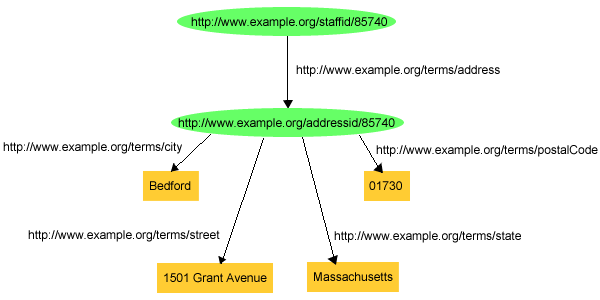
Structured information like this is represented in RDF by considering the aggregate thing to be described (like John Smith's address) as a resource, and then making statements about that new resource. So, in the RDF graph, in order to break up John Smith's address into its component parts, a new node is created to represent the concept of John Smith's address, with a new URIref to identify it, say
http://www.example.org/addressid/85740(abbreviated asexaddressid:85740). RDF statements (additional arcs and nodes) can then be written with that node as the subject, to represent the additional information, producing the graph shown in Figure 5: -
-
This way of representing structured information in RDF can involve generating numerous "intermediate" URIrefs such as
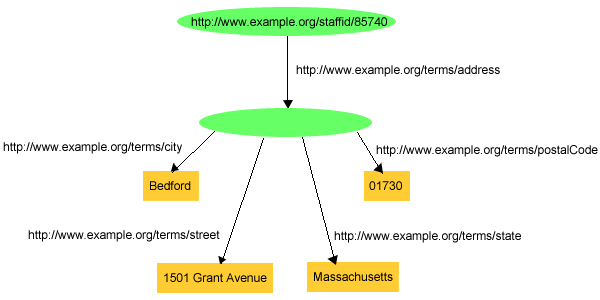
exaddressid:85740to represent aggregate concepts such as John's address. Such concepts may never need to be referred to directly from outside a particular graph, and hence may not require "universal" identifiers. In addition, in the drawing of the graph representing the group of statements shown in Figure 5, the URIref assigned to identify "John Smith's address" is not really needed, since the graph could just as easily have been drawn as in Figure 6: -
-
This blank node serves its purpose in the drawing without needing a URIref, since the node itself provides the necessary connectivity between the various other parts of the graph. (Blank nodes were called anonymous resources in [RDF-MS].)
-
However, some form of explicit identifier for that node is needed in order to represent this graph as triples.
-
Since a complex graph might contain more than one blank node, there also needs to be a way to differentiate between these different blank nodes in a triples representation of the graph.
-
As a result, triples use blank node identifiers, having the form
_:name, to indicate the presence of blank nodes. -
In a triples representation of a graph, each distinct blank node in the graph is given a different blank node identifier. Unlike URIrefs and literals, blank node identifiers are not considered to be actual parts of the RDF graph
-
Blank node identifiers are just a way of representing the blank nodes in a graph (and distinguishing one blank node from another) when the graph is written in triple form. Blank node identifiers also have significance only within the triples representing a single graph (two different graphs with the same number of blank nodes might independently use the same blank node identifiers to distinguish them, and it would be incorrect to assume that blank nodes from different graphs having the same blank node identifiers are the same).
-
Finally, because blank node identifiers represent (blank) nodes, rather than arcs, in the triple form of an RDF graph, blank node identifiers may only appear as subjects or objects in triples; blank node identifiers may not be used as predicates in triples.
-
important aspect of RDF: RDF directly represents only binary relationships
-
For each n-ary relationship, one of the participants is chosen as the subject of the relationship (John in this case), and a blank node is created to represent the rest of the relationship (John's address in this case). The remaining participants in the relationship (such as the city in this example) are then represented as separate properties of the new resource represented by the blank node.
-
Blank nodes also provide a way to more accurately make statements about resources that may not have URIs, but that are described in terms of relationships with other resources that do have URIs.
-
(Note that
mailto:jane@example.orgis written within angle brackets in the first triple. This is becausemailto:jane@example.orgis a full URIref in themailtoURI scheme, rather than a QName abbreviation, and full URIrefs must be enclosed in angle brackets in the triples notation.) -
That is, the blank node can be read as "there is a resource". Statements with that blank node as subject then provide information about the characteristics of that resource.
-
Incidentally, some RDF-based schema languages allow specifying that certain properties are unique identifiers of the resources they describe.
-
Using blank nodes in this way can also help avoid the use of literals in what might be inappropriate situations.
-
Such information is often omitted in contexts where it can be safely assumed that anyone accessing the property value will understand the units being used. However, in the wider context of the Web, it is generally not safe to make this assumption.
-
In general, careful consideration should be given to explicitly representing units and similar information.
-
In RDF, typed literals are used to provide this kind of information.
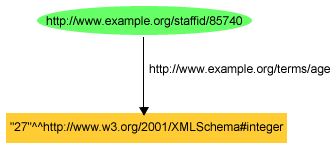
An RDF typed literal is formed by pairing a string with a URIref that identifies a particular datatype. This results in a single literal node in the RDF graph with the pair as the literal. The value represented by the typed literal is the value that the specified datatype associates with the specified string. For example, using a typed literal, John Smith's age could be described as being the integer number 27 using the triple:
<http://www.example.org/staffid/85740> <http://www.example.org/terms/age> "27"^^<http://www.w3.org/2001/XMLSchema#integer> .
or, using the QName simplification for writing long URIs:
exstaff:85740 exterms:age "27"^^xsd:integer .
or as shown in Figure 8:

-
-
Unlike typical programming languages and database systems, RDF has no built-in set of datatypes of its own, such as datatypes for integers, reals, strings, or dates. Instead, RDF typed literals simply provide a way to explicitly indicate, for a given literal, what datatype should be used to interpret it. The datatypes used in typed literals are defined externally to RDF, and identified by their datatype URIs.
-
An advantage of this approach is that it gives RDF the flexibility to directly represent information coming from different sources without the need to perform type conversions between these sources and a native set of RDF datatypes. (Type conversions would still be required when moving information between systems having different sets of datatypes, but RDF would impose no extra conversions into and out of a native set of RDF datatypes.)
-
Not all datatypes are suitable for use in RDF. For a datatype to be suitable for use in RDF, it must conform to the conceptual framework just described. This basically means that, given a character string, the datatype must unambiguously define whether or not the string is in its lexical space, and what value in its value space the string represents.
-
Since the value that a given typed literal denotes is defined by the typed literal's datatype, and, with the exception of
rdf:XMLLiteral, RDF does not define any datatypes, the actual interpretation of a typed literal appearing in an RDF graph (e.g., determining the value it denotes) must be performed by software that is written to correctly process not only RDF, but the typed literal's datatype as well. Effectively, this software must be written to process an extended language that includes not only RDF, but also the datatype, as part of its built-in vocabulary. This raises the issue of which datatypes will be generally available in RDF software. Generally, the XML Schema datatypes that are listed as suitable for use in RDF in [RDF-SEMANTICS] have a "first among equals" status in RDF. -
In general, RDF software may be called on to process RDF data that contains references to datatypes that the software has not been written to process, in which case there are some things the software will not be able to do. For one thing, with the exception of
rdf:XMLLiteral, RDF itself does not define the URIrefs that identify datatypes. As a result, RDF software, unless it has been written to recognize specific URIrefs, will not be able to determine whether or not a URIref written in a typed literal actually identifies a datatype. Moreover, even when a URIref does identify a datatype, RDF itself does not define the validity of pairing that datatype with a particular literal. This validity can only be determined by software written to correctly process that particular datatype. -
A blank node identifier serves to identify a blank node within a particular RDF/XML document but, unlike a URIref, is unknown outside the document in which it is assigned. A blank node is referred to in RDF/XML using an
rdf:nodeIDattribute, with a blank node identifier as its value, in places where the URIref of a resource would otherwise appear. Specifically, a statement with a blank node as its subject can be written in RDF/XML using anrdf:Descriptionelement with anrdf:nodeIDattribute instead of anrdf:aboutattribute. Similarly, a statement with a blank node as its object can be written using a property element with anrdf:nodeIDattribute instead of anrdf:resourceattribute. -
1. <?xml version="1.0"?> 2. <rdf:RDF xmlns:rdf="http://www.w3.org/1999/02/22-rdf-syntax-ns#" 3. xmlns:dc="http://purl.org/dc/elements/1.1/" 4. xmlns:exterms="http://example.org/stuff/1.0/"> 5. <rdf:Description rdf:about="http://www.w3.org/TR/rdf-syntax-grammar"> 6. <dc:title>RDF/XML Syntax Specification (Revised)</dc:title> 7. <exterms:editor rdf:nodeID="abc"/> 8. </rdf:Description> 9. <rdf:Description rdf:nodeID="abc"> 10. <exterms:fullName>Dave Beckett</exterms:fullName> 11. <exterms:homePage rdf:resource="http://purl.org/net/dajobe/"/> 12. </rdf:Description> 13. </rdf:RDF>
-
using a blank node identifier allows the same blank node to be referred to in more than one place in the same RDF/XML document
-
A typed literal is represented in RDF/XML by adding an
rdf:datatypeattribute specifying a datatype URIref to the property element containing the literal. -
In RDF/XML, both plain and typed literals (and, with certain exceptions, tags) can contain Unicode [UNICODE] characters, allowing information from many languages to be directly represented.
-
XML entities can be used in RDF/XML to improve readability in such cases, by providing an additional abbreviation facility for URIrefs. Essentially, an XML entity declaration associates a name with a string of characters. When the entity name is referenced elsewhere within an XML document, XML processors replace the reference with the corresponding string.
-
Although RDF does not specify or control how URIrefs are assigned to resources, sometimes it is desirable to achieve the effect of assigning URIrefs to resources that are part of an organized group of resources.
-
Using
rdf:IDspecifies a fragment identifier, given by the value of therdf:IDattribute (item10245in this case, which might be the catalog number assigned by example.com), as an abbreviation of the complete URIref of the resource being described. The fragment identifieritem10245will be interpreted relative to a base URI, in this case, the URI of the containing catalog document. The full URIref for the tent is formed by taking the base URI (of the catalog), and appending the character "#" (to indicate that what follows is a fragment identifier) and thenitem10245to it, giving the absolute URIrefhttp://www.example.com/2002/04/products#item10245. -
The
rdf:IDattribute is somewhat similar to theIDattribute in XML and HTML, in that it defines a name which must be unique relative to the current base URI (in this example, that of the catalog). In this case, therdf:IDattribute appears to be assigning a name (item10245) to this particular kind of tent. Any other RDF/XML within this catalog could refer to the tent by using either the absolute URIrefhttp://www.example.com/2002/04/products#item10245, or the relative URIref#item10245. The relative URIref would be understood as being a URIref defined relative to the base URIref of the catalog. Using a similar abbreviation, the URIref of the tent could also be given by specifyingrdf:about="#item10245"in the catalog entry (i.e., by specifying the relative URIref directly) instead ofrdf:ID="item10245". As an abbreviation mechanism, the two forms are essentially synonyms: the full URIref formed by RDF/XML is the same in either case:http://www.example.com/2002/04/products#item10245. However, usingrdf:IDprovides an additional check when assigning a set of distinct names, since a given value of therdf:IDattribute can only appear once relative to the same base URI (the catalog document, in this example). Using either form, example.com would be giving the URIref for the tent in a two-stage process, first assigning the URIref for the whole catalog, and then using a relative URIref in the description of the tent in the catalog to indicate the URIref that has been assigned to this particular kind of tent. Moreover, this use of a relative URIref can be thought of either as being an abbreviation for a full URIref that has been assigned to the tent independently of the RDF, or as being the assignment of the URIref to the tent within the catalog. -
First, even though RDF does not specify or control how URIrefs are assigned to resources (in this case, the various tents and other items in the catalog), the effect of assigning URIrefs to resources in RDF can be achieved by combining a process (external to RDF) that identifies a single document (the catalog in this case) as the source for descriptions of those resources, with the use of relative URIrefs in descriptions of those resources within that document.
-
Note that RDF does not assume any particular relationship exists between two resources just because their URIrefs have the same base, or are otherwise similar. This relationship may be known to example.com, but it is not directly defined by RDF.
-
anyone should be able to freely add information about an existing resource, using any vocabulary they please
-
the RDF describing a particular resource does not need to be located all in one place; instead, it may be distributed throughout the Web. This is true not only for situations like this one, in which one organization is rating or commenting on a resource defined by another, but also for situations in which the original definer of a resource (or anyone else) wishes to amplify the description of that resource by providing additional information about it. This may be done by modifying the RDF document in which the resource was originally described, to add the properties and values needed to describe the additional information. Or, as this example illustrates, a separate document could be created, providing the additional properties and values in
rdf:Descriptionelements that refer to the original resource via its URIref usingrdf:about. -
However, in some cases it is desirable to be able to explicitly specify this base URI.
-
To deal with such cases, RDF/XML supports XML Base [XML-BASE], which allows an XML document to specify a base URI other than the URI of the document itself.
-
xml:base="http://www.example.com/2002/04/products"
-
When an RDF resource is described with an
rdf:typeproperty, the value of that property is considered to be a resource that represents a category or class of things, and the subject of that property is considered to be an instance of that category or class. -
It is fairly common in RDF for resources to have
rdf:typeproperties that describe the resources as instances of specific types or classes. Such resources are called typed nodes in the graph, or typed node elements in the RDF/XML -
RDF/XML provides a special abbreviation for describing these typed nodes. In this abbreviation, the
rdf:typeproperty and its value are removed, and therdf:Descriptionelement for the node is replaced by an element whose name is the QName corresponding to the value of the removedrdf:typeproperty (a URIref that names a class). -
Since a resource may be described as an instance of more than one class, a resource may have more than one
rdf:typeproperty. However, only one of theserdf:typeproperties can be abbreviated in this way. The others must be written out usingrdf:typeproperties, in the manner illustrated by therdf:typeproperty in Example 12. -
In addition to its use in describing instances of user-defined classes such as
exterms:Tent, the typed node abbreviation is also commonly used in RDF/XML when describing instances of the built-in RDF classes (such asrdf:Bag) to be described in Section 4, and the built-in RDF Schema classes (such asrdfs:Class) to be described in Section 5.
-
-
22 Jun 08
-
23 May 08
-
14 May 08
-
27 Apr 08

-
22 Apr 08
-
18 Apr 08
-
12 Apr 08
-
27 Mar 08
-
28 Feb 08
-
27 Feb 08
-
24 Feb 08
-
11 Feb 08
-
29 Jan 08
-
14 Dec 07
-
04 Dec 07
-
RDF refers to a set of URIrefs (particularly a set intended for a specific purpose) as a vocabulary. Often, the URIrefs in such vocabularies are organized so that they can be represented as a set of QNames using a common prefix
-
The URIrefs in this RDF vocabulary all begin with
http://www.w3.org/1999/02/22-rdf-syntax-ns#, conventionally associated with the QName prefixrdf:
-
-
30 Oct 07
-
11 Sep 07
-
16 Aug 07

-
14 Aug 07
-
03 Jun 07
-
31 May 07
-
by generalizing the concept of a "Web resource", RDF can also be used to represent information about things that can be identified on the Web, even when they cannot be directly retrieved on the Web.
-
RDF is intended for situations in which this information needs to be processed by applications, rather than being only displayed to people.
-
The ability to exchange information between different applications means that the information may be made available to applications other than those for which it was originally created.
-
To make this discussion somewhat more concrete as soon as possible, the group of statements "there is a Person identified by
http://www.w3.org/People/EM/contact#me, whose name is Eric Miller, whose email address is em@w3.org, and whose title is Dr." could be represented as the RDF graph in -
RDF also provides an XML-based syntax (called RDF/XML) for recording and exchanging these graphs
-
while English is good for communicating between (English-speaking) humans, RDF is about making machine-processable statements.
-
the idea of using URI references to identify the things referred to in RDF statements
-
RDF's basic statement concepts
-
RDF/XML as a machine-processable way to represent RDF statements
-
-
06 May 07
-
25 Apr 07
-
13 Apr 07
-
06 Apr 07
-
25 Feb 07
-
24 Jan 07
-
19 Jan 07
 avivajazz jazzaviva
This Primer is designed to provide the reader with the basic knowledge required to effectively use RDF. It introduces the basic concepts of RDF and describes its XML syntax. It describes how to define RDF vocabularies using the RDF Vocabulary Description
-
09 Jan 07
-
06 Jan 07
-
03 Dec 06
-
19 Nov 06
 Alan Dean
This Primer is designed to provide the reader with the basic knowledge required to effectively use RDF.
-
14 Nov 06
-
13 Nov 06
 jeanjordaan
This Primer is designed to provide the reader with the basic knowledge required to effectively use RDF. It introduces the basic concepts of RDF and describes its XML syntax. It describes how to define RDF vocabularies using the RDF Vocabulary Description
-
10 Oct 06
-
21 Sep 06
-
08 Sep 06
-
28 Aug 06
-
24 Aug 06
 Fabien Gandon
The Resource Description Framework (RDF) is a language for representing information about resources in the World Wide Web. This Primer is designed to provide the reader with the basic knowledge required to effectively use RDF. It introduces the basic conc
recommendation W3C semweb semanticweb semantic semantic_web rdf web KnowledgeRepresentation metadata
-
10 Aug 06
-
02 Aug 06
-
21 Jul 06
-
23 Jun 06
-
01 Jun 06
-
11 May 06
-
"there is a Person identified by
http://www.w3.org/People/EM/contact#me, whose name is Eric Miller, whose email address is em@w3.org, and whose title is Dr." -
However, unlike conventional hypertext, RDF URIs can refer to any identifiable thing, including things that may not be directly retrievable on the Web (such as the person Eric Miller).
-
RDF is intended to provide a simple way to make statements about Web resources,
-
RDF is based on the idea that the things being described have properties which have values
-
Specifically, the part that identifies the thing the statement is about (the Web page in this example) is called the subject. The part that identifies the property or characteristic of the subject that the statement specifies (creator, creation-date, or language in these examples) is called the predicate, and the part that identifies the value of that property is called the object.
-
RDF is intended for situations in which this information needs to be processed by applications, rather than being only displayed to people.
-
-
25 Apr 06
-
21 Apr 06
-
20 Apr 06
-
27 Jan 06
-
14 Jan 06
-
12 Jan 06
-
21 Nov 05


Would you like to comment?
Join Diigo for a free account, or sign in if you are already a member.