


we are inculede in biomes cool
This link has been bookmarked by 161 people . It was first bookmarked on 08 May 2007, by littlsj.
-
10 Jun 17
-
05 May 17
-
02 Jan 17
-
22 Jul 15
-
06 Mar 15
-
Biomes are defined as "the world's major communities, classified according to the predominant vegetation and characterized by adaptations of organisms to that particular environment"
-
-
18 Oct 13
 Sofia Stubborn
Biology class site
-
09 Sep 13
-
03 Dec 12
-
27 Jul 12
-
17 Jun 12
-
14 Jun 12
 Kevin Gibbs
University of Califormia Museum of Paleontology site on Biomes
-
28 Apr 12

-
07 Apr 12
-
21 Feb 12
-
16 Feb 12
-
03 Nov 11
-
02 Nov 11
-
17 Oct 11

-
20 Sep 11
-
17 Sep 11
-
11 Aug 11
-
07 Aug 11
-
06 Jul 11
-
12 May 11
-
08 Apr 11
-
28 Mar 11
-
16 Feb 11
-
27 Jan 11
-
24 Jan 11
-
09 Jan 11
-
12 Dec 10
-
29 Nov 10

-
12 Nov 10
-
10 Nov 10
-
08 Nov 10
-
02 Nov 10
-
14 Oct 10
-
10 Oct 10
-
04 Oct 10
-

Online exhibits The world's biomes
Biomes are defined as "the world's major communities, classified according to the predominant vegetation and characterized by adaptations of organisms to that particular environment" (Campbell 1996). The importance of biomes cannot be overestimated. Biomes have changed and moved many times during the history of life on Earth. More recently, human activities have drastically altered these communities. Thus, conservation and preservation of biomes should be a major concern to all. For further information, please consult the references page.
Here we group biomes into six major types:

Freshwater

Marine

Desert

Forest

Grassland

TundraConservation and preservation of biomes
Because we share the world with many other species of plants and animals, we must consider the consequences of our actions. Over the past several decades, increasing human activity has rapidly destroyed or polluted many ecological habitats throughout the world. It is important to preserve all types of biomes as each houses many unique forms of life. However, the continued heavy exploitation of certain biomes, such as the forest, freshwater, and marine, may have more severe implications.
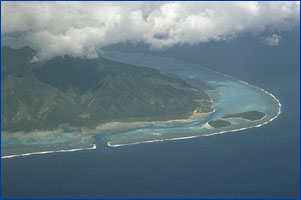
A coral reef surrounds an island in French Polynesia.
Forests are important as they are home to the most diverse biotic communties in the world. Hidden within these biomes are potential medicines and many thousands of unseen and undiscovered species. Also, forests have a global climate-buffering capacity, so their destruction may cause large-scale changes in global climate.
Logging has depleted many old-growth temperate forests. The increased demand for homes, paper, and other wood products have not allowed for much conservation. More recently, people have begun to realize that logging has cleared much of these forests. Wiser use of the forests and efforts to replant trees have helped to slow down the depletion of these communities.
Tropical forests have fallen victim to timber exploitation, slash and burn farming, and clearfelling for industrial use or cattle ranching, particularly in Latin America. Our increasing demand for meat products has spurred these events. For years, this destruction was occuring at a rapid rate. Over half of the world's original tropical forests are already gone. Public attention to this exploitation have helped to alleviate the problem somewhat, though many challenges are still to be faced.
The freshwater and marine biomes are probably the most important of all the biomes. Their medium, water, is a major natural resource. Water is the basis of life, it supports life, and countless species live in it for all or part of their lives. Freshwater biomes supply us with our drinking water and water for crop irrigation. The world's oceans have an even greater effect on global climate than forests do. Water has a high capacity for heat, and because the Earth is mostly covered with water, the temperature of the atmosphere is kept fairly constant and able to support life. In addition to this climate-buffering capacity, the oceans contain several billion photosynthetic plankton which account for most of the photosynthesis occuring on Earth. Without these, there might not be enough oxygen to support such a large world population and complex animal life.
Freshwater biomes have suffered mainly from pollution. Runoff containing fertilizer and other wastes and industrial dumpings enter into rivers, ponds, and lakes and tend to promote abnormally rapid algae growth. When these algae die, dead organic matter accumulates in the water. This makes the water unusable and it kills many of the organisms living in the habitat. Stricter laws have helped to slow down this thoughtless pollution.
-
-
30 Sep 10
-
23 Sep 10
-
22 Aug 10
 Mindy Rau
use for biomes, fossils
teacher_resources science_earth_science science_ecology ecology biomes
-
17 Aug 10

-
15 Jun 10
-
07 Jun 10
-
02 Jun 10

-
Biomes are defined as "the world's major communities, classified according to the predominant vegetation and characterized by adaptations of organisms to that particular environment" (Campbell 1996).
-
Here we group biomes into six major types:
-
-
11 May 10
-
07 May 10
-
25 Mar 10
 Hope Chrysler
This website has information on each type of biome. This website could be used as a resource for the teacher or the students. It has several links on each page that will take you to another page desribing the biome you are looking at.
-
18 Mar 10
-
09 Mar 10
 Jennifer Richardson
Good site from the University of California Museum of Paleontology, Berkley.
-
23 Feb 10
-
14 Feb 10
 Donna DesRoches
Biomes are defined as "the world's major communities, classified according to the predominant vegetation and characterized by adaptations of organisms to that particular environment
-
12 Feb 10
-
14 Jan 10

-
06 Jan 10
-
03 Jan 10
-
02 Jan 10
-
17 Dec 09
-
14 Dec 09
-
01 Dec 09
-
Conservation and preservation of biomes
-
-
17 Nov 09
-
 Lorna Guthrie
The worlds biomes
-
09 Nov 09
-
03 Nov 09

-
-
biotic communties in the world. Hidden within these biomes are potential medicines and many thousands of unseen and undiscovered species.
-
Also, forests have a global climate-buffering capacity, so their destruction may cause large-scale changes in global climate.
-
Freshwater biomes have suffered mainly from pollution. Runoff containing fertilizer and other wastes and industrial dumpings enter into rivers, ponds, and lakes and tend to promote abnormally rapid algae growth.
-
-
-
Add Sticky NoteTropical forests have fallen victim to timber exploitation, slash and burn farming, and clearfelling for industrial use or cattle ranching, particularly in Latin America
-
-
ok
-
-
-
02 Nov 09
-
Biomes are defined as "the world's
-
importance of biomes cannot be overestimated
-
-
-
Biomes
-
The world's
-
Biomes are defined as "the world's major communities
-
Marine
-
Tundra
-
plants and animals
-
many other species
-
Because
-
Because we share the world with many other species of plants and animals , we must consider the consequences of our actions.
-
we share the world
-
Because we share the world with many other species of plants and animals, we must consider the consequences of our actions.
-
Because
-
A coral reef surrounds an island in French Polynesia.
-
-
26 Oct 09
-
14 Oct 09

-
13 Oct 09
-
25 Sep 09
-
14 Sep 09
-
03 Sep 09
-
02 Sep 09
-
Biomes are defined as "the world's major communities, classified according to the predominant vegetation and characterized by adaptations of organisms to that particular environment" (Campbell 1996).
-
-
18 Aug 09
-
05 Aug 09
-
19 Jul 09
 Mary Garetto
great reference from hotchalk lesson creator in freshwater, marine,desert, forest,grassland, and tundra biomes.
-
15 Jun 09
-
10 Jun 09
-
05 Jun 09
 Holly Debenham
More recently, human activities have drastically altered these communities. Thus, conservation and preservation of biomes should be a major concern to all. For further information, please consult the references page
-
28 May 09
-
22 May 09
-
19 May 09
-
18 May 09
-
Add Sticky NoteThe freshwater and marine biomes are probably the most important of all the biomes. Their medium, water, is a major natural resource. Water is the basis of life, it supports life, and countless species live in it for all or part of their lives. Freshwater biomes supply us with our drinking water and water for crop irrigation. The world's oceans have an even greater effect on global climate than forests do. Water has a high capacity for heat, and because the Earth is mostly covered with water, the temperature of the atmosphere is kept fairly constant and able to support life. In addition to this climate-buffering capacity, the oceans contain several billion photosynthetic plankton which account for most of the photosynthesis occuring on Earth. Without these, there might not be enough oxygen to support such a large world population and complex animal life.
-
Info about the most important biomes and why they are considered to be so.
-
ok
-
-
-
14 May 09
-
22 Apr 09
 k carberry
University of California Museum of Paleontology - Biomes are defined as "the world's major communities, classified according to the predominant vegetation and characterized by adaptations of organisms to that particular environment" (Campbell 1996). The importance of biomes cannot be overestimated. Biomes have changed and moved many times during the history of life on Earth. More recently, human activities have drastically altered these communities. Thus, conservation and preservation of biomes should be a major concern to all. For further information, please consult the references page.
Includes information on different biomes.biomes science habitats ecology ecosystems desert marine freshwater forest grassland tundra
-
08 Apr 09
-
19 Feb 09
-
13 Feb 09
-
12 Feb 09
 Brian Garrett
This site is an excellent starting point to collect information on the world's biomes. You can get pictures, information, maps etc.
-
03 Feb 09
-
21 Jan 09
-
15 Jan 09
-
14 Jan 09
-
16 Dec 08


Public Stiky Notes
Would you like to comment?
Join Diigo for a free account, or sign in if you are already a member.