


sounds good, by the way am i annoying you with my sticky note??? well, TOO BAD!!!!!!
This link has been bookmarked by 63 people . It was first bookmarked on 22 Jul 2006, by someone privately.
-
10 Nov 16
 heldali Eldali
Article talks about how the atmosphere of earth and the color of the sky are related, and the reason that makes the color of the sky blue.
-
The blue color of the sky is due to Rayleigh scattering.
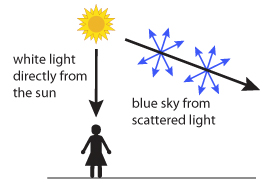 As light moves through the atmosphere, most of the longer wavelengths pass straight through. Little of the red, orange and yellow light is affected by th
-
-
07 Nov 16
-
01 Nov 16
-
23 Feb 14
 Anne-Marie Park
Why is the Sky Blue?
-
30 Oct 13
-
The blue color of the sky is due to Rayleigh scattering. As light moves through the atmosphere, most of the longer wavelengths pass straight through. Little of the red, orange and yellow light is affected by the air.
However, much of the shorter wavelength light is absorbed by the gas molecules. The absorbed blue light is then radiated in different directions. It gets scattered all around the sky. Whichever direction you look, some of this scattered blue light reaches you. Since you see the blue light from everywhere overhead, the sky looks blue.
-
-
28 Oct 13
-
s light moves through the atmosphere, most of the longer wavelengths pass straight through. Little of the red, orange and yellow light is affected by the air.
However, much of the shorter wavelength light is absorbed by the gas molecules. The absorbed blue light is then radiated in different directions. It gets scattered all around the sky. Whichever direction you look, some of this scattered blue light reaches you. Since you see the blue light from everywhere overhead, the sky looks blue.
-
The blue color of the sky is due to Rayleigh scattering. A
-
-
09 Apr 13
-
26 Mar 13
-
27 Feb 13
-
20 Feb 13
-
18 Feb 13
-
16 Feb 13
-
WHY IS THE SKY BLUE?
-
SCIENCE MADE SIMPLE
-
-
08 Jan 13
 Julian Snoeks
blue sky
-
06 Nov 12
 Caleb Lambert
this is some goood info
-
19 Sep 12
-
28 May 12
-
13 May 12
-
04 Mar 12
-
21 Nov 11
-
atmosphere is the mixture of gas molecules a
-
s surrounding the earth. It is made most
-
gen (78%), and oxygen (21%). Argon gas and water (in the form of vapor, droplets and ice crystals) are the next most common things. There are also small amounts of other gases, plus many small solid particles, like dust, soot and ashes, pollen, and salt from the oceans.
The composition of the atmosphere varies, depending on your location, the weather, and many other things. There may be more water in the air after a rainstorm, or near the ocean. Volcanoes can put large amounts of dust particles high into the atmosphere. Pollution can add different gases or dust and soot.
-
ight from the sun or a lig
-
-
28 Aug 11
-
09 Jun 11
-
21 Apr 11
-
08 Feb 11
-
31 Jan 11
-
21 Dec 10
-
08 Oct 10
-
27 Sep 10
-
The atmosphere is the mixture of gas molecules and other materials surrounding the earth. It is made mostly of the gases nitrogen (78%), and oxygen (21%). Argon gas and water (in the form of vapor, droplets and ice crystals) are the next most common things. There are also small amounts of other gases, plus many small solid particles, like dust, soot and ashes, pollen, and salt from the oceans.
-
-
07 Aug 10
-
05 Mar 10
-
To answer these questions, we must learn about light, and the Earth's atmosphere.
-
To answer these questions, we must learn about light, and the Earth's atmosphere
-
-
02 Jan 10

-
13 Dec 09
-
26 Oct 09
-
09 May 09
-
Light is a kind of energy that radiates, or travels, in waves. Many different kinds of energy travel in waves. For example, sound is a wave of vibrating air. Light is a wave of vibrating electric and magnetic fields. It is one small part of a larger range of vibrating electromagnetic fields. This range is called the electromagnetic spectrum.
-
Light is a kind of energy that radiates, or travels, in waves. Many different kinds of energy travel in waves. For example, sound is a wave of vibrating air. Light is a wave of vibrating electric and magnetic fields. It is one small part of a larger range of vibrating electromagnetic fields. This range is called the electromagnetic spectrum.
Electromagnetic waves travel thro
-
Light is a kind of energy that radiates, or travels, in waves. Many different kinds of energy travel in waves. For example, sound is a wave of vibrating air. Light is a wave of vibrating electric and magnetic fields. It is one small part of a larger range of vibrating electromagnetic fields. This range is called the electromagnetic spectrum.
Electromagnetic waves travel thro
-
ind of energy that radiates, or travels, in waves. Many different kinds of energy travel in waves. For example, sound is a wave of vibrating air. Light is a wave of vibrating electric and magnetic fields. It is one small part of a larger range of vibrating electromagnetic fields. This range is called the electromagnetic spectrum.
Electromagnetic waves travel through space at 299,792 km/sec (186,
-
ates, or travels, in waves. Many different kinds of energy travel in waves. For example, sound is a wave of vibrating air. Light is a wave of vibrating electric and magnetic fields. It is one small part of a larger r
-
ind of energy that radiates, or travels, in waves. Many different kinds of energy travel in waves. For example, sound is a wave of vibrating air. Light is a wave of vibrating electric and magnetic fields. It is one small part of a larger range of vibrating electromagnetic fields. This range is called the electromagnetic spectrum.
Electromagnetic waves travel through space at 299,792 km/sec (186,
-
adiates, or travels, in waves. Many different kinds of energy travel in waves. For example, sound is a wave of vibrating air. Light is a wave of vibrating electric and magnetic fields. It is one small part of a la
-
ind of energy that radiates, or travels, in waves. Many different kinds of energy travel in waves. For example, sound is a wave of vibrating air. Light is a wave of vibrating electric and magnetic fields. It is one small part of a larger range of vibrating electromagnetic fields. This range is called the electromagnetic spectrum.
Electromagnetic waves travel through space at 299,792 km/sec (186,
-
-
17 Jan 09
-
02 Dec 08
-
26 Jan 08
-
24 Feb 07
-
23 Jul 06
 Carol LeCrone
and other common questions
-
11 Jan 05


Public Stiky Notes
Would you like to comment?
Join Diigo for a free account, or sign in if you are already a member.