
This link has been bookmarked by 127 people . It was first bookmarked on 29 Jun 2006, by Andreash andreas.
-
18 Nov 15
-
07 Aug 15
-
25 Mar 15
-
28 Feb 15
-
29 Mar 14
-
20 Mar 14
-
27 Oct 13
-
19 May 13
-
11 May 13
-
03 Sep 12
-
04 May 12
-
11 Apr 12

-
17 Mar 12
-
SUPPLIER POWER
Supplier concentration
Importance of volume to supplier
Differentiation of inputs
Impact of inputs on cost or differentiation
Switching costs of firms in the industry
Presence of substitute inputs
Threat of forward integration
Cost relative to total purchases in industryTHREAT OF
NEW ENTRANTS
Barriers to Entry
Absolute cost advantages
Proprietary learning curve
Access to inputs
Government policy
Economies of scale
Capital requirements
Brand identity
Switching costs
Access to distribution
Expected retaliation
Proprietary products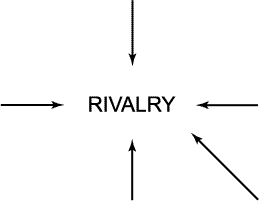
THREAT OF
SUBSTITUTES
-Switching costs
-Buyer inclination to
substitute
-Price-performance
trade-off of substitutesBUYER POWER
Bargaining leverage
Buyer volume
Buyer information
Brand identity
Price sensitivity
Threat of backward integration
Product differentiation
Buyer concentration vs. industry
Substitutes available
Buyers' incentivesDEGREE OF RIVALRY
-Exit barriers
-Industry concentration
-Fixed costs/Value added
-Industry growth
-Intermittent overcapacity
-Product differences
-Switching costs
-Brand identity
-Diversity of rivals
-Corporate stakes
<!--Copyright QuickMBA.com. All rights reserved.-->
-
-
23 Feb 12
-
02 Feb 12
-
17 Dec 11
-
12 Oct 11
-
01 Oct 11
-
13 Sep 11
-
10 Aug 11
-
30 Jun 11
-
23 Feb 11
-
08 Feb 11
-
28 Jan 11
-
22 Oct 10
-
24 Sep 10
-
The model of pure competition implies that risk-adjusted rates of return should be constant across firms and industries.
-
explained by industry structure.
-
seeking to develop an edge over rival firms can use this model
-
not unsophisticated passive price takers.
-
and strategic analysts are interested in these differences.
-
The Bureau of Census periodically reports the CR for major Standard Industrial Classifications (SIC's).
-
A high concentration ratio indicates that a high concentration of market share is held by the largest firms - the industry is concentrated.
-
fragmented markets are said to be competitive.
-
in low-rivalry industries competitive moves must be constrained informally. However, a maverick firm seeking a competitive advantage can displace the otherwise disciplined market.
-
Changing prices
-
Improving product differentiation
-
Creatively using channels of distribution
-
Exploiting relationships with suppliers
-
The rivalry intensifies if the firms have similar market share, leading to a struggle for market leadership.
-
Slow market growth causes firms to fight for market share.
-
Since the firm must sell this large quantity of product, high levels of production lead to a fight for market share and results in increased rivalry.
-
highly perishable products cause a producer to sell goods as soon as possible.
-
When a customer can freely switch from one product to another there is a greater struggle to capture customers.
-
Brand identification, on the other hand, tends to constrain rivalry.
-
When the plant and equipment required for manufacturing a product is highly specialized, these assets cannot easily be sold to other buyers in another industry.
-
induces new firms to enter a market and incumbent firms to increase production.
-
The industry may become crowded if its growth rate slows and the market becomes saturated, creating a situation of excess capacity with too many goods chasing too few buyers.
-
a stable market will not have more than three significant competitors, and the largest competitor will have no more than four times the market share of the smallest.
-
substitute products refer to products in other industries.
-
as more substitutes become available, the demand becomes more elastic since customers have more alternatives.
-
In the truck tire market, retreading remains a viable substitute industry.
-
monopsony - a market in which there are many suppliers and one buyer.
-
This requirement leads to buyer-supplier relationships between the industry and the firms that provide it the raw materials used to create products.
-
industries possess characteristics that protect the high profit levels of firms in the market and inhibit additional rivals from entering the market. These are barriers to entry.
-
Firms also may be reluctant to enter markets that are extremely uncertain, especially if entering involves expensive start-up costs.
-
government also restricts competition through the granting of monopolies and through regulation.
-
the markets that banks could enter were limited by state governments.
-
patented, preventing others from using the knowledge and thus creating a barrier to entry.
-
In 1975, Kodak attempted to enter the instant camera market and sold a comparable camera. Polaroid sued for patent infringement and won, keeping Kodak out of the instant camera industry.
-
When an industry requires highly specialized technology or plants and equipment, potential entrants are reluctant to commit to acquiring specialized assets that cannot be sold or converted into other uses if the venture fails.
-
Minimum Efficient Scale (MES). This is the point at which unit costs for production are at minimum - i.e., the most cost efficient level of production.
-
The nature and fascination of business is that it is not static.
-
interdependence of forces as dynamic, or punctuated equilibrium, as Porter terms it.
-
identified three generic strategies (cost leadership, differentiation, and focus) that can be implemented at the business unit level to create a competitive advantage.
-
-
09 Jul 10
-
26 May 10
-
25 May 10
-
08 May 10
-
24 Apr 10
-
14 Apr 10
-
05 Apr 10
-
08 Mar 10
-
05 Mar 10
-
16 Feb 10
-
22 Jan 10
-
15 Oct 09
-
18 Aug 09
-
28 Jun 09
-
12 Jun 09
-
22 Mar 09
-
02 Mar 09
 Enrico Marongiu
Exit barriers
-Industry concentration
-Fixed costs/Value added
-Industry growth
-Intermittent overcapacity
-Product differences
-Switching costs
-Brand identity
-Diversity of rivals
-Corporate stakesmarketing product business development strategy porter five forces
-
14 Jan 09
-
07 Dec 08
-
Porter's Five Forces
A MODEL FOR INDUSTRY ANALYSIS
-
-
30 Oct 08
-
07 Oct 08
 Carl Setzer
A well written assessment of Porter's Five Forces.
business economics marketing research education management analysis industry
-
03 Oct 08
-
16 Sep 08
-
04 Aug 08
-
17 Apr 08
-
07 Mar 08
-
03 Sep 07
-
09 Jun 07
-
21 May 07
-
05 Apr 07
-
-
09 Mar 07
-
28 Aug 06
-
identity
-
-
16 Aug 06
-
17 Jul 06
-
21 Oct 05
-
24 Feb 05
-
14 Feb 05


Would you like to comment?
Join Diigo for a free account, or sign in if you are already a member.