
This link has been bookmarked by 75 people . It was first bookmarked on 15 Oct 2008, by Todd Way.
-
10 Apr 17
-
28 Mar 17
-
The global financial and economic crisis resulted in many nations cutting back on all sorts of public spending, and yet military spending continued to increase
-
-
07 Nov 16
-
- World military expenditure in 2012 is estimated to have reached $1.756 trillion;
- This is a 0.4 per cent decrease in real terms than in 2011 — the first fall since 1998;
- The total is still higher than in any year between the end of World War II and 2010;
- This corresponds to 2.5 per cent of world gross domestic product (GDP), or approximately $249 for each person in the world;
-
The USA with its massive spending budget, has long been the principal determinant of the current world trend, often accounting for close to half of all the world’s military expenditure.
-
-
06 Nov 16
-
12 May 16
-
Of all the enemies to public liberty war is, perhaps, the most to be dreaded because it comprises and develops the germ of every other. War is the parent of armies; from these proceed debts and taxes … known instruments for bringing the many under the domination of the few.… No nation could preserve its freedom in the midst of continual warfare.
-
The USA with its massive spending budget, has long been the principal determinant of the current world trend, often accounting for close to half of all the world’s military expenditure. The effects of global financial crisis and the post-Iraq/Afghanistan military operations have seen a decline in its spending, now accounting for 39% of spending in 2012
-
-
13 Dec 15
-
the world can spend so much on their military but contribute so little to the goals of global security, international cooperation and peace
-
Shareholders and employees in the aerospace and defense industry are clearly the ones who benefit most from growing defense spending.
-
routinely highlight their capacity to contribute to economic growth and to provide employment
-
industries that create or manage violence
-
The US alone accounts for over two-fifths (or just under half) of the world’s spending
-
the fundamental goal of ensuring continued US dominance across the spectrum of military capabilities, for both conventional and ‘asymmetric’ warfare, has not changed.
-
“national defense” category of federal spending is typically just over half of the United States discretionary budget
-
Americans are willing to pay for defense, but they would probably be much less willing to spend billions of dollars if the money were labeled “Foreign Military Operations
-
-
29 Apr 15
-
29 Jan 15
 kai123098
Shah, Anup. "World Military Spending." - Global Issues. N.p., 20 July 1998. Web. 27 Jan. 2015. <http://www.globalissues.org/article/75/world-military-spending>.
this site shows how much all the country spend on their military the us uses 40% of tax payer dollars on our milattary -
12 Nov 14
 kellinghuysen
US and world military spending and budgets are very high, almost back to Cold War levels.
-
11 Sep 14
 ecarlile
"expenditure "
-
06 Jul 14
-
30 Apr 14
-
29 Apr 14
-
- The 15 countries with the highest spending account for over 81% of the total;
- The USA is responsible for 39 per cent of the world total, distantly followed by the China (9.5% of world share), Russia (5.2%), UK (3.5%) and Japan (3.4%)
The USA with its massive spending budget, has long been the principal determinant of the current world trend, often accounting for close to half of all the world’s military expenditure. The effects of global financial crisis and the post-Iraq/Afghanistan military operations have seen a decline in its spending, now accounting for 39% of spending in 2012.
SIPRI has commented in the past on the increasing concentration of military expenditure, i.e. that a small number of countries spend the largest sums. This trend carries on into 2012 spending. For example,
-
- World military expenditure in 2012 is estimated to have reached $1.756 trillion;
- This is a 0.4 per cent decrease in real terms than in 2011 — the first fall since 1998;
- The total is still higher than in any year between the end of World War II and 2010;
- This corresponds to 2.5 per cent of world gross domestic product (GDP), or approximately $249 for each person in the world;
-
- The 15 countries with the highest spending account for over 81% of the total;
- The USA is responsible for 39 per cent of the world total, distantly followed by the China (9.5% of world share), Russia (5.2%), UK (3.5%) and Japan (3.4%)
The USA with its massive spending budget, has long been the principal determinant of the current world trend, often accounting for close to half of all the world’s military expenditure. The effects of global financial crisis and the post-Iraq/Afghanistan military operations have seen a decline in its spending, now accounting for 39% of spending in 2012.
SIPRI has commented in the past on the increasing concentration of military expenditure, i.e. that a small number of countries spend the largest sums. This trend carries on into 2012 spending. For example,
-
-
28 Apr 14
-
Generally, compared to Cold War levels, the amount of military spending and expenditure in most nations has been reduced. For example, global military spending declined from $1.2 trillion in 1985 to $809 billion in 1998, though since 2005 has risen to over $1 trillion again. The United States’ spending, up to 2009 requests may have be reduced compared to the Cold War era but is still close to Cold War levels.
-
-
12 Feb 14
-
23 Sep 13
-
Global military expenditure stands at over $1.7 trillion in annual expenditure
-
-
13 May 13
-
military expenditure now accounts for just under half of the world total, at 41% of the world total;
-
military expenditure now accounts for just under half of the world total, at 41% of the world total;
-
There is a large gap between what countries are prepared to allocate for military means to provide security and maintain their global and regional power status, on the one hand, and to alleviate poverty and promote economic development, on the other
-
The United Nations and all its agencies and funds spend about $30 billion each year, or about $4 for each of the world’s inhabitants
-
As of December 31, 2010, members’ arrears to the Regular Budget topped $348 million, of which the US owed 80%
-
UN Financial Crisis, Global Policy Forum (accessed May 2, 2011)
-
The budget for nuclear weapons falls under the Department of Energy, and for the 2010 request, was about $25 billion.
-
Nonetheless, compared to the rest of the world, these numbers have long been described as “staggering.
-
Furthermore, rather than creating/sustaining jobs, some research suggests that increased military spending leads to job losses .
-
Osama Bin Laden, for example, was part of an enormous Islamic militancy encouraged and trained by the US to help fight the Soviet Union
-
Furthermore, “national defense” category of federal spending is typically just over half of the United States discretionary budget
-
For those hoping the world can decrease its military spending, SIPRI warns that “while the invasion [of Iraq] may have served as warning to other states with weapons of mass destruction, it could have the reverse effect in that some states may see an increase in arsenals as the only way to prevent a forced regime change.”
-
most likely forms of threat to the United States would be through terrorist actions
-
spending is still geared towards Cold War-type scenarios and other such conventional confrontations
-
It goes to supporting U.S. military activities, including interventions, throughout the world
-
-
09 May 13
-
Of all the enemies to public liberty war is, perhaps, the most to be dreaded because it comprises and develops the germ of every other. War is the parent of armies; from these proceed debts and taxes … known instruments for bringing the many under the domination of the few.… No nation could preserve its freedom in the midst of continual warfare.
-
Of all the enemies to public liberty war is, perhaps, the most to be dreaded because it comprises and develops the germ of every other. War is the parent of armies; from these proceed debts and taxes … known instruments for bringing the many under the domination of the few.… No nation could preserve its freedom in the midst of continual warfare.
-
Global military expenditure stands at over $1.7 trillion in annual expenditure
-
-
13 Feb 13
-
The USA is responsible for 41 per cent of the world total, distantly followed by the China (8.2% of world share), Russia (4.1%), UK and France (both 3.6%)
-
-
06 Feb 13
-
05 Oct 12
-
26 Sep 12
-
29 Jun 12
-
07 May 12
-
Military might delivers geopolitical supremacy, but peace delivers economic prosperity and stability.
-
-
15 Jan 12
-
09 Jan 12
-
27 Oct 11
-
- World military expenditure in 2010 is estimated to have reached $1.62 trillion in current dollars;
- This represents a 1.3 per cent increase in real terms since 2009 and a 50 per cent increase since 2001;
- This corresponds to 2.6 per cent of world gross domestic product (GDP), or approximately $236 for each person in the world;
- The USA with its massive spending budget, is the principal determinant of the current world trend, and its military expenditure now accounts for just under half of the world total, at 43% of the world total;
-
World
-
- World military expenditure in 2010 is estimated to have reached $1.62 trillion in current dollars;
- This represents a 1.3 per cent increase in real terms since 2009 and a 50 per cent increase since 2001;
- This corresponds to 2.6 per cent of world gross domestic product (GDP), or approximately $236 for each person in the world;
- The USA with its massive spending budget, is the principal determinant of the current world trend, and its military expenditure now accounts for just under half of the world total, at 43% of the world total;
-
- World military expenditure in 2010 is estimated to have reached $1.62 trillion in current dollars;
- This represents a 1.3 per cent increase in real terms since 2009 and a 50 per cent increase since 2001;
- This corresponds to 2.6 per cent of world gross domestic product (GDP), or approximately $236 for each person in the world;
- The USA with its massive spending budget, is the principal determinant of the current world trend, and its military expenditure now accounts for just under half of the world total, at 43% of the world total;
-
But even during the past year in the aftermath of the financial crisis and cries of governments cutting back, military spending appears to have been spared. How is that justified? SIPRI provides some observations:
-
The USA led the rise [in military spending], but it was not alone. Of those countries for which data was available, 65% increased their military spending in real terms in 2009. The increase was particularly pronounced among larger economies, both developing and developed: 16 of the 19 states in the G20 saw real-terms increases in military spending in 2009.
-
As of December 31, 2010, members’ arrears to the Regular Budget topped $348 million, of which the US owed 80%
-
Congress has already approved
-
nearly $700
-
additional $126 billion in FY'08 war funding is still pending before the House and Senate.
-
-
09 Jun 11
-
18 May 11
-
World military expenditure in 2010 is estimated to have reached $1.62 trillion in current dollars
-
This corresponds to 2.6 per cent of world gross domestic product (GDP), or approximately $236 for each person in the world
-
- The 15 countries with the highest spending account for over 82% of the total;
- The USA is responsible for 43 per cent of the world total, distantly followed by the China (7.3% of world share), UK (3.7%), France (3.6%), and Russia (3.6%)
-
Geopolitics and strategic interests to project or maintain power: “rising military spending for the USA, as the only superpower, and for other major or intermediate powers, such as Brazil, China, Russia and India, appears to represent a strategic choice in their long-term quest for global and regional influence; one that they may be loath to go without, even in hard economic times
-
-
09 May 11
 Sean Reeves
Of all the enemies to public liberty war is, perhaps, the most to be dreaded because it comprises and develops the germ of every other. War is the parent of armies; from these proceed debts and taxes … known instruments for bringing the many under the dom
-
18 Mar 11
-
17 Mar 11
-
07 Dec 10
-
10 Nov 10
-
15 Oct 10
-
29 Sep 10
-
20 Aug 10
-
07 Jul 10
-
29 Jun 10
-
14 Apr 10
-
14 Mar 10
-
12 Mar 10
-
Of all the enemies to public liberty war is, perhaps, the most to be dreaded because it comprises and develops the germ of every other. War is the parent of armies; from these proceed debts and taxes … known instruments for bringing the many under the domination of the few.… No nation could preserve its freedom in the midst of continual warfare.
— James Madison, Political Observations, 1795
-
- Iraq war reduction and redeployment to Afghanistan
- 2010 figures are preliminary as of writing, not including nuclear weapons programs
- The global financial crisis, affecting all nations, is making governments rethink some military spending.
US Military Spending
The United States has unquestionably been the most formidable military power in recent years. Its spending levels, as noted earlier, is the principle determinant of world military spending and is therefore worth looking at further.
Generally, US military spending has been on the rise. Recent increases are attributed to the so-called War on Terror and the Afghanistan and Iraq invasions, but it had also been rising before that.
For example, Christopher Hellman, an expert on military budget analysis notes in The Runaway Military Budget: An Analysis
 , (Friends Committee on National Legislation, March 2006, no. 705, p. 3) that military spending had been rising since at least 1998, if not earlier.
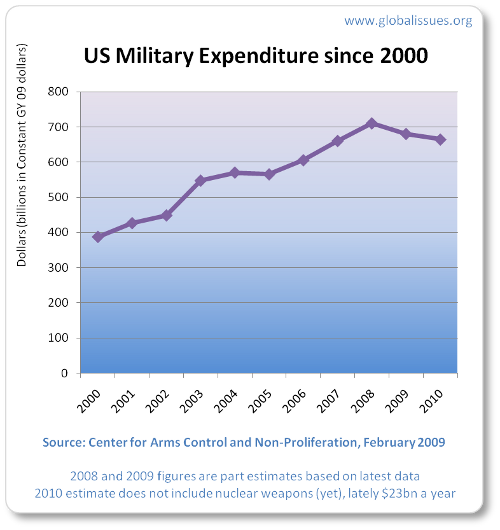
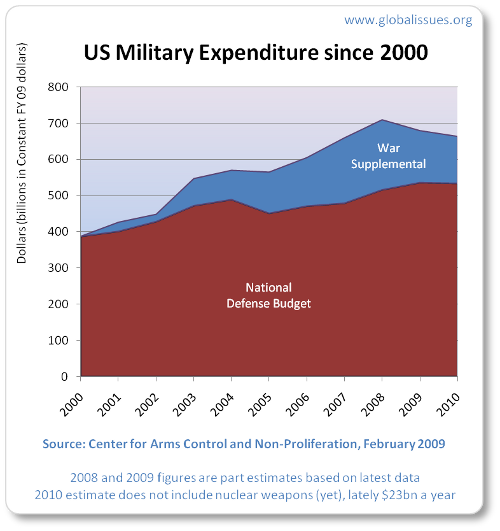
Travis Sharp, from the Center for Arms Control provides spending figures from 2000 to the requested figures for 2010 shown here:
Overall spending
Defense budget vs War spending
Raw data and sources
US Defense Spending Since 2000 in constant FY09 dollars Year National defense budget ($bn) War Supplemental ($bn) Total military spending ($bn) Source: Travis Sharp, Growth in U.S. Defense Spending Over the Last Decade, Center for Arms Control and Non-Proliferation, February 26, 2009. (2010 data comes from Fiscal Year 2010 Pentagon Defense Spending Request: February “Topline”)
Note: Figures up to 2009 include Department of Defense spending, Department of Energy’s nuclear weapons program, the costs of the wars in Afghanistan and Iraq, and DoD-related spending by other agencies. At time of writing, 2010 figures for the nuclear weapons program is not available.
2010 534 130 664 2009 536 144 680 2008 516 194 710 2007 471 134 660 2006 471 134 605 2005 451 114 565 2004 489 81 570 2003 472 75 547 2002 428 20 448 2001 401 25 426 2000 387 0 387 The decline seen in recent years above are due to a number of factors:
Nonetheless, compared to the rest of the world, these numbers have long been described as “staggering.”
-
In Context: US Military Spending Versus Rest of the World
When the US Fiscal Year 2009 budget request for military spending came out in early 2008, Travis Sharp and Christopher Hellman (mentioned earlier) projected the spending of other nations planned for 2008 thus allowing comparison between US military spending and the rest of the world:
Note that the sources for world military spending is different to SIPRI, used above. As well as combining war supplemental spending to regular US military spending, other numbers and estimates will differ to graphs and charts shown earlier. See sources for further information.
-
-
05 Feb 10
-
06 Oct 09

-
Constant 2005 dollar values are used for comparing past years, where the the 2008 spending amount is over $1.2 trillion:
-
- Foreign policy objectives
- Real or perceived threats
- Armed conflict and policies to contribute to multilateral peacekeeping operations
- Availability of economic resources
-
-
16 Jun 09
-
05 Apr 09
-
05 Mar 09
-
13 Feb 09
-
25 Jan 09
 annest
No nation could preserve its freedom in the midst of continual warfare.
-
24 Dec 08
 mikael böök
SIPRI continues that, “In addition to its direct impact of high military expenditure, there are also indirect and more long-term effects. According to one study taking these factors into account, the overall past and future costs until year 2016 to the US
-
15 Oct 08
-

-
Why does the US number seem so high when the budget announced $517.9 for the Department of Defense?
Unfortunately, the budget numbers can be a bit confusing. For example, the Fiscal Year budget requests for US military spending do not include combat figures (which are supplemental requests that Congress approves separately). The budget for nuclear weapons falls under the Department of Energy, and for the 2009 request, was about $29 billion.
The cost of war (Iraq and Afghanistan) is estimated to be about $170 billion for the 2009 spending alone. Christopher Hellman and Travis Sharp also discuss the US fiscal year 2009 Pentagon spending request and note that “Congress has already approved nearly $700 billion in supplemental funding for operations in Iraq and Afghanistan and an additional $126 billion in FY'08 war funding is still pending before the House and Senate.”
Furthermore, other costs such as care for vetarans, healthcare, military training/aid, secret operations, may fall under other departments or be counted separately.
-
2007 (in billions of dollars) 2007 percent of federal funds budget Source: 43% Percent of Your 2007 Taxes Go to War, Friends Committee on National Legislation, February 14, 2008
Current Military Spending 598 29% Cost of Past Wars 282 14% Total military percent 43% Health Research & Services 423.7 20.5% Responses to Poverty 255.0 12.4% Interest on Non-Military Share of Federal Debt 226.2 11% Government Operations 138.9 6.6% Social Programs 59.9 2.9% Science, Energy, & Environment 53.7 2.6% Non-Military International Programs 29.1 1.4% -

-


Would you like to comment?
Join Diigo for a free account, or sign in if you are already a member.