
This link has been bookmarked by 34 people . It was first bookmarked on 27 Dec 2006, by Philip Guth.
-
03 Nov 12
-
23 Apr 12
-
If your task, for example, is to classify independent musicians for a website and database, you may choose a taxonomy that organizes the artists by musical style and then create metadata to describe the members of the band, the year of inception, record label, discography, and geography.
-
How to develop content classification requirements
-
When developing a content classification strategy, it’s important that you know your needs, your application,
-
Address governance as early as possible in the design cycle.
How will your content classification get revised and extended? How frequently? What person or team will be responsible for the maintenance of your metadata? How will you settle disputes? -
Every time you reorganize the website, the organization of content in your management application shifts.
-
-
05 Jan 12
-
23 Jun 11
 Melinda Miller
In content metadata and hierarchies, however, you will often find a goldmine of implicit and explicit data that you can leverage to creatively contextualize content. Following a brief introduction on taxonomy and metadata (what I call content classificati
-
15 Apr 11
-
Specifically, taxonomy is a hierarchical structure for the classification or organization of data. Historically used by biologists to classify plants or animals according to a set of natural relationships, in content management and information architecture, we tend to leverage taxonomies as a tool for organizing content
-
taxonomy as a means of organizing content and metadata as method of further describing it.
-
2. Content Mapping
A more robust, albeit more complex, method of managing content is to maintain structures and metadata in the content management application that is independent of the delivery system’s organization (navigation).
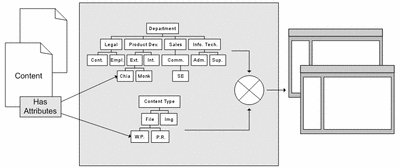
Figure 4: Organizing content for delivery by Content Mapping (Click to enlarge) -
When developing your content classification strategies (for both content management and presentation), make a point of evaluating your hierarchical structures for relationships and valuable data hidden within them. Relationships between nodes of a hierarchy are complex, but often mirror the perception of your users.
By leveraging these relationships, you can broaden the scope of your queries. Broaden the scope of data presented to the users, and drive users toward tangential content.
-
-
10 Nov 10
-
20 May 10
-
31 Oct 09
-
26 Oct 09
-
23 Aug 09
-
23 Jul 09
-
04 Feb 09
-
21 Jan 08
-
19 Sep 07
 Andre Malheiro
The information architect will be expected to lead or contribute to development of the content classification requirements. And we don’t classify our content without reason.
-
01 Jul 07
-
16 May 07
-
Specifically, taxonomy is a hierarchical structure for the classification or organization of data
-
Historically used by biologists to classify plants or animals according to a set of natural relationships, in content management and information architecture, we tend to leverage taxonomies as a tool for organizing content
-
While much metadata is flat or one-dimensional in nature (e.g., size or weight), some of it is hierarchical (e.g., taxonomies), making the definition and distinction between metadata and taxonomy vague and fuzzy.
-
A more robust, albeit more complex, method of managing content is to maintain structures and metadata in the content management application that is independent of the delivery system’s organization (navigation).
-
By some rule or algorithm, leveraging your content classification data, material gets “mapped” to the presentation framework
-
There may be more than one way to organize content (think: content reuse). Given the same set of content, same set of classification criteria, but multiple algorithms, we can now build a delivery framework that allows for many methods of organization.
-
You no longer need to reorganize your content management application to change the delivery application. Just the algorithms (mappings) change.
-
Parts of the site may only be sparsely populated. It may not be readily obvious that you are creating gaps (with little or no content) in your site.
-
it’s an easy and logical choice that allows you to manage security in the content management application at the department level, but it doesn’t accurately reflect the organization of your internet site.
-
-
13 Apr 07
-
12 Feb 07
-
19 Jan 07


Would you like to comment?
Join Diigo for a free account, or sign in if you are already a member.