
This link has been bookmarked by 3 people . It was first bookmarked on 29 Jan 2008, by James Linzel.
-
09 Dec 15
-
29 Jan 08
-
Johaness Kepler (lived 1571--1630 C.E.) was hired by Tycho Brahe to work out the mathematical details of Tycho's version of the geocentric universe.
-
Kepler was motivated by his faith in God to try to discover God's plan in the universe---to ``read the mind of God.'' Kepler shared the Greek view that mathematics was the language of God. He knew that all previous models were inaccurate, so he believed that other scientists had not yet ``read the mind of God.''
-
This idea went against the 2,000 year-old Pythagorean paradigm of the perfect shape being a circle! Kepler had a hard time convincing himself that planet orbits are not circles and his contemporaries, including the great scientist Galileo, disagreed with Kepler's conclusion. He discovered that planetary orbits are ellipses with the Sun at one focus. This is now known as Kepler's 1st law.
-
An ellipse is a squashed circle that can be drawn by punching two thumb tacks into some paper, looping a string around the tacks, stretching the string with a pencil, and moving the pencil around the tacks while keeping the string taut. The figure traced out is an ellipse and the thumb tacks are at the two foci of the ellipse. An oval shape (like an egg) is not an ellipse: an oval tapers at one end, but an ellipse is tapered at both ends (Kepler had tried oval shapes but he found they did not work).
-
- Major axis---the length of the longest dimension of an ellipse.
- Semi-major axis---one half of the major axis and equal to the distance from the center of the ellipse to one end of the ellipse. It is also the average distance of a planet from the Sun at one focus.
- Minor axis---the length of the shortest dimension of an ellipse.
- Perihelion---point on a planet's orbit that is closest to the Sun. It is on the major axis.
- Aphelion---point on a planet orbit that is farthest from the Sun. It is on the major axis directly opposite the perihelion point. The aphelion + perihelion = the major axis.
- Focus---one of two special points along the major axis such that the distance between it and any point on the ellipse + the distance between the other focus and the same point on the ellipse is always the same value. The Sun is at one of the two foci (nothing is at the other one). The Sun is NOT at the center of the orbit!
-
As the foci are moved farther apart from each other, the ellipse becomes more eccentric (skinnier). See the figure below. A circle is a special form of an ellipse that has the two foci at the same point (the center of the ellipse).
-
The eccentricity (e) of an ellipse is a number that quantifies how elongated the ellipse is.
-
The figure above illustrates how the shape of an ellipse depends on the semi-major axis and the eccentricity. The eccentricity of the ellipses increases from top left to bottom left in a counter-clockwise direction in the figure but the semi-major axis remains the same. Notice where the Sun is for each of the orbits. As the eccentricity increases, the Sun's position is closer to one side of the elliptical orbit, but the semi-major axis remains the same.
-
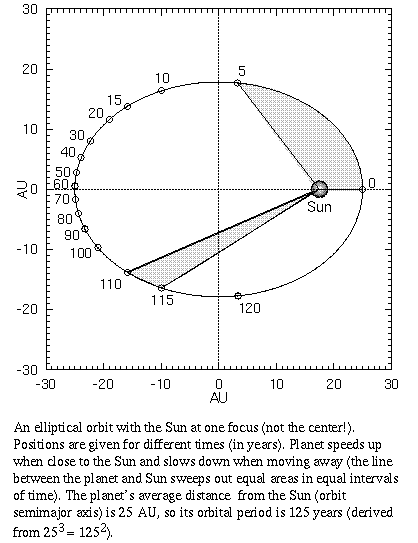
To account for the planets' motion (particularly Mars') among the stars, Kepler found that the planets must move around the Sun at a variable speed. When the planet is close to perihelion, it moves quickly; when it is close to aphelion, it moves slowly. This was another break with the Pythagorean paradigm of uniform motion! Kepler discovered another rule of planet orbits: a line between the planet and the Sun sweeps out equal areas in equal times. This is now known as Kepler's 2nd law.
-
-


Would you like to comment?
Join Diigo for a free account, or sign in if you are already a member.