
This link has been bookmarked by 4 people . It was first bookmarked on 29 Jan 2008, by James Linzel.
-
09 Dec 15
-
17 May 10

-
29 Oct 08
-
29 Jan 08
-
Plato gave his students a major problem to work on. Their task was to find a geometric explanation for the apparent motion of the planets, especially the strange retrograde motion. One key observation: as a planet undergoes retrograde motion (drifts westward with respect to the stars), it becomes brighter. Plato and his students were, of course, also guided by the Pythagorean Paradigm. This meant that regardless of the scheme they came up with, the Earth should be at the unmoving center of the planet motions. One student named Aristarchus violated that rule and developed a model with the Sun at the center. His model was not accepted because of the obvious observations against a moving Earth.
-
- The celestial objects are bright points of light while the Earth is an immense, nonluminous sphere of mud and rock. Modern astronomers now know that the stars are objects like our Sun but very far away and the planets are just reflecting sunlight.
- The Greeks saw little change in the heavens---the stars are the same night after night. In contrast to this, they saw the Earth as the home of birth, change, and destruction. They believed that the celestial bodies have an immutable regularity that is never achieved on the corruptible Earth. Today astronomers know that stars are born and eventually die (some quite spectacularly!)---the length of their lifetimes are much more than a human lifetime so they appear unchanging. Also, modern astronomers know that the stars do change positions with respect to each other over, but without a telescope, it takes hundreds of years to notice the slow changes.
- Finally, our senses show that the Earth appears to be stationary! Air, clouds, birds, and other things unattached to the ground are not left behind as they would be if the Earth was moving. There should be a strong wind if the Earth were spinning as suggested by some radicals. There is no strong wind. If the Earth were moving, then anyone jumping from a high point would hit the Earth far behind from the point where the leap began. Furthermore, they knew that things can be flung off an object that is spinning rapidly. The observation that rocks, trees, and people are not hurled off the Earth proved to them that the Earth was not moving. Today we have the understanding of inertia and forces that explains why this does not happen even though the Earth is spinning and orbiting the Sun. That understanding, though, developed about 2000 years after Plato.
-
Aristotle chose this model because most popular and observational evidence supported it and his physics and theory of motion necessitated a geocentric (Earth-centered) universe. In his theory of motion, things naturally move to the center of the Earth and the only way to deviate from that is to have a force applied to the object. So a ball thrown parallel to the ground must have a force continually pushing it along. This idea was unchallenged for almost two thousand years until Galileo showed experimentally that things will not move or change their motion unless a force is applied. Also, the crystalline spheres model agreed with the Pythagorean paradigm of uniform, circular motion (see the previous section).
-
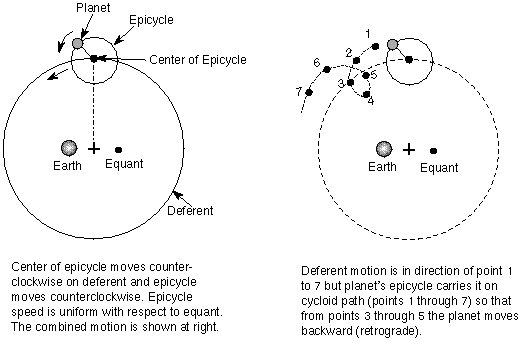
In order to explain the retrograde motion some models used epicycles---small circles attached to larger circles centered on the Earth. The planet was on the epicycle so it executed a smaller circular motion as it moved around the Earth. This meant that the planet's distance from us changed and if the epicyclic motion was in the same direction (e.g., counter-clockwise) as the overall motion around the Earth, the planet would be closer to the Earth as the epicycle carried the planet backward with respect to the usual eastward motion. This explained why planets are brighter as they retrogress.
-
Ptolemy (lived 85--165 C.E.) set out to finally solve the problem of the planets motion. He combined the best features of the geocentric models that used epicycles with the most accurate observations of the planet positions to create a model that would last for nearly 1500 years. He added some refinements to explain the details of the observations: an ``eccentric'' for each planet that was the true center of its motion (not the Earth!) and an ``equant'' for each planet moved uniformily in relation to (not the Earth!). See the figure below for a diagram of this setup.
-
-


Would you like to comment?
Join Diigo for a free account, or sign in if you are already a member.