
This link has been bookmarked by 87 people . It was first bookmarked on 01 Mar 2007, by Ronny Vandecasteele.
-
08 Nov 17
-
Kyoto Protocol
-
The Kyoto Protocol is an international agreement linked to the United Nations Framework Convention on Climate Change, which commits its Parties by setting internationally binding emission reduction targets.
Recognizing that developed countries are principally responsible for the current high levels of GHG emissions in the atmosphere as a result of more than 150 years of industrial activity, the Protocol places a heavier burden on developed nations under the principle of "common but differentiated responsibilities."
The Kyoto Protocol was adopted in Kyoto, Japan, on 11 December 1997 and entered into force on 16 February 2005. The detailed rules for the implementation of the Protocol were adopted at COP 7 in Marrakesh, Morocco, in 2001, and are referred to as the "Marrakesh Accords." Its first commitment period started in 2008 and ended in 2012.
-
In Doha, Qatar, on 8 December 2012, the "Doha Amendment to the Kyoto Protocol" was adopted.
-
During the first commitment period, 37 industrialized countries and the European Community committed to reduce GHG emissions to an average of five percent against 1990 levels. During the second commitment period, Parties committed to reduce GHG emissions by at least 18 percent below 1990 levels in the eight-year period from 2013 to 2020; however, the composition of Parties in the second commitment period is different from the firs
-
-
17 May 16
-
Kyoto Protocol
-
Kyoto Protocol 
The Kyoto Protocol is an international agreement linked to the United Nations Framework Convention on Climate Change, which commits its Parties by setting internationally binding emission reduction targets.
Recognizing that developed countries are principally responsible for the current high levels of GHG emissions in the atmosphere as a result of more than 150 years of industrial activity, the Protocol places a heavier burden on developed nations under the principle of "common but differentiated responsibilities."
The Kyoto Protocol was adopted in Kyoto, Japan, on 11 December 1997 and entered into force on 16 February 2005. The detailed rules for the implementation of the Protocol were adopted at COP 7 in Marrakesh, Morocco, in 2001, and are referred to as the "Marrakesh Accords." Its first commitment period started in 2008 and ended in 2012.
-
- New commitments for Annex I Parties to the Kyoto Protocol who agreed to take on commitments in a second commitment period from 1 January 2013 to 31 December 2020;
- A revised list of greenhouse gases (GHG) to be reported on by Parties in the second commitment period; and
- Amendments to several articles of the Kyoto Protocol which specifically referenced issues pertaining to the first commitment period and which needed to be updated for the second commitment period.
Doha Amendment 
In Doha, Qatar, on 8 December 2012, the "Doha Amendment to the Kyoto Protocol" was adopted. The amendment includes:
- New commitments for Annex I Parties to the Kyoto Protocol who agreed to take on commitments in a second commitment period from 1 January 2013 to 31 December 2020;
-
On 21 December 2012, the amendment was circulated by the Secretary-General of the United Nations, acting in his capacity as Depositary, to all Parties to the Kyoto Protocol in accordance with Articles 20 and 21 of the Protocol.
During the first commitment period, 37 industrialized countries and the European Community committed to reduce GHG emissions to an average of five percent against 1990 levels. During the second commitment period, Parties committed to reduce GHG emissions by at least 18 percent below 1990 levels in the eight-year period from 2013 to 2020; however, the composition of Parties in the second commitment period is different from the first.
-
The Kyoto mechanisms

Under the Protocol, countries must meet their targets primarily through national measures. However, the Protocol also offers them an additional means to meet their targets by way of three market-based mechanisms.
-
The Kyoto mechanisms are:
-
The mechanisms help to stimulate green investment and help Parties meet their emission targets in a cost-effective way.
Monitoring emission targets
Under the Protocol, countries' actual emissions have to be monitored and precise records have to be kept of the trades carried out.
Registry systems track and record transactions by Parties under the mechanisms. The UN Climate Change Secretariat, based in Bonn, Germany, keeps an international transaction log to verify that transactions are consistent with the rules of the Protocol.
Reporting is done by Parties by submitting annual emission inventories and national reports under the Protocol at regular intervals.
A compliance system ensures that Parties are meeting their commitments and helps them to meet their commitments if they have problems doing so.
-
Adaptation
The Kyoto Protocol, like the Convention, is also designed to assist countries in adapting to the adverse effects of climate change. It facilitates the development and deployment of technologies that can help increase resilience to the impacts of climate change.The Adaptation Fund was established to finance adaptation projects and programmes in developing countries that are Parties to the Kyoto Protocol. In the first commitment period, the Fund was financed mainly with a share of proceeds from CDM project activities. In Doha, in 2012, it was decided that for the second commitment period, international emissions trading and joint implementation would also provide the Adaptation Fund with a 2 percent share of proceeds.
The road ahead
The Kyoto Protocol is seen as an important first step towards a truly global emission reduction regime that will stabilize GHG emissions, and can provide the architecture for the future international agreement on climate change.
In Durban, the Ad Hoc Working Group on the Durban Platform for Enhanced Action (ADP) was established to develop a protocol, another legal instrument or an agreed outcome with legal force under the Convention, applicable to all Parties. The ADP is to complete its work as early as possible, but no later than 2015, in order to adopt this protocol, legal instrument or agreed outcome with legal force at the twenty-first session of the Conference of the Parties and for it to come into effect and be implemented from 2020.
-
-
24 Feb 16
-
12 Nov 15
-
The Kyoto Protocol is an international agreement linked to the United Nations Framework Convention on Climate Change, which commits its Parties by setting internationally binding emission reduction targets.
-
yoto Protocol is an international agreement linked to the United Nations Framework Convention on Climate Change, which commits its Parties by setting internationally binding emission reduction targets.
-
commits its Parties by setting internationally binding emission reduction targets.
-
he Protocol places a heavier burden on developed nations under the principle of "common but differentiated responsibilities."
-
entered into force on 16 February 2005.
-
Kyoto, Japan, on 11 December 1997
-
untries' actual emissions have to be monitored and precise records have to be kept of the trades carried out.
-
-
23 Mar 15
-
12 Jan 15
-
19 Nov 14
-
13 Nov 14
-
The Kyoto Protocol is an international agreement linked to the United Nations Framework Convention on Climate Change, which commits its Parties by setting internationally binding emission reduction targets.
Recognizing that developed countries are principally responsible for the current high levels of GHG emissions in the atmosphere as a result of more than 150 years of industrial activity, the Protocol places a heavier burden on developed nations under the principle of "common but differentiated responsibilities."
The Kyoto Protocol was adopted in Kyoto, Japan, on 11 December 1997 and entered into force on 16 February 2005. The detailed rules for the implementation of the Protocol were adopted at COP 7 in Marrakesh, Morocco, in 2001, and are referred to as the "Marrakesh Accords." Its first commitment period started in 2008 and ended in 2012.
-
-
19 Oct 14
-
commits its Parties by setting internationally binding emission reduction targets.
-
developed countries
-
common but differentiated responsibilities
-
Annex I Parties
-
second commitment period from 1 January 2013 to 31 December 2020
-
37 industrialized countries and the European Community
-
reduce GHG emissions by at least 18 percent below 1990 levels
-
-
16 Sep 14
-
commits its Parties by setting internationally binding emission reduction targets.
-
developed countries are principally responsible for the current high levels of GHG emissions in the atmosphere as a result of more than 150 years of industrial activity
-
the Protocol places a heavier burden on developed nations under the principle of "common but differentiated responsibilities."
-
detailed rules for the implementation of the Protocol
-
-
27 Apr 14
-
Kyoto Protocol is an international agreement linked to the United Nations Framework Convention on Climate Change
-
commits its Parties
-
binding emission reduction targets
-
places a heavier burden on developed nations under the principle of "common but differentiated responsibilities."
-
entered into force
-
February 2005
-
Its first commitment period started in 2008 and ended in 2012
-
December 2012
-
Doha Amendment to the Kyoto Protocol
-
New commitments for Annex I Parties
-
second commitment period from
-
2013 to
-
December 2020
-
evised list of greenhouse gases (GHG)
-
first commitment perio
-
educe GHG emissions to an average of five percent against 1990 levels
-
econd commitment period,
-
educe GHG emissions by at least 18 percent below 1990 levels in the eight-year period from 2013 to 2020; however, the composition of Parties in the second commitment period is different from the first.
-
Under the Protocol, countries must meet their targets primarily through national measures. However, the Protocol also offers them an additional means
-
three market-based mechanisms.
-
-
01 Apr 14
-
The Kyoto Protocol was adopted in Kyoto, Japan, on 11 December 1997 and entered into force on 16 February 2005. The detailed rules for the implementation of the Protocol were adopted at COP 7 in Marrakesh, Morocco, in 2001, and are referred to as the "Marrakesh Accords." Its first commitment period started in 2008 and ended in 2012.
-
Under the Protocol, countries' actual emissions have to be monitored and precise records have to be kept of the trades carried out.
-
-
10 Dec 13
-
29 Nov 13
-
During the second commitment period, Parties committed to reduce GHG emissions by at least 18 percent below 1990 levels in the eight-year period from 2013 to 2020; however, the composition of Parties in the second commitment period is different from the first.
-
-
18 Nov 13
-
07 Nov 13
-
The Kyoto Protocol is an international agreement linked to the United Nations Framework Convention on Climate Change, which commits its Parties by setting internationally binding emission reduction targets.
-
Recognizing that developed countries are principally responsible for the current high levels of GHG emissions in the atmosphere as a result of more than 150 years of industrial activity, the Protocol places a heavier burden on developed nations under the principle of "common but differentiated responsibilities."
-
-
21 Oct 13
-
etting internationally binding emission reduction targets.
-
-
29 Sep 13
-
internationally binding emission reduction targets.
-
Doha, Qatar, on 8 December 2012, the "Doha Amendment to the Kyoto Protocol" was adopted.
-
37 industrialized countries
-
average of five percent against 1990 levels
-
reduce GHG emissions by at least 18 percent
-
three market-based mechanisms.
-
The mechanisms help to stimulate green investment and help Parties meet their emission targets in a cost-effective way.
-
Under the Protocol, countries' actual emissions have to be monitored and precise records have to be kept of the trades carried out.
-
The Adaptation Fund was established to finance adaptation projects and programmes in developing countries that are Parties to the Kyoto Protocol.
-
financed mainly with a share of proceeds from CDM project activities.
-
international emissions trading and joint implementation would also provide the Adaptation Fund with a 2 percent share of proceeds.
-
-
28 May 13
-
12 Apr 13
-
The Kyoto Protocol is an international agreement linked to the United Nations Framework Convention on Climate Change, which commits its Parties by setting internationally binding emission reduction targets.
-
Recognizing that developed countries are principally responsible for the current high levels of GHG emissions in the atmosphere as a result of more than 150 years of industrial activity, the Protocol places a heavier burden on developed nations under the principle of "common but differentiated responsibilities."
-
The Kyoto Protocol was adopted in Kyoto, Japan, on 11 December 1997 and entered into force on 16 February 2005
-
During the first commitment period, 37 industrialized countries and the European Community committed to reduce GHG emissions to an average of five percent against 1990 levels
-
The Kyoto mechanisms are:
-
-
17 Jan 13
-
07 Jan 13
-
07 Dec 12
-
The Kyoto Protocol is an international agreement linked to the United Nations Framework Convention on Climate Change. The major feature of the Kyoto Protocol is that it sets binding targets for 37 industrialized countries and the European community for reducing greenhouse gas (GHG) emissions .
-
-
12 Oct 12
-
he Kyoto Protocol is an international agreement linked to the United Nations Framework Convention on Climate Change. The major feature of the Kyoto Protocol is that it sets binding targets for 37 industrialized countries and the European community for reducing greenhouse gas (GHG) emissions .These amount to an average of five per cent against 1990 levels over the five-year period 2008-2012.
The major distinction between the Protocol and the Convention is that while the Convention encouraged industrialised countries to stabilize GHG emissions, the Protocol commits them to do so.
-
- Emissions trading – known as “the carbon market"
- Clean development mechanism (CDM)
- Joint implementation (JI).
The Kyoto mechanisms are:
-
The mechanisms help stimulate green investment and help Parties meet their emission targets in a cost-effective way.
-
-
03 Oct 12
-
developed countries are principally responsible for the current high levels of GHG emissions in the atmosphere as a result of more than 150 years of industrial activity
-
-
28 Sep 12
-
14 Sep 12
-
28 May 12
-
05 May 12
-
he Kyoto Protocol is an international agreement linked to the United Nations Framework Convention on Climate Change. The major feature of the Kyoto Protocol is that it sets binding targets for 37 industrialized countries and the European community for reducing greenhouse gas (GHG) emissions .These amount to an average of five per cent against 1990 levels over the five-year period 2008-2012.
-
Protocol commits them to do so.
-
the Protocol places a heavier burden on developed nations under the principle of “common but differentiated responsibilities.”
-
-
20 Apr 12
-
13 Apr 12
-
n international agreement
-
-
15 Dec 11
-
The Kyoto Protocol is an international agreement linked to the United Nations Framework Convention on Climate Change. The major feature of the Kyoto Protocol is that it sets binding targets for 37 industrialized countries and the European community for reducing greenhouse gas (GHG) emissions .These amount to an average of five per cent against 1990 levels over the five-year period 2008-2012.
-
-
14 Dec 11
 gtpagett
definition and terms
references-
The Kyoto Protocol is an international agreement linked to the United Nations Framework Convention on Climate Change. The major feature of the Kyoto Protocol is that it sets binding targets for 37 industrialized countries and the European community for reducing greenhouse gas (GHG) emissions .These amount to an average of five per cent against 1990 levels over the five-year period 2008-2012.
-
Recognizing that developed countries are principally responsible for the current high levels of GHG emissions in the atmosphere as a result of more than 150 years of industrial activity
-
places a heavier burden on developed nations under the principle of “common but differentiated responsibilities.”
-
countries must meet their targets primarily through national measures
-
- Emissions trading – known as “the carbon market"
- Clean development mechanism (CDM)
- Joint implementation (JI).
The Kyoto mechanisms are:
-
The Adaptation Fund was established to finance adaptation projects and programmes in developing countries that are Parties to the Kyoto Protocol. The Fund is financed mainly with a share of proceeds from CDM project activities.
-
-
18 Nov 11
-
The Kyoto Protocol is an international agreement linked to the United Nations Framework Convention on Climate Change
-
binding targets for 37 industrialized countries
-
The Kyoto Protocol is an international agreement linked to the United Nations Framework Convention on Climate Change. The major feature of the Kyoto Protocol is that it sets binding targets for 37 industrialized countries and the European community for reducing greenhouse gas (GHG) emissions .These amount to an average of five per cent against 1990 levels over the five-year period 2008-2012.
The
-
The major feature of the Kyoto Protocol is that it sets binding targets for 37 industrialized countries and the European community for reducing greenhouse gas (GHG) emissions
-
ajor distinction between the Protocol and the Convention is that while the Convention encouraged industrialised countries to stabilize GHG emissions, the Protocol commits them to do so.
-
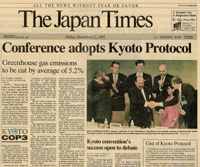
Delegates celebrated adoption of the Protocol in 1997.The Kyoto Protocol is an international agreement linked to the United Nations Framework Convention on Climate Change. The major feature of the Kyoto Protocol is that it sets binding targets for 37 industrialized countries and the European community for reducing greenhouse gas (GHG) emissions .These amount to an average of five per cent against 1990 levels over the five-year period 2008-2012 -
Delegates celebrated adoption of the Protocol in 1997. The Kyoto Protocol is an international agreement linked to the United Nations Framework Convention on Climate Change. The major feature of the Kyoto Protocol is that it sets binding targets for 37 industrialized countries and the European community for reducing greenhouse gas (GHG) emissions .These amount to an average of five per cent against 1990 levels over the five-year period 2008-2012.
The m
-
Delegates celebrated adoption of the Protocol in 1997.The Kyoto Protocol is an international agreement linked to the United Nations Framework Convention on Climate Change. The major feature of the Kyoto Protocol is that it sets binding targets for 37 industrialized countries and the European community for reducing greenhouse gas (GHG) emissions .These amount to an average of five per cent against -
Delegates celebrated adoption of the Protocol in 1997.The Kyoto Protocol is an international agreement linked to the United Nations Framework C on vention on Climate Change. The major feature of the Kyoto Protocol is that it sets binding targets for 37 industrialized countries and the European community for reducing greenhouse gas (GHG) emissions .These amount to an average of five per cent against 1990 levels over the five-year period 2008-2012 -
Delegates celebrated adoption of the Protocol in 1997.The Kyoto Protocol is an international agreement linked to the United Nations Framework C on venti on on Climate Change. The major feature of the Kyoto Protocol is that it sets binding targets for 37 industrialized countries and the European community for reducing greenhouse gas (GHG) emissions .These amount to an average of five per cent against 1990 levels over the five-year period 2008-2012 -
Protocol places a heavier burden on developed nations
-
The mechanisms help stimulate green investment and help Parties meet their emission targets in a cost-effective way.
-
Under the Protocol, countries’actual emissions have to be monitored and precise records have to be kept of the trades carried out.
-
first step
-
By the end of the first commitment period of the Kyoto Protocol in 2012, a new international framework needs to have been negotiated and ratified that can deliver the stringent emission reductions the Intergovernmental Panel on Climate Change (IPCC) has clearly indicated are needed.
-
-
22 Sep 11
-
The Kyoto Protocol is an international agreement linked to the United Nations Framework Convention on Climate Change. The major feature of the Kyoto Protocol is that it sets binding targets for 37 industrialized countries and the European community for reducing greenhouse gas (GHG) emissions .These amount to an average of five per cent against 1990 levels over the five-year period 2008-2012.
-
-
15 Aug 11
-
18 Apr 11
-
The Kyoto Protocol is an international agreement linked to the United Nations Framework Convention on Climate Change. The major feature of the Kyoto Protocol is that it sets binding targets for 37 industrialized countries and the European community for reducing greenhouse gas (GHG) emissions .These amount to an average of five per cent against 1990 levels over the five-year period 2008-2012.
The major distinction between the Protocol and the Convention is that while the Convention encouraged industrialised countries to stabilize GHG emissions, the Protocol commits them to do so.
-
Recognizing that developed countries are principally responsible for the current high levels of GHG emissions in the atmosphere as a result of more than 150 years of industrial activity, the Protocol places a heavier burden on developed nations under the principle of “common but differentiated responsibilities.”
The Kyoto Protocol was adopted in Kyoto, Japan, on 11 December 1997 and entered into force on 16 February 2005. The detailed rules for the implementation of the Protocol were adopted at COP 7 in Marrakesh in 2001, and are called the “Marrakesh Accord
-
The Kyoto Protocol is generally seen as an important first step towards a truly global emission reduction regime that will stabilize GHG emissions, and provides the essential architecture for any future international agreement on climate change.
-
-
14 Apr 11
-
The Kyoto Protocol is an international agreement linked to the United Nations Framework Convention on Climate Change
-
ets binding targets for 37 industrialized countries and the European community for reducing greenhouse gas (GHG) emissions
-
1990 levels over the five-year period 2008-2012
-
-
10 Apr 11

-
Kyoto Protocol
-
international agreement linked to the United Nations Framewo
-
Convention on Climate Change
-
Kyoto Protocol
-
reducing greenhouse gas (GHG) emissions
-
-
08 Apr 11

-
21 Mar 11
-
02 Mar 11
-
24 Jan 11
-
The major feature of the Kyoto Protocol is that it sets binding targets for 37 industrialized countries and the European community for reducing greenhouse gas (GHG) emissions .
-
-
13 Jan 11
-
05 Dec 10
-
25 Sep 10
-
The major feature of the Kyoto Protocol is that it sets binding targets for 37 industrialized countries and the European community for reducing greenhouse gas (GHG) emissions .These amount to an average of five per cent against 1990 levels over the five-year period 2008-2012.
-
encouraged
-
The detailed rules for the implementation of the Protocol were adopted at COP 7 in Marrakesh in 2001, and are called the “Marrakesh Accords.”
-
-
13 Jul 10
-
27 May 10
-
11 Apr 10
-
The major feature of the Kyoto Protocol is that it sets binding targets for 37 industrialized countries and the European community for reducing greenhouse gas (GHG) emissions
-
The major distinction between the Protocol and the Convention is that while the Convention encouraged industrialised countries to stabilize GHG emissions, the Protocol commits them to do so.
-
-
14 Jan 10
-
04 Dec 09
-
The Kyoto Protocol was adopted in Kyoto, Japan, on 11 December 1997 and entered into force on 16 February 2005.
-
-
12 Nov 09
-
22 Sep 09
-
The Kyoto Protocol is an international agreement linked to the United Nations Framework Convention on Climate Change. The major feature of the Kyoto Protocol is that it sets binding targets for 37 industrialized countries and the European community for reducing greenhouse gas (GHG) emissions .
-
-
-
The Kyoto Protocol is an international agreement linked to the United Nations Framework Convention on Climate Change. The major feature of the Kyoto Protocol is that it sets binding targets for 37 industrialized countries and the European community for reducing greenhouse gas (GHG) emissions .These amount to an average of five per cent against 1990 levels over the five-year period 2008-2012.
-
-
15 May 09
-
24 Aug 08
-
08 Apr 08
-
it became increasingly evident that only a firm and binding commitment by developed countries to reduce emissions could send a signal strong enough to convince businesses, communities and individuals to act on climate change
-
The major distinction between the two, however, is that while the Convention encouraged developed countries to stabilize GHG emissions, the Protocol commits them to do so.
-
Because it will affect virtually all major sectors of the economy, the Kyoto Protocol is considered to be the most far-reaching agreement on environment and sustainable development ever adopted.
-
These targets must be met within a five-year time frame between 2008 and 2012, and add up to a total cut in GHG emissions of at least 5% against the baseline of 1990
-
The Protocol places a heavier burden on developed nations under the principle of “common but differentiated responsibilities.” This has two main reasons. Firstly, those countries can more easily pay the cost of cutting emissions. Secondly, developed countries have historically contributed more to the problem by emitting larger amounts of GHGs per person than in developing countries.
-
These mechanisms help identify lowest-cost opportunities for reducing emissions and attract private sector participation in emission reduction efforts.
-
Some scientists have doubted the scientific basis of the Kyoto Protocol, claiming that there is not a clear connection between increases in GHG emissions and climate change. The Fourth Assessment Report of the Intergovernmental Panel on Climate Change (IPCC), launched in the course of 2007, put an end to that discussion. Prepared by scientists from all over the world, it placed the reality of human-induced climate change beyond any doubt.
-
As a result of the Protocol, governments have already put, and are continuing to put legislation and policies in place to meet their commitments; a carbon market has been created; and more and more businesses are making the investment decisions needed for a climate-friendly future.
-
-
05 Oct 07
-
The 1997 Kyoto Protocol shares the Convention’s objective, principles and institutions, but significantly strengthens the Convention by committing Annex I Parties to individual, legally-binding targets to limit or reduce their greenhouse gas emissions.
-
-
01 Mar 07
-
17 Dec 06


Would you like to comment?
Join Diigo for a free account, or sign in if you are already a member.