
This link has been bookmarked by 1 people . It was first bookmarked on 17 Oct 2007, by Nicolas.
-
17 Oct 07
-
In many ways, I think, how a game world handles the losers says more about it and its participants than how it handles the winners. If a game system can tolerate more losers (not scare them off) it can more richly reward the winners. Yet, to have winners a PvP game must be able to recycle its losers. If the losers feel like they are only serving as the redshirts to the fantasy of a few yellow-shirts (fn1) they will leave.
-
Eve-Online seems to not only have been able to recycle its losers, it has built an ecosystem to nurture them for another day. In its own way I think this speaks some to the ways social systems under stress can be resilient.
-
First it has to a large extent (I reckon) redefined winning from the perspective of the individual away from simple metrics. Winning to some players is belonging to an "leet" (elite) corporation or alliance. To others it means reveling in (e.g.) "pirate" /trader /miner /mercenary /miner etc. subcultures. Pirates may be poor, without a permanent home and with bad breath. But what counts to them is a code of conduct that seems to bind them, for example.
-
Second, the Eve-Online game culture has also developed, I think, a number of narratives that allow players to more easily detach themselves from their losses:
1.) conspiracy theories and the shadow-world stories (subterfuge) distance blame
2.) the scale of the alliance struggle dwarfs individual losses
3.) the "intel" / information superiority game introduces a helpful fiction (not bested, but undone!)Beyond cultural considerations, I think there are at least two structural elements that help recycle losers:
A.) There is an interconnected social/economic/security ecosystem that spans the three distinctive types of "terrain" in Eve-Online: "0.0" space (alliances), "low-security", and "Empire Space".
B.) There exists a high degree of organizational fluidity that can exploit the ecosystem of (A.)
The combination of (A.) and (B.) above seems to faciliate the ability of players and player organizations to adapt to changing circumstances.
-
Just one scenario that illustrates the number of ways the security, social, and economic terrain of the Eve-Online system may be exploited to regenerate the health of a tribe that once lost.
-
"(i)t's pretty significant to the understanding of... EVE has large areas of "high-security" space wherein only special, legally-sanctioned and paid for wars are in effect (and few 0.0 alliances seek to engage in those wars) as well as much "low-security" but (NPC) Empire-claimed space where rules of engagement are typically relaxed in a friendly direction (Some corps in my alliance prohibit killing neutrals in lowsec. Mine doesn't, but we generally only go after them if we're on the hunt, and we usually have better things to do than hunt in lowsec). To put this in perspective, imagine that there are cities, and no one shoots strangers there. There are large areas of wilderness, and it's dangerous but rarely fully interdicted. And then there are clan strongholds, and a few of those ...are open to strangers, but most alliances, if they catch you on their land (or rather, in their space) will shoot you."
-
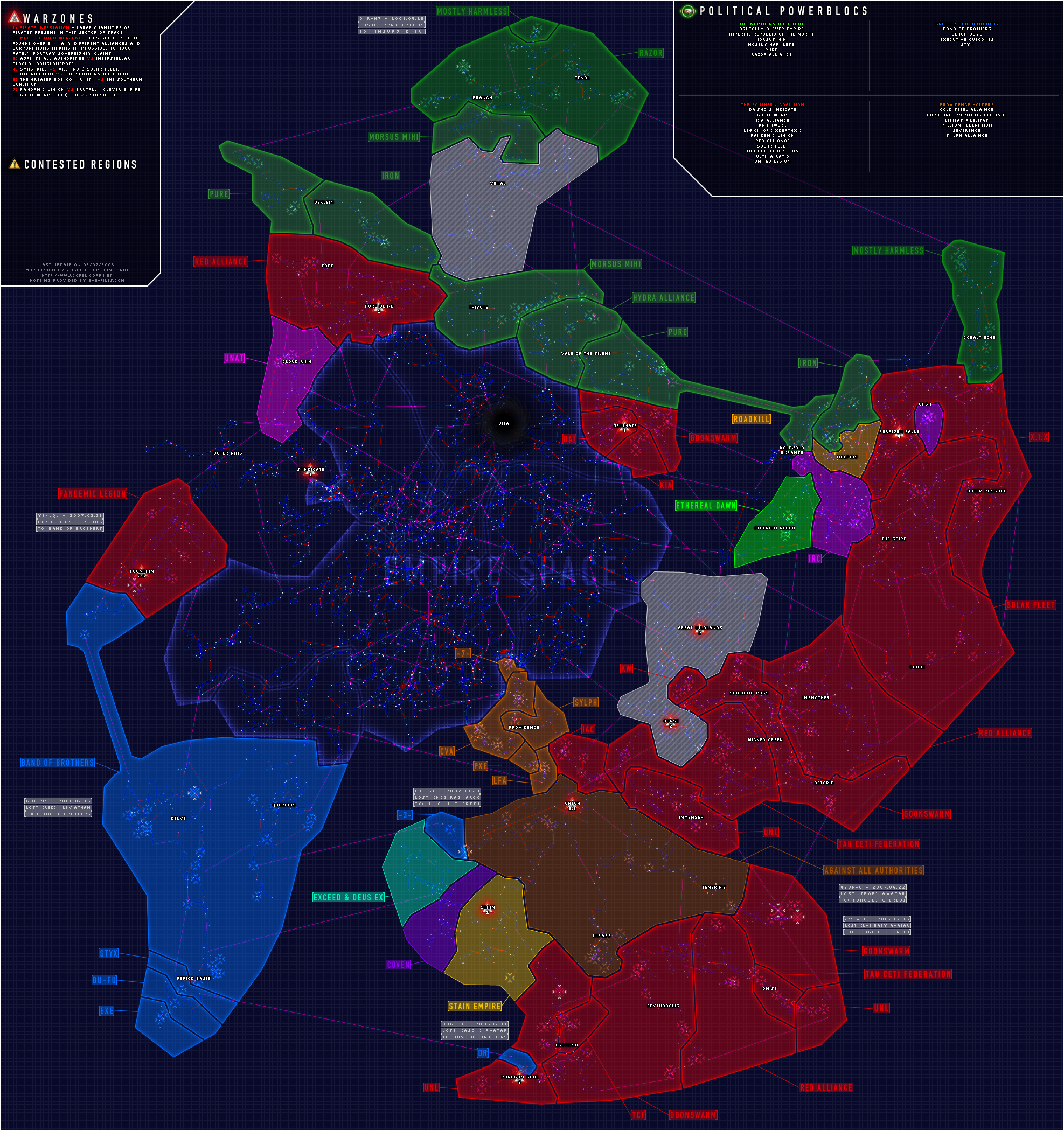
For a graphical depiction, consider the latest Eve-Online political map (fn3). The colored regions are spaces controlled by the largest alliances. There is a swath in the middle labeled "Empire Space." That is where most players, I reckon inhabit. It is too where most of the commerce occurs. Empire Space is as Devin wrote, the "big city."
-
The fringe around Empire Space that is called "low-security" space. Low-security space is an estuarial place where Empire corporations and alliance interests meet-up. It too has wealth (minerals) and pirates. Alliance areas are everywhere else beyond the "low-security" areas.
-
It is misleading to think of "0.0" or alliance regions as lawless. As I've tried to depict in my earlier posts in this series, these are surprisingly lawful places. It is just that all the law-abiding parties may be at war with each other.
-
One of the biggest factors in why losers can rebuild: The scale of the world. If the tides of war and/or politics drive you out of your space, assuming you can retain a critical mass of people under a coherent identity, you can find somewhere else on the map, far away, where things are finely balanced. Your entry can tip the scales, and give you the opportunity to start serious rebuilding. Or you can become a "renter", a vassal that pays for the priviledge of using space somebody else "owns".
-
The most interesting thing is the 3-tier structure that has grown up for exploiting and protecting chunks of 0.0. At the highest level you have major powers, capable of sustaining the economic and psychological strain of protracted warfare. The next step down are the minor powers, generally aligned with a major power for defense and usually contributing manpower and treasure to the offensives. At the bottom you have the "renters", much weaker militarily and focused almost exclusively on resource extraction.
-
As I'm sure you know, I could go on at some length about the political environment of Eve, it's by far the most complex and nuanced of any MMO, *ever*. Just trying to give the general history of it would be incredibly difficult, because at any given time there are hundreds of parallel tracks of that history occuring, and every player is biased by his viewpoint to assume that the pieces he was involved in were the most important.
-
EVE lacks two important aspects that other traditional MMORPGs have.
First is a goal. EVE's strength and weakness is the open ended nature of gameplay. There is no maximum achievable level, except for a specific niche (and even these niches are constantly expanded upon with diferent specialisations). EVE also lacks any character class mechanic, preventing players from simply being a warrior, trader etc. In fact EVE resolutely shies away from pushing a character down any path.
-
Whilst this is not a problem for self-motivated individuals, goal-orientated players who expect to be provided an objective tend to flounder. As my wife described it, "Too big, too pointless."
-
The second problem Eve faces, which again can also be perceived as a strength, is complexity. I'm an academic scholar who has worked in IT and played computer games obsessively since I was 4. I've been lead QA on a very successful and fairly complex multiplayer online game. I'm not exactly a noob. However, even I would have to admit to finding the interface of EVE daunting, to be charitable, before you even enter into the complexities of trading, manufacturing and construction.
-

Would you like to comment?
Join Diigo for a free account, or sign in if you are already a member.