
This link has been bookmarked by 32 people . It was first bookmarked on 19 Jan 2007, by Mark Marino.
-
19 Apr 13
-
Borges's narrator describes how his universe consists of an enormous expanse of interlocking hexagonal rooms, each of which contains the bare necessities for human survival—and four walls of bookshelves. Though the order and content of the books is random and apparently completely meaningless, the inhabitants believe that the books contain every possible ordering of just a few basic characters (23 letters, spaces and punctuation marks). Though the majority of the books in this universe are pure gibberish, the library also must contain, somewhere, every coherent book ever written, or that might ever be written, and every possible permutation or slightly erroneous version of every one of those books. The narrator notes that the library must contain all useful information, including predictions of the future, biographies of any person, and translations of every book in all languages. Conversely, for many of the texts some language could be devised that would make it readable with any of a vast number of different contents.
-
The concept of the library is also overtly analogous to the view of the universe as a sphere having its center everywhere and its circumference nowhere. The mathematician and philosopher Blaise Pascal employed this metaphor, and in an earlier essay Borges noted that Pascal's manuscript called the sphere effroyable, or "frightful".
-
a library containing all possible books, arranged at random, might as well be a library containing zero books, as any true information would be buried in, and rendered indistinguishable from, all possible forms of false information; the experience of opening to any page of any of the library's books has been simulated by websites which create screenfuls of random letters. Of course, this argument is only relevant for factual books. The library will contain every poem, play and novel imaginable; and in the case of non-factual material such as this, the idea of distinguishing 'true' from 'false' information is not of relevance.
-
Every book in the library is "intelligible", if one decodes it right, simply because it can be decoded into any other book in the library, using a third book as a One-time pad. This lends itself to the philosophical idea proposed by Immanuel Kant, that our mind helps to structure our experience of reality; thus the rules of reality (as we know it) are intrinsic to the mind. So if we identify these rules, we can better decode 'reality'.
-
On a psychological level, the infinite storehouse of information is a hindrance and a distraction, because it lures one away from writing one's own book (i.e. living one's own life).
-
-
05 Apr 13
-
24 Feb 13
-
Though the order and content of the books is random and apparently completely meaningless, the inhabitants believe that the books contain every possible ordering of just a few basic characters (23 letters, spaces and punctuation marks).
-
-
06 Dec 12
-
19 Oct 12
 Thomas James
"Borges's narrator describes how his universe consists of an enormous expanse of interlocking hexagonal rooms, each of which contains the bare necessities for human survival—and four walls of bookshelves. Though the order and content of the books is random and apparently completely meaningless, the inhabitants believe that the books contain every possible ordering of just a few basic characters (23 letters, spaces and punctuation marks). Though the majority of the books in this universe are pure gibberish, the library also must contain, somewhere, every coherent book ever written, or that might ever be written, and every possible permutation or slightly erroneous version of every one of those books. The narrator notes that the library must contain all useful information, including predictions of the future, biographies of any person, and translations of every book in all languages. Conversely, for many of the texts some language could be devised that would make it readable with any of a vast number of different contents.
Despite — indeed, because of — this glut of information, all books are totally useless to the reader, leaving the librarians in a state of suicidal despair. This leads some librarians to superstitions and cult-like behaviour, such as the "Purifiers", who arbitrarily destroy books they deem nonsense as they scour through the library seeking the "Crimson Hexagon" and its illustrated, magical books. Another is the belief that since all books exist in the library, somewhere one of the books must be a perfect index of the library's contents; some even believe that a messianic figure known as the "Man of the Book" has read it, and they travel through the library seeking him." -
25 Aug 12
-
13 Jun 12
-
The Library contains at least
 books
books -
- Authentic volume:

- Variants with one misprint:
 = 31,488,000
 - Variants with exactly two misprints:
 = 495,746,694,144,000
 - Variants with exactly three misprints:
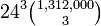 = 5,203,349,369,788,317,696,000
 - Variants with exactly four misprints:
 = 40,960,672,578,684,980,713,193,472,000
Just one "authentic" volume, together with all those variants containing only a handful of misprints, would occupy so much space that they would fill the known universe. Ignoring punctuation:
The number of different ways in which the books could be arranged is
 .[8][9]
 - Authentic volume:
-
-
by defining rules for the universe, we create rules of the universe. In short, any room in the library could be the crimson hexagon. Hidden in the gibberish of the library, there are works beyond human capacity to write.
-
Babel can be constructed in its entirety simply by writing a dot on one piece of paper and a dash on another.
-
-
06 Jun 12
-
22 Mar 12
-
26 Jun 10
-
31 Oct 09
-
02 Aug 09
-
19 Mar 09
-
21 Dec 07
-
30 Nov 07
-
27 Jan 07
-
La biblioteca de Babel
-
Borges's best known story
-
every possible ordering
-
mp3 audio version
-
Wikipedia
-
The Library of Babel
-
Argentine author
-
postage stamp
-
Contents
[hide] -
There is no reference to monkeys or typewriters
-
half-dozen monkeys provided with typewriters would, in a few eternities, produce all the books in the British Museum
-
The conclusions which Kelly draws are intriguing.
-
logarithms.
-
-
10 Nov 05
 spinster
"The Library of Babel" ("La biblioteca de Babel") is a short story by Argentine author (and librarian) Jorge Luis Borges, conceiving of a universe in the form of a vast library containing all possible 410-page books that can be composed in a certain chara


 books
books
 = 31,488,000
 = 495,746,694,144,000
 = 5,203,349,369,788,317,696,000
 = 40,960,672,578,684,980,713,193,472,000
 .
.


Would you like to comment?
Join Diigo for a free account, or sign in if you are already a member.