
This link has been bookmarked by 65 people and liked by 1 people. It was first bookmarked on 04 Dec 2006, by Diana Carlisle.
-
16 Mar 15
-
01 Feb 15
-
26 Nov 14
-
He stated, "I will never accept any proposals that will obligate the Jewish people to leave France, because to me the Jews are the same as any other citizen in our country. It takes weakness to chase them out of the country, but it takes strength to assimilate them."[183] He was seen as so favourable to the Jews that the Russian Orthodox Church formally condemned him as "Antichrist and the Enemy of God"
-
-
15 Nov 14
-
1804
-
feudalism
-
jurisdictions
-
jurisdictions
-
-
10 Oct 14
-
He won the large majority of his battles and seized control of most of continental Europe in a quest for personal power and to spread the ideals of the French Revolution.[3] Widely regarded as one of the greatest commanders in history, his campaigns are studied at military academies worldwid
-
nch with a heavy Corsican accent. Well-educated, he rose to prominence under the French First Republic and led successful campaigns against the enemies of the French revolution who set up the First and Second Coalitions, most notably his campaigns in Italy.
He took power in a coup d'état in 1799 and installed himself as First Consul. In 1804 he made himself emperor of the French people. He fought a series of wars—the Napoleonic Wars—that involved complex coalitions for and against him. After a streak of victories, France secured a dominant position in continental Europe, and Napoleon maintained the French sphere of influence through the formation of extensive alliances and the elevation of friends and family members to ru
-
but he was finally defeated
-
adly damaged and never fully recovered. In 1813, the Sixth Coalition defeated his forces at the Battle of Leipzig and his enemies invaded France. Napoleon was forced to abdicate and go in exile to the Italian island of Elba. In 1815 he escaped and returned to power, but he was finally defeated at the Battle of Waterloo in June 1815. He spent the last six years of his life in confinement by the British on the island of Saint Helena. An autopsy concluded he died of stomach cancer but there has been debate about the c
-
and the French invasion of
-
Napoléon Bonaparte (French pronunciation: [napɔleɪˈɔ̃ bɔnaˈpart], born Napoleone di Buonaparte; 15 August 1769 – 5 May 1821) was a French military and political leader who rose to prominence during the latter stages of the French Revolution and its associated wars in Europe.
As Napoleon I, he was Emperor of the French from 1804 to 1814 and again in 1815. He implemented a wide array of liberal reforms across Europe, including the abolition of feudalism and the spread of religious toleration.[2] His legal code in France, the Napoleonic Code, influenced numerous civil law jurisdictions worldwide. Napoleon is remembered for his role in leading France against a series of coalitions in the Napoleonic Wars. He won the large majority of his battles and seized control of most of continental Europe in a quest for personal power and to spread the ideals of the French Revolution.[3] Widely regarded as one of the greatest commanders in history, his campaigns are studied at military academies worldwide. He remains one of the most studied political and military leaders in all of history.[4]
Napoleon was born in Corsica in a family of noble Italian ancestry that had settled in Corsica in the 16th century. He spoke French with a heavy Corsican accent. Well-educated, he rose to prominence under the French First Republic and led successful campaigns against the enemies of the French revolution who set up the First and Second Coalitions, most notably his campaigns in Italy.
He took power in a coup d'état in 1799 and installed himself as First Consul. In 1804 he made himself emperor of the French people. He fought a series of wars—the Napoleonic Wars—that involved complex coalitions for and against him. After a streak of victories, France secured a dominant position in continental Europe, and Napoleon maintained the French sphere of influence through the formation of extensive alliances and the elevation of friends and family members to rule other European countries as French vassal states.
The Peninsular War (1807–14) and the French invasion of Russia in 1812 marked major military failures. His Grande Armée was badly damaged and never fully recovered. In 1813, the Sixth Coalition defeated his forces at the Battle of Leipzig and his enemies invaded France. Napoleon was forced to abdicate and go in exile to the Italian island of Elba. In 1815 he escaped and returned to power, but he was finally defeated at the Battle of Waterloo in June 1815. He spent the last six years of his life in confinement by the British on the island of Saint Helena. An autopsy concluded he died of stomach cancer but there has been debate about the cause of his death, and some scholars have speculated he was a victim of arsenic poisoning.
-
red for his role in leading France against a series of coalitions in the Napoleonic Wars. He won the large majority of his battles and seized control of most of continental Europe in a quest for personal power and to spread the ideals of the French Revolution.[3] Widely regarded as one of the greatest commanders in history, his campaigns are studied at military academies worldwide.
-
he was Emperor of the French from 1804 to 1814 and again in 1815. He implemented a wide array of liberal reforms across Euro
-
His legal code in France, the Napoleonic Code, influenced numerous civil law jurisdictions worldwide. Napoleon is remembered for his role in leading France against a series of coalitions in the Napoleonic Wars. He won the large majority of his battles and seized control of most of continental Europe in a quest for personal power and to spread the ideals of the French Revolution.[3] Widely regarded as one of the greatest commanders in history, his campaigns are studied at military academies worldwide. He remains one of the most studied political and military leaders in all of history.[4]
-
He took power in a coup d'état in 1799 and installed himself as First Consul. In 1804 he made himself emperor of the French people. He fought a series of wars—the Napoleonic Wars—that involved complex coalitions for and against him. After a streak of victories, France secured a dominant position in continental Europe, and Napoleon maintained the French sphere of influence through the formation of extensive alliances and the elevation of friends and family members to rule other European countries as French vassal states.
-
His legal code in France, the Napoleonic Code, influenced numerous civil law jurisdictions worldwide. Napoleon is remembered for his role in leading France against a series of coalitions in the Napoleonic Wars.
-
His legal code in France, the Napoleonic Code, influenced numerous civil law jurisdictions worldwide. Napoleon is remembered for his role in leading France against a series of coalitions in the Napoleonic Wars
-
His legal code in France, the Napoleonic Code, influenced numerous civil law jurisdictions worldwide. Napoleon is remembered for his role in leading France against a series of coalitions in the Napoleonic Wars
-
g France against a series of coalitions in the Napoleonic Wars. He won the large majority of his battles and seized control of most of continental Europe in a quest for personal power and to spread th
-
His legal code in France, the Napoleonic Code, influenced numerous civil law jurisdictions worldwide. Napoleon is remembered for his role in leading France against a series of coalitions in the Napoleonic Wars. He won the large majority of his battles and seized control of most of continental Europe in a quest for personal power and to spread the ideals o
-
He won the large majority of his battles and seized control of most of continental Europe in a quest for personal power and to spread the ideals of the French Revolution.[3] Widely regarded as one of the greatest commanders in history, his campaigns are studied at military academies worldwide. He remains one of the most studied political and military leaders in all of history.[4]
-
As Napoleon I, he was Emperor of the French from 1804 to 1814 and again in 1815. He implemented a wide array of liberal reforms acro
-
-
23 May 14
-
Napoleon Bonaparte (French: Napoléon Bonaparte [napoleɔ̃ bɔnɑpaʁt], Italian: Napoleone Buonaparte; 15 August 1769 – 5 May 1821) was a French military and political leader who rose to prominence during the latter stages of the French Revolution and its associated wars in Europe.
-
Napoleon was born in Corsica in a family of noble Italian ancestry that had settled in Corsica in the 16th century.
-
He took power in a coup d'état in 1799 and installed himself as First Consul.
-
-
21 Apr 14
-
He won the majority of his battles and seized control of most of continental Europe in a quest for personal power and to spread the ideals of the French Revolution.
-
-
12 Mar 14
-
03 Mar 14
-
13 Feb 14
-
Napoleon
-
Napoleon Bonaparte
-
15 August 1769 – 5 May 1821)
-
French military and political leader who rose to prominence during the latter stages of the French Revolution and its associated wars in Europe.
-
Napoleon I
-
he was Emperor of the French from 1804 to 1814.
-
implemented a wide array of liberal reforms across Europe
-
spread of religious toleration
-
influenced numerous civil law
-
abolition of feudalism
-
jurisdictions worldwide
-
coalitions in the Napoleonic Wars.
-
majority of his battles and seized control of most of continental Europe
-
spread the ideals of the French Revolution.
-
one of the greatest commanders in history
-
campaigns are studied at military academies worldwide.
-
most studied political and military leaders in all of history.
-
one of the
-
Corsica in the 16th century
-
Napoleon was born in Corsica
-
spoke French with a heavy Corsican accent
-
French First Republic and led successful campaigns against the enemies of the French revolution who set up the First and Second Coalitions, most notably his campaigns in Italy.
-
rose to prominence
-
Well-educated
-
coup d'état in 1799
-
In 1804
-
installed himself as First Consul.
-
himself emperor of the French people.
-
streak of victories,
-
complex coalitions for and against him
-
extensive alliances and the elevation of friends and family members to rule other European countries as French vassal states.
-
Napoleon maintained the French sphere of influence
-
1812 marked major military failures.
-
The Peninsular War (1807–14)
-
Grande Armée was badly damaged and never fully recovered.
-
n 1815 he escaped and returned to power, but he was finally defeated at the Battle of Waterloo in June 1815.
-
invaded France.
-
exile to the Italian island of Elba
-
last 6 years of his life in confinement by the British on the island of Saint Helena.
-
died of stomach cancer
-
debate about the cause of his death, some scholars have speculated he was a victim of arsenic poisoning.
-
18 May 1804 – 11 April 1814
20 March 1815 – 22 June 1815 -
2 December 1804
-
Himself as First Consul
-
Louis XVIII (de jure in 1814)
-
17 March 1805 – 11 April 1814
-
26 May 1805
-
-
Napoleon was born on 15 August 1769
-
In January 1779, Napoleon was enrolled at a religious school
-
Upon graduating in September 1785
-
-
11 Feb 14
-
spread of religious toleration.[2] His legal code
-
Napoleon was born in Corsica in a family of noble Italian ancestry which had settled in Corsica in the 16th century. He spoke French with a heavy Corsican accent. Well-educated, he rose to prominence under the French First Republic and led successful campaigns against the enemies of the French revolution who set up the First and Second Coalitions, most notably his campaigns in Italy.
-
He took power in a coup d'état in 1799 and installed himself as First Consul. In 1804 he made himself emperor of the French people.
-
-
11 Dec 13
 denkcjames
Napoleon Wikipedia
-
03 Dec 13
-
the first monarch of France bearing the title emperor
-
-
09 Oct 13
-
legal reform, the
-
influence
-
hegemony
-
established
-
hegemony
-
consolidating an imperial monarchy
-
greatest military commanders of all time,
-
Ruler of France
-
tired of wa
-
colonial territories
-
withdrawal
-
British troops
-
withdrawal of British troops from most colonial territories it had recently occupied
-
First Consul for life in
-
short-lived.
-
uneasy
-
declaration of war
-
invasion camp
-
re-established slavery
-
Haitian Revolution.
-
banned following the Revolution
-
slave revolt,
-
fierce resistance
-
bankruptcy
-
French possessions on the mainland of North America would be indefensible
-
sold them to the United States
-
justify
-
hereditary monarchy
-
re-creation
-
Bourbon restoration
-
more difficult
-
secure
-
allegiance of the army.
-
broke
-
Peace of Amiens
-
declared war
-
Great Britain
-
prepare
-
convinced
-
Austria and Russia
-
Third Coalition
-
o join
-
away fr
-
o lure
-
attack
-
West Indies,
-
Franco-Spanish fleet
-
take control
-
French armies t
-
cross
-
defeat
-
naval
-
concede territory;
-
dissolution
-
so successful
-
finest of all I have fought
-
not o
-
sed to be French foreign policy
-
reality
-
personal Napoleonic one"
-
lost touch
-
thirty million Frenchmen
-
ambitions
-
ambitious for himself,
-
embodied
-
grand scheme to establish a French presence in the Middle East.
-
"our sincere and natural ally",
-
divided the continent between the two powers
-
stripped that country of half its territory.
-
Europe-wide commercial boycott of Britain
-
economic warfare
-
Continental S
-
invaded Spain as well,
-
central to his final defeat,
-
o open
-
another front
-
apoleonic code
-
remained in force
-
after Napoleon's defeat.
-
what will live forever, is my Civil Code.
-
importance today
-
quarter of the world's jurisdictions
-
arge section
-
unpopular
-
French socie
-
aided
-
adoption
-
new standard
-
French
-
metric system
-
aid the foundations
-
definitive introduction
-
across Europe
-
showed
-
discussions
-
much tolerance
-
political reasons
-
pretended interest
-
for their religion;
-
elieve in this religion
-
religious opportunism
-
making myself
-
Italian
-
making myself
-
Moslem
-
established myself
-
genuine
-
Prophet Muhammad,
-
admiration
-
eligiously married
-
Austrian princess
-
abolished
-
doubted
-
-
finest of all"
-
like the Mohammedan religion best
-
anointed by a priest
-
revolutionaries and Catholics
-
reconciliation
-
solidified the Roman Catholic Church
-
civil status.
-
brought back
-
hostility
-
favor
-
state
-
Napoleon's favour
-
tilted firmly
-
Skillful conquerors
-
controlling Rome
-
olitical sense
-
not got entangled with priests.
-
Religious
-
emancipation
-
restricted
-
property, worship, and careers.
-
expanded
-
anti-semitic
-
reaction
-
rights
-
benefit
-
France
-
emancipation
-
attracting Jews t
-
proposals
-
eave France
-
same as any other citizen in our country.
-
ewish people
-
obligate
-
takes
-
weakness
-
strength
-
assimilate them.
-
so favourable t
-
Antichrist and the Enemy of God"
-
remarkable personality
-
strongest leaders to his will.
-
intellectual
-
powers
-
y bent
-
hypnotic
-
unrivaled
-
impact
-
devoured statistical information
-
innovator
-
financial, bureaucratic, and diplomatic resources of France.
-
integrate
-
organize
-
brilliant insights
-
using
-
generating
-
own thoughts
-
organize
-
"seeing"
-
best plays
-
many moves ahead.
-
chess master,
-
nexhaustible energy,
-
lost his old verve.
-
1812,
-
After
-
great Russian campaign
-
recognize
-
leaders
-
opportunity
-
seize it
-
crisis after crisis
-
to the occasion.
-
rarely rose
-
stood by them. He
-
reorganized
-
Napoleon's
-
personality
-
supply the men and money ne
-
inspired
-
presence
-
France
-
worth
-
force
-
neutralized
-
material difficultie
-
soldiers
-
personalities
-
the most competent human being who ever lived"
-
-
14 Aug 13
-
09 Apr 13
-
05 Jan 13
 Arrogance Group
Source of the image, in the public domain, of which my original profile image was a detail
-
12 Dec 12
-
As Napoleon I, he was Emperor of the French from 1804 to 1815
-
-
20 Nov 12
-
24 Sep 12
-
Napoleon Bonaparte ( fransk : Napoléon Bonaparte [napoleɔ bɔnɑpaʁt] ) (15 August 1769 - 5. maj 1821) var en fransk militær og politisk leder, der steg til fremhævelse i løbet af de sidste stadier af franske revolution og dens tilhørende krige i Europa.
-
han var kejser af det franske fra 1804 til 1815
-
-
Han er uddannet som en artilleri officer i det franske fastland.
-
I det første årti af det 19. århundrede, den franske imperium engageret under Napoleon i en række konflikter, Napoleonskrigene, at de involverede hver europæisk stormagt.
-
I 1799 iscenesatte han et statskup og installeret sig selv som First Consul , fem år senere det franske senat proklamerede ham kejser
-
Den Peninsular War og 1812 franske invasion af Rusland mærket vendepunkter i Napoleons formue
-
I 1813, den sjette Coalition besejrede sine styrker i Leipzig , det følgende år koalitionen invaderede Frankrig, tvang Napoleon til at abdicere og forvist ham til øen Elba .
-
Mindre end et år senere, han undslap Elba og vendte tilbage til magten, men blev besejret i Slaget ved Waterloo i juni 1815. Napoleon tilbragte de sidste seks år af sit liv i fangenskab af briterne på øen Sankt Helena . En obduktion konkluderede, at han døde af mavekræft . Der har været debat om hans død, som nogle forskere har fastslået, at han var offer for arsen forgiftning.
-
Napoleon blev født den 15. august 1769, den anden af otte børn, i sin families
-
barndomshjem Casa Buonaparte , der ligger i byen Ajaccio , Corsica.
-
Han blev døbt Napoleone di Buonaparte , sandsynligvis opkaldt efter en onkel (en storebror, som ikke overlevede vorden , var den første af sønnerne til kaldes Napoleone)
-
I tyverne, vedtog han mere fransk-klingende Napoléon Bonaparte .
-
-
Napoleon blev døbt som katolik lige før hans anden fødselsdag, den 21 juli 1771 kl Ajaccio-katedralen .
-
En censor bemærkede, at Napoleon "har altid været kendetegnet for sin ansøgning i matematik
-
Napoleon blev drillet af andre studerende for hans accent og anvendt sig til læsning .
-
Denne dreng ville gøre en fremragende sømand.
-
Ved afslutningen af sine studier ved Brienne i 1784, blev Napoleon indlagt på elite École Militaire i Paris.
-
Han er uddannet til at blive en artilleri officer,
-
Han var den første korsikanske at opgradere fra École Militaire.
-
Efter sin eksamen i september 1785, blev Bonaparte bestilt en sekondløjtnant i La Fere artilleriregiment.
-
-
"Som nationen var fortabte jeg blev født. Tredive tusinde franskmænd blev kastet op på vore kyster, drukning trone frihed i bølger af blod. Sådan var det forhadte syn som var den første til at strejke mig."
-
Han tilbragte de første år af revolutionen i Korsika, kæmpe i en kompleks tre-vejs kamp mellem royalister, revolutionære, og korsikanske nationalister.
-
War of the Third Coalition
-
Napoleon oprettet en lejr ved Boulogne-sur-Mer til at forberede en invasion af Storbritannien . Af 1805, havde Storbritannien overbevist Østrig og Rusland til at slutte sig til en tredje koalition mod Frankrig.
-
Storbritannien brød Freden i Amiens og erklærede krig mod Frankrig i maj 1803.
-
Napoleon vidste den franske flåde ikke kunne besejre Royal Navy i et head-to-head kamp og planlagt at lokke den væk fra den Engelske Kanal.
-
Men efter nederlag i Naval Battle of Cape Finisterre i juli 1805 og admiral Villeneuve s tilbagetrækning til Cadiz, var invasion aldrig igen en realistisk mulighed for Napoleon. [ 85 ]
-
Den 20. oktober 1805, erobrede den franske 30 tusind fanger i Ulm , selvom den næste dag Storbritanniens sejr ved Slaget ved Trafalgar betød Royal Navy fik kontrol over havene. [
-
Seks uger senere, på den første årsdag for hans kroning, besejrede Napoleon Østrig og Rusland på Austerlitz . Dette endte den tredje Coalition, og han bestilte Triumfbuen for at fejre sejren.
-
Napoleon ville fortsætte med at sige, "Slaget ved Austerlitz er den fineste af alle jeg har kæmpet."
-
-
-
Napoleon Bonaparte (French: Napoléon Bonaparte [napoleɔ̃ bɔnɑpaʁt]) (15 August 1769 – 5 May 1821) was a French military and political leader who rose to prominence during the latter stages of the French Revolution and its associated wars in Europe.
-

Napoleon I 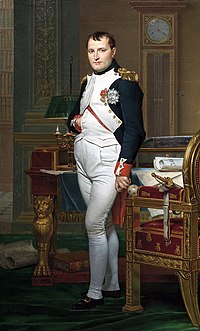
The Emperor Napoleon in His Study at the Tuileries, by Jacques-Louis David, 1812 Emperor of the French Reign 18 May 1804 – 11 April 1814
20 March 1815 – 22 June 1815Coronation 2 December 1804 Predecessor None (himself as First Consul of the French First Republic; previous ruling monarch was Louis XVI) Successor Louis XVIII (de jure in 1814) King of Italy Reign 17 March 1805 – 11 April 1814 Coronation 26 May 1805 Predecessor None (himself as President of the Italian Republic; previous ruling monarch was Emperor Charles V) Successor None (kingdom disbanded, next king of Italy was Victor Emmanuel II) Spouse Joséphine de Beauharnais
Marie Louise of AustriaIssue Napoleon II Full name Napoleon Bonaparte House House of Bonaparte Father Carlo Buonaparte Mother Letizia Ramolino Born (1769-08-15)15 August 1769
Ajaccio, Corsica, FranceDied 5 May 1821(1821-05-05) (aged 51)
Longwood, Saint HelenaBurial Les Invalides, Paris, France Signature 
Religion Roman Catholicism (see Napoleon and religions)  Imperial Standard of Napoleon I
-
As Napoleon I, he was Emperor of the French from 1804 to 1815. His legal reform, the Napoleonic Code, has been a major influence on many civil law jurisdictions worldwide, but he is best remembered for his role in the wars led against France by a series of coalitions, the so-called Napoleonic Wars. He established hegemony over most of continental Europe and sought to spread the ideals of the French Revolution, while consolidating an imperial monarchy which restored aspects of the deposed Ancien Régime. Due to his success in these wars, often against numerically superior enemies, he is generally regarded as one of the greatest military commanders of all time, and his campaigns are studied at military academies throughout much of the world.[1]
-
Napoleon was born at Ajaccio in Corsica to parents of noble Italian ancestry. He trained as an artillery officer in mainland France. He rose to prominence under the French First Republic and led successful campaigns against the First and Second Coalitions arrayed against France. He led a successful invasion of the Italian peninsula.
-
n 1799, he staged a coup d'état and installed himself as First Consul; five years later the French Senate proclaimed him emperor. In the first decade of the 19th century, the French Empire under Napoleon engaged in a series of conflicts—the Napoleonic Wars—that involved every major European power.[1] After a streak of victories, France secured a dominant position in continental Europe, and Napoleon maintained the French sphere of influence through the formation of extensive alliances and the appointment of friends and family members to rule other European countries as French client states.
The Peninsular War and 1812 French invasion of Russia marked turning points in Napoleon's fortunes. His Grande Armée was badly damaged in the campaign and never fully recovered. In 1813, the Sixth Coalition defeated his forces at Leipzig; the following year the Coalition invaded France, forced Napoleon to abdicate and exiled him to the island of Elba. Less than a year later, he escaped Elba and returned to power, but was defeated at the Battle of Waterloo in June 1815. Napoleon spent the last six years of his life in confinement by the British on the island of Saint Helena. An autopsy concluded he died of stomach cancer. There has been debate about his death, as some scholars have held that he was a victim of arsenic poisoning.
-
-
-
Napoleon Bonaparte
-
15 August 1769 – 5 May
-
1821)
-
a French military and political leader
-
His legal reform, the Napoleonic Code
-
he was Emperor of the French from 1804 to 1815
-
the so-called Napoleonic
-
is best remembered for his role in the wars led against France by a series of coalitions
-
-
 Thea Marie Laursen
"Napoleon Bonaparte (French: Napoléon Bonaparte [napoleɔ̃ bɔnɑpaʁt]) (15 August 1769 – 5 May 1821) was a French military and political leader who rose to prominence during the latter stages of the French Revolution and its associated wars in Europe."
-
Napoléon Bonaparte [napoleɔ̃ bɔnɑpaʁt]) (15 August 1769 – 5 May 1821) was a French military and political leader who rose to prominence during the latter stages of the French Revolution and its associated wars in Europe.
-
As Napoleon I, he was Emperor of the French from 1804 to 1815. His legal reform, the Napoleonic Code, h
-
-
Napoleon I, he was Emperor of the French from 1804 to 1815.
-
s Napoleon I
-
but he is best remembered for his role in the wars led against France
-
-
-
<!-- /subtitle --> <!-- jumpto -->Jump to: navigation, search<!-- /jumpto --> <!-- bodycontent -->
-
-
-
apoleon Bonapart
-
-
15 Aug 12
-
As Napoleon I, he was Emperor of the French from 1804 to 1815. His legal reform, the Napoleonic Code, has been a major influence on many civil law jurisdictions worldwide, but he is best remembered for his role in the wars led against France by a series of coalitions, the so-called Napoleonic Wars. He established hegemony over most of continental Europe and sought to spread the ideals of the French Revolution, while consolidating an imperial monarchy which restored aspects of the deposed Ancien Régime. Due to his success in these wars, often against numerically superior enemies, he is generally regarded as one of the greatest military commanders of all time, and his campaigns are studied at military academies throughout much of the world.[1]
-
-
08 May 12
-
08 Mar 12
 Alexandra (Rammell) Crafton
Wiki on Napoleon
-
09 Dec 11

-
09 Oct 11
-
15 August 1769 – 5 May 1821)
-
Napoleon I, he was Emperor of the French from 1804 to 1815.
-
His legal reform, the Napoleonic code, has been a major influence on many civil law jurisdictions worldwide,
-
he established hegemony over most of continental Europe and sought to spread the ideals of the French Revolution, while consolidating an imperial monarchy
-
generally regarded as one of the greatest military commanders of all time.
-
trained as an artillery officer in mainland France
-
born in Corsica
-
rose to prominence under the French First Republic
-
1799, he staged a coup d'état and installed himself as First Consu
-
five years later the French Senate proclaimed him emperor.
-
the Napoleonic Wars—
-
France secured a dominant position in continental Europe, and Napoleon maintained the French sphere of influence through the formation of extensive alliances
-
1813, the Sixth Coalition defeated his forces at Leipzig;
-
escaped Elba and returned to power, but was defeated at the Battle of Waterloo in June 1815.
-
exiled him to the island of Elba
-
1812 French invasion of Russia marked turning points in Napoleon's fortunes
-
Grande Armée was badly damaged in the campaign and never fully recovered.
-
last six years of his life in confinement by the British on the island of Saint Helena.
-
Sten Forshufvud) have held that he was a victim of arsenic poisoning.
-
eight children
-
Casa Buonaparte, located in the town of Ajaccio, Corsica.
-
one year after Corsica was transferred to France by the Republic of Geno
-
twenties, when he adopted the more French-sounding Napoléon Bonaparte
-
Corsican Buonapartes originated from minor Italian nobility of Lombard origin,
-
-
23 Aug 11
-
22 Jun 11
-
s Napoleon I, he was Emperor of the French from 1804 to 1815. His leg
-
-
02 Dec 10
-
01 Feb 10
-
Napoleon Bonaparte
-
Napoleon Bonaparte
-
Napoleon Bonaparte
-
-

-
25 Jan 10
-
Napoleon Bonaparte (French: Napoléon Bonaparte French pronunciation: [napoleɔ̃ bɔnɑpaʁt], Italian: Napoleone di Buonaparte; 15 August 1769 – 5 May 1821), was a military and political leader of France and Emperor of the French as Napoleon I, whose actions shaped European politics in the early 19th century.
-
He was initially named Napoleone di Buonaparte, acquiring his first name from an uncle who had been killed fighting the French,[
-
-
24 Jan 10
-
23 Jan 10
-
Napoleon I of France
-
-
06 Oct 08
-
31 May 08
-
Born in Corsica and trained in mainland France as an artillery officer
-
-
04 Dec 06
-
In January 1804, Bonaparte's police uncovered an assassination plot against him, ostensibly sponsored by the Bourbons. In retaliation, Bonaparte ordered the arrest of the Duc d'Enghien, in a violation of the sovereignty of Baden. After a hurried secret trial, the Duke was executed on 21 March. Bonaparte then used this incident to justify the re-creation of a hereditary monarchy in France, with himself as Emperor, on the theory that a Bourbon restoration would be impossible once the Bonapartist succession was entrenched in the constitution.
-
Napoleon was in many ways the direct inspiration for later autocrats: he never flinched when facing the prospect of war and destruction for thousands, friend or foe, and turned his search of undisputed rule into a continuous cycle of conflict throughout Europe, ignoring treaties and conventions alike.
-
the rise of the nation state,
-
An unusual aspect of the Egyptian expedition was the inclusion of a large group of scientists assigned to the French expeditionary force: among their discoveries was the finding of the Rosetta Stone. This deployment of intellectual resources is considered by some an indication of Bonaparte's devotion to the principles of the Enlightenment, and by others as a masterstroke of propaganda, obfuscating the true imperialist motives of the invasion. In a largely unsuccessful effort to gain the support of the Egyptian populace, Bonaparte also issued proclamations casting himself as a liberator of the people from Ottoman oppression, and praising the precepts of Islam.
-


Would you like to comment?
Join Diigo for a free account, or sign in if you are already a member.