
This link has been bookmarked by 72 people . It was first bookmarked on 05 Nov 2007, by hhajiah.
-
20 Apr 15
-
Mars can easily be seen from Earth with the naked eye, as can its reddish coloring. Its apparent magnitude reaches −3.0,[8] which is surpassed only by Jupiter, Venus, the Moon, and the Sun. Optical ground-based telescopes are typically limited to resolving features about 300 kilometers (190 mi) across when Earth and Mars are closest because of Earth's atmospher
-
-
22 Jan 15
-
21 Nov 14
-
Mars is the fourth planet from the Sun and the second smallest planet in the Solar System, after Mercury. Named after the Roman god of war, it is often described as the "Red Planet" because the iron oxide prevalent on its surface gives it a reddish appearance.[15] Mars is a terrestrial planet with a thin atmosphere, having surface features reminiscent both of the impact craters of the Moon and the volcanoes, valleys, deserts, and polar ice caps of Earth. The rotational period and seasonal cycles of Mars are likewise similar to those of Earth, as is the tilt that produces the seasons. Mars
-
-
21 Oct 14
-
magnetosphere
-
Mars is also nearly, or perhaps totally, geologically dead
-
he Viking probes of the mid-1970s carried experiments designed to detect microorganisms in Martian soil at their respective landing sites and had positive results, including a temporary increase of CO2 production on exposure to water and nutrients.
-
The German Aerospace Center discovered that Earth lichens can survive in simulated Mars conditions
-
-
01 Oct 14
-
Mars is the fourth planet from the Sun and the second smallest planet in the Solar System, after Mercury. Named after the Roman god of war, it is often described as the "Red Planet" because the iron oxide prevalent on its surface gives it a reddish appearance.[16] Mars is a terrestrial planet with a thin atmosphere, having surface features reminiscent both of the impact craters of the Moon and the volcanoes, valleys, deserts, and polar ice caps of Earth.
-
-
09 Sep 14
 ralawami
IRON OXIDE prevalent on the surface
TERRESTIAL PLANET -- thin atmosphere
Phobos and Deimos -- CAPTURED ASTEROID
Mariner 4 -
22 Jun 14
-
it is often described as the "Red Planet" because the iron oxide prevalent on its surface gives it a reddish appearance.
-
Mars is a terrestrial planet with a thin atmosphere, having surface features reminiscent both of the impact craters of the Moon and the volcanoes, valleys, deserts, and polar ice caps of Earth. The rotational period and seasonal cycles of Mars are likewise similar to those of Earth, as is the tilt that produces the seasons.
-
Although Mars has no evidence of a current structured global magnetic field,[37] observations show that parts of the planet's crust have been magnetized, and that alternating polarity reversals of its dipole field have occurred in the past. This paleomagnetism of magnetically susceptible minerals has properties that are very similar to the alternating bands found on the ocean floors of Earth. One theory, published in 1999 and re-examined in October 2005 (with the help of the Mars Global Surveyor), is that these bands demonstrate plate tectonics on Mars four billion years ago, before the planetary dynamo ceased to function and the planet's magnetic field faded away.[38]
-
lements with comparatively low boiling points, such as chlorine, phosphorus, and sulphur, are much more common on Mars than Eart
-
This theory suggests that Mars was struck by a Pluto-sized body about four billion years ago. The event, thought to be the cause of the Martian hemispheric dichotomy, created the smooth Borealis basin that covers 40% of the planet.[44][45]
-
Amazonian period (named after Amazonis Planitia): 2.9–3.3 billion years ago to present. Amazonian regions have few meteorite impact craters, but are otherwise quite varied. Olympus Mons formed during this period, along with lava flows elsewhere on Mars.
-
-
Streaks are common across Mars and new ones appear frequently on steep slopes of craters, troughs, and valleys. The streaks are dark at first and get lighter with age. Sometimes, the streaks start in a tiny area which then spread out for hundreds of metres. They have also been seen to follow the edges of boulders and other obstacles in their path. The commonly accepted theories include that they are dark underlying layers of soil revealed after avalanches of bright dust or dust devils.[53] Several explanations have been put forward, some of which involve water or even the growth of organisms.[54][55]
Hydrology
-
Other geological features, such as deltas and alluvial fans preserved in craters, also argue very strongly for warmer, wetter conditions at some interval or intervals in earlier Mars history.[71] Such conditions necessarily require the widespread presence of crater lakes across a large proportion of the surface, for which there is also independent mineralogical, sedimentological and geomorphological evidence.[72] Some authors have even gone so far as to argue that at times in the Martian past, much of the low northern plains of the planet were covered with a true ocean hundreds of meters deep, though this remains controversial.[73]
-
Mars has two permanent polar ice caps. During a pole's winter, it lies in continuous darkness, chilling the surface and causing the deposition of 25–30% of the atmosphere into slabs of CO2 ice (dry ice).[83] When the poles are again exposed to sunlight, the frozen CO2 sublimes, creating enormous winds that sweep off the poles as fast as 400 km/h. These seasonal actions transport large amounts of dust and water vapor, giving rise to Earth-like frost and large cirrus clouds. Clouds of water-ice were photographed by the Opportunity rover in 2004.[84]
-
Mars lost its magnetosphere 4 billion years ago,
-
143 million miles from the Sun
-
ts orbital period is 687 (Earth) days -
-
The current understanding of planetary habitability – the ability of a world to develop and sustain life – favors planets that have liquid water on their surface. This most often requires that the orbit of a planet lie within the habitable zone, which for the Sun currently extends from just beyond Venus to about the semi-major axis of Mars.[155]
-
Mars is also nearly, or perhaps totally, geologically dead; the end of volcanic activity has apparently stopped the recycling of chemicals and minerals between the surface and interior of the planet.[157]
-
Many other observations and proclamations by notable personalities added to what has been termed "Mars Fever".[212] In 1899 while investigating atmospheric radio noise using his receivers in his Colorado Springs lab, inventor Nikola Tesla observed repetitive signals that he later surmised might have been radio communications coming from another planet, possibly Mars. In a 1901 interview Tesla said:
It was some time afterward when the thought flashed upon my mind that the disturbances I had observed might be due to an intelligent control. Although I could not decipher their meaning, it was impossible for me to think of them as having been entirely accidental. The feeling is constantly growing on me that I had been the first to hear the greeting of one planet to another.[213]
Tesla's theories gained support from Lord Kelvin who, while visiting the United States in 1902, was reported to have said that he thought Tesla had picked up Martian signals being sent to the United States.[214] Kelvin "emphatically" denied this report shortly before departing America: "What I really said was that the inhabitants of Mars, if there are any, were doubtless able to see New York, particularly the glare of the electricity."[215]
-
In a New York Times article in 1901, Edward Charles Pickering, director of the Harvard College Observatory, said that they had received a telegram from Lowell Observatory in Arizona that seemed to confirm that Mars was trying to communicate with the Earth.[216]
Early in December 1900, we received from Lowell Observatory in Arizona a telegram that a shaft of light had been seen to project from Mars (the Lowell observatory makes a specialty of Mars) lasting seventy minutes. I wired these facts to Europe and sent out neostyle copies through this country. The observer there is a careful, reliable man and there is no reason to doubt that the light existed. It was given as from a well-known geographical point on Mars. That was all. Now the story has gone the world over. In Europe it is stated that I have been in communication with Mars, and all sorts of exaggerations have spring up. Whatever the light was, we have no means of knowing. Whether it had intelligence or not, no one can say. It is absolutely inexplicable.[216]
-
they are named after the characters Phobos (panic/fear) and Deimos (terror/dread), who, in Greek mythology, accompanied their father Ares, god of war, into battle.
-
-
12 Dec 13
-
05 Dec 13
-
Named after the Roman god of war, it is often described as the "Red Planet" because the iron oxide prevalent on its surface gives it a reddish appearance
-
-
Mars is currently host to five functioning spacecraft: three in orbit – the Mars Odyssey, Mars Express, and Mars Reconnaissance Orbiter – and two on the surface – Mars Exploration Rover Opportunity and the Mars Science Laboratory Curiosity.
-
-
-
Mars is the fourth planet from the Sun and the second smallest planet in the Solar System. Named after the Roman god of war, it is often described as the "Red Planet" because the iron oxide prevalent on its surface gives it a reddish appearance.[14] Mars is a terrestrial planet with a thin atmosphere, having surface features reminiscent both of the impact craters of the Moon and the volcanoes, valleys, deserts, and polar ice caps of Earth. The rotational period and seasonal cycles of Mars are likewise similar to those of Earth, as is the tilt that produces the seasons.
-
-
-
Mars is the fourth planet from the Sun and the second smallest planet in the Solar System. Named after the Roman god of war, it is often described as the "Red Planet" because the iron oxide prevalent on its surface gives it a reddish appearance.[14]
-
Mars has approximately half the diameter of Earth.
-
Mars is a terrestrial planet that consists of minerals containing silicon and oxygen, metals, and other elements that typically make up rock. The surface of Mars is primarily composed of tholeiitic basalt,[32] although parts are more silica-rich than typical basalt and may be similar to andesitic rocks on Earth or silica glass
-
-
25 Nov 13
-
Mars is the fourth planet from the Sun and the second smallest planet in the Solar System. Named after the Roman god of war, it is often described as the "Red Planet" because the iron oxide prevalent on its surface gives it a reddish appearance.[14] Mars is a terrestrial planet with a thin atmosphere, having surface features reminiscent both of the impact craters of the Moon and the volcanoes, valleys, deserts, and polar ice caps of Earth. The rotational period and seasonal cycles of Mars are likewise similar to those of Earth, as is the tilt that produces the seasons. Mars is the site of Olympus Mons, the second highest known mountain within the Solar System (the tallest on a planet), and of Valles Marineris, one of the largest canyons. The smooth Borealis basin in the northern hemisphere covers 40% of the planet and may be a giant impact feature.[15][16] Mars has two known moons, Phobos and Deimos, which are small and irregularly shaped. These may be captured asteroids,[17][18] similar to 5261 Eureka, a Martian trojan asteroid.
-
Mars is currently host to five functioning spacecraft: three in orbit – the Mars Odyssey, Mars Express, and Mars Reconnaissance Orbiter – and two on the surface – Mars Exploration Rover Opportunity and the Mars Science Laboratory Curiosity. Defunct spacecraft on the surface include MER-A Spirit and several other inert landers and rovers such as the Phoenix lander, which completed its mission in 2008. Observations by the Mars Reconnaissance Orbiter have revealed possible flowing water during the warmest months on Mars.[24] In 2013, NASA's Curiosity rover discovered that Mars' soil contains between 1.5% and 3% water by mass (about two pints of water per cubic foot or 33 liters per cubic meter, albeit attached to other compounds and thus not freely accessible).[25]
-
Mars can easily be seen from Earth with the naked eye, as can its reddish coloring. Its apparent magnitude reaches −3.0,[7] which is surpassed only by Jupiter, Venus, the Moon, and the Sun. Optical ground-based telescopes are typically limited to resolving features about 300 km (186 miles) across when Earth and Mars are closest because of Earth's atmosphere.[26]
-
The Phoenix lander returned data showing Martian soil to be slightly alkaline and containing elements such as magnesium, sodium, potassium and chlorine. These nutrients are found in gardens on Earth, and are necessary for growth of plants.[49] Experiments performed by the Lander showed that the Martian soil has a basic pH of 8.3, and may contain traces of the salt perchlorate.[50][51]
Streaks are common across Mars and new ones appear frequently on steep slopes of craters, troughs, and valleys. The streaks are dark at first and get lighter with age. Sometimes, the streaks start in a tiny area which then spread out for hundreds of metres. They have also been seen to follow the edges of boulders and other obstacles in their path. The commonly accepted theories include that they are dark underlying layers of soil revealed after avalanches of bright dust or dust devils.[52] Several explanations have been put forward, some of which involve water or even the growth of organisms.[53][54]
-
Mars has two permanent polar ice caps. During a pole's winter, it lies in continuous darkness, chilling the surface and causing the deposition of 25–30% of the atmosphere into slabs of CO2 ice (dry ice).[83] When the poles are again exposed to sunlight, the frozen CO2 sublimes, creating enormous winds that sweep off the poles as fast as 400 km/h. These seasonal actions transport large amounts of dust and water vapor, giving rise to Earth-like frost and large cirrus clouds. Clouds of water-ice were photographed by the Opportunity rover in 2004.[84]
-
The polar caps at both poles consist primarily of water ice. Frozen carbon dioxide accumulates as a comparatively thin layer about one metre thick on the north cap in the northern winter only, while the south cap has a permanent dry ice cover about eight metres thick.[85] This permanent dry ice cover at the south pole is peppered by flat floored, shallow, roughly circular pits, which repeat imaging shows are expanding by meters per year; this suggests that the permanent CO2 cover over the south pole water ice is degrading over time.[86] The northern polar cap has a diameter of about 1,000 kilometres during the northern Mars summer,[87] and contains about 1.6 million cubic km of ice, which, if spread evenly on the cap, would be 2 km thick.[88] (This compares to a volume of 2.85 million cubic km (km3) for the Greenland ice sheet.) The southern polar cap has a diameter of 350 km and a thickness of 3 km.[89] The total volume of ice in the south polar cap plus the adjacent layered deposits has also been estimated at 1.6 million cubic km.[90] Both polar caps show spiral troughs, which recent analysis of SHARAD ice penetrating radar has shown are a result of katabatic winds that spiral due to the Coriolis Effect.
-
he shield volcano Olympus Mons (Mount Olympus) is an extinct volcano in the vast upland region Tharsis, which contains several other large volcanoes. Olympus Mons is over three times the height of Mount Everest, which in comparison stands at just over 8.8 km.[113] It is either the tallest or second tallest mountain in the solar system, depending how you measure, with sources ranging from about 21 to 27 km high.
-
Mars lost its magnetosphere 4 billion years ago,[121] so the solar wind interacts directly with the Martian ionosphere, lowering the atmospheric density by stripping away atoms from the outer layer. Both Mars Global Surveyor and Mars Express have detected ionised atmospheric particles trailing off into space behind Mars,[121][122] and this atmospheric loss will be studied by the upcoming MAVEN orbiter. Compared to Earth, the atmosphere of Mars is quite rarefied. Atmospheric pressure on the surface today ranges from a low of 30 Pa (0.030 kPa) on Olympus Mons to over 1,155 Pa (1.155 kPa) in Hellas Planitia, with a mean pressure at the surface level of 600 Pa (0.60 kPa).[123] The highest atmospheric density on Mars is equal to the density found 35 km[124] above the Earth's surface. The resulting mean surface pressure is only 0.6% of that of the Earth (101.3 kPa). The scale height of the atmosphere is about 10.8 km,[125] which is higher than Earth's (6 km) because the surface gravity of Mars is only about 38% of Earth's, an effect offset by both the lower temperature and 50% higher average molecular weight of the atmosphere of Mars. The atmosphere of Mars consists of about 96% carbon dioxide, 1.93% argon and 1.89% nitrogen along with traces of oxygen and water.[6][126] The atmosphere is quite dusty, containing particulates about 1.5 µm in diameter which give the Martian sky a tawny color when seen from the surface
-
-
-
Mars is the fourth planet from the Sun and the second smallest planet in the Solar System. Named after the Roman god of war, it is often described as the "Red Planet" because the iron oxide prevalent on its surface gives it a reddish appearance.[14] Mars is a terrestrial planet with a thin atmosphere,
-
Mars has approximately half the diameter of Earth. It is less dense than Earth, having about 15% of Earth's volume and 11% of the mass. Its surface area is only slightly less than the total area of Earth's dry land.
-
-
07 Nov 13
-
05 Nov 13
-
-
Mars is the site of Olympus Mons, the second highest known mountain within the Solar System (the tallest on a planet), and of Valles Marineris, one of the largest canyons.
-
Until the first successful Mars flyby in 1965 by Mariner 4, many speculated about the presence of liquid water on the planet's surface. This was based on observed periodic variations in light and dark patches, particularly in the polar latitudes, which appeared to be seas and continents; long, dark striations were interpreted by some as irrigation channels for liquid water
-
Mars has approximately half the diameter of Earth. It is less dense than Earth, having about 15% of Earth's volume and 11% of the mass. Its surface area is only slightly less than the total area of Earth's dry land.
-
-
07 Oct 13

-
09 Sep 13
-
es, vall
-
ns in light and dark patches, particularly in the polar latitudes, which appeared to be seas and continents; long, dark striations were interpreted by some as irrigation channels for liquid water. These straight line features we
-
-
23 May 13

-
15 May 13
-
30 Apr 13
-
it is often described as the "Red Planet", as the iron oxide prevalent on its surface gives it a reddish appearance.
-
-
08 Aug 12
-
07 Aug 12
-
presence of larg
-
-
23 Apr 12
-
Liquid water cannot exist on the surface of Mars due to low atmospheric pressure, except at the lowest elevations for short periods.
-
water ice
-
contains traces of oxygen and water
-
quite dusty
-
seasons of Mars are the most Earth-like
-
wide range in temperatures
-
−87 °C (−125 °F) during the polar winters to highs of up to −5 °C
-
thin atmosphere which cannot store much solar heat
-
he planet is also 1.52 times as far from the sun as Earth, resulting in just 43% of the amount of sunlight
-
any water on the Martian surface may have been too salty and acidic to support regular terrestrial life
-
little heat transfer across its surface, poor insulation against bombardment of the solar wind and insufficient atmospheric pressure to retain water in a liquid form (water instead sublimates to a gaseous state)
-
intense ultraviolet light
-
-
09 Nov 11
-
30 Mar 11
-
Namespaces
-
Mars is the fourth planet from the Sun in the Solar System. The planet is named after the Roman god of war, Mars. It is often described as the "Red Planet", as the iron oxide prevalent on its surface gives it a reddish appearance.[13] Mars is a terrestrial planet with a thin atmosphere, having surface features reminiscent both of the impact craters of the Moon and the volcanoes, valleys, deserts, and polar ice caps of Earth. The rotational period and seasonal cycles of Mars are likewise similar to those of Earth, as is the tilt that produces the seasons. Mars is the site of Olympus Mons, the highest known mountain within the Solar System, and of Valles Marineris, the largest canyon. The smooth Borealis basin in the northern hemisphere covers 40% of the planet and may be a giant impact feature.[14][15]
Until the first flyby of Mars occurred in 1965, by Mariner 4, many speculated about the presence of liquid water on the planet's surface. This was based on observed periodic variations in light and dark patches, particularly in the polar latitudes, which appeared to be seas and continents; long, dark striations were interpreted by some as irrigation channels for liquid water. These straight line features were later explained as optical illusions, though geological evidence gathered by unmanned missions suggest that Mars once had large-scale water coverage on its surface.[16] In 2005, radar data revealed the presence of large quantities of water ice at the poles,[17] and at mid-latitudes.[18][19] The Mars rover Spirit sampled chemical compounds containing water molecules in March 2007. The Phoenix lander directly sampled water ice in shallow Martian soil on July 31, 2008.[20]
Mars has two moons, Phobos and Deimos, which are small and irregularly shaped. These may be captured asteroids, similar to 5261 Eureka, a Martian Trojan asteroid. Mars is currently host to three functional orbiting spacecraft: Mars Odyssey, Mars Express, and the Mars Reconnaissance Orbiter. On the surface are the two Mars Exploration Rovers (Spirit and Opportunity) and several inert landers and rovers, both successful and unsuccessful. The Phoenix lander completed its mission on the surface in 2008. Observations by NASA's now-defunct Mars Global Surveyor show evidence that parts of the southern polar ice cap have been receding.[21]
Mars can easily be seen from Earth with the naked eye. Its apparent magnitude reaches −3.0[7] a
brightness surpassed only by Venus, the Moon, and the Sun. -
brightness surpassed only
-
-
-
volcanoes, valleys, deserts, and polar ice caps of Earth. The rotational period and seasonal cycles of Mars are likewise
-
-
-
-
tenuous atmosphere of Mars
-
-
Mars is the fourth planet from the Sun in the Solar System. The planet is named after the Roman god of war, Mars. It is often described as the "Red Planet", as the iron oxide prevalent on its surface gives it a reddish appearance.[13] Mars is a terrestrial planet with a thin atmosphere, having surface features reminiscent both of the impact craters
-
-
-
<div id="siteSub"> Wikipedia, the free encyclopedia</div><!-- /tagline --><!-- subtitle --><br/><div id="contentSub"></div><!-- /subtitle --><!-- jumpto --><br/><div id="jump-to-nav">Jump to: <a rel="nofollow" href="http://en.wikipedia.org/#mw-head">navigation</a>, <a rel="nofollow" href="http://en.wikipedia.org/#p-search">search</a> </div><!-- /jumpto --><!-- bodytext --><br/><div class="dablink">This article is about the planet. For other uses, see <a rel="nofollow" href="http://en.wikipedia.org/wiki/Mars_(disambiguation)">Mars (disambiguation)</a>.</div><br/><div class="metadata topicon" style="DISPLAY: none; RIGHT: 55px" id="protected-icon"><a rel="nofollow" href="http://en.wikipedia.org/wiki/Wikipedia:Protection_policy#semi" title="This article is semi-protected indefinitely in response to an ongoing high risk of vandalism."><img src="http://upload.wikimedia.org/wikipedia/commons/thumb/f/fc/Padlock-silver.svg/20px-Padlock-silver.svg.png" height="20" width="20" alt="Page semi-protected"></a></div><br/><div class="metadata topicon" style="DISPLAY: none; RIGHT: 10px" id="featured-star"><a rel="nofollow" href="http://en.wikipedia.org/wiki/Wikipedia:Featured_articles" title="This is a featured article. Click here for more information."><img src="http://upload.wikimedia.org/wikipedia/commons/thumb/e/e7/Cscr-featured.svg/14px-Cscr-featured.svg.png" height="13" width="14" alt="Featured article"></a></div><br/><table class="infobox vcard" style="TEXT-ALIGN: left; WIDTH: 20em; FONT-SIZE: 90%" cellspacing="2"><br/><caption><span class="fn org" style="FONT-SIZE: 120%"><b>Mars</b></span> <a rel="nofollow" href="http://en.wikipedia.org/wiki/File:Mars_symbol.svg" class="image" title="Astronomical symbol of Mars"><img src="http://upload.wikimedia.org/wikipedia/commons/thumb/b/b7/Mars_symbol.svg/25px-Mars_symbol.svg.png" height="25" width="25" alt="Astronomical symbol of Mars"></a></caption><br/><tbody><br/><tr><br/><td style="TEXT-ALIGN: center; LINE-HEIGHT: 1.2em" colspan="2"><a rel="nofollow" href="http://en.wikipedia.org/wiki/File:Mars_Valles_Marineris.jpeg" class="image" title="The planet Mars"><img src="http://upload.wikimedia.org/wikipedia/commons/thumb/5/56/Mars_Valles_Marineris.jpeg/250px-Mars_Valles_Marineris.jpeg" height="250" width="250" alt="The planet Mars"></a> <br/><div style="FONT-SIZE: 95%; PADDING-TOP: 0.25em">Mars in 1980 as seen by the <a rel="nofollow" href="http://en.wikipedia.org/wiki/Viking_1">Viking 1</a> Orbiter</div></td></tr><br/><tr><br/><th style="TEXT-ALIGN: center; PADDING-TOP: 0.75em" colspan="2"><br/><div style="BACKGROUND: #e8ab79">Designations</div></th></tr><br/><tr><br/><th style="LINE-HEIGHT: 1.1em">Pronunciation</th><br/><td style="LINE-HEIGHT: 1.2em"><span style="WHITE-SPACE: nowrap"><a rel="nofollow" href="http://upload.wikimedia.org/wikipedia/commons/8/83/En-us-Mars.ogg" title="Listen"><img src="http://upload.wikimedia.org/wikipedia/en/thumb/3/3c/Speakerlink.svg/11px-Speakerlink.svg.png" height="11" width="11" alt="Listen"></a><sup><span class="IPA" style="PADDING-BOTTOM: 0px; PADDING-LEFT: 0.1em; PADDING-RIGHT: 0.1em; FONT: bold 80% sans-serif; COLOR: #00e; PADDING-TOP: 0px"><a rel="nofollow" href="http://en.wikipedia.org/wiki/File:En-us-Mars.ogg" title="File:En-us-Mars.ogg">i</a></span></sup> <span class="IPA" title="Representation in the International Phonetic Alphabet (IPA)"><a rel="nofollow" href="http://en.wikipedia.orghttp://en.wikipedia.org/wiki/Wikipedia:IPA_for_English" title="Wikipedia:IPA for English">/</a></span><span class="IPA"><a rel="nofollow" href="http://en.wikipedia.orghttp://en.wikipedia.orghttp://en.wikipedia.orghttp://en.wikipedia.orghttp://en.wikipedia.org/wiki/Wikipedia:IPA_for_English#Key" title="Wikipedia:IPA for English"><span style="BORDER-BOTTOM: 1px dotted" title="primary stress">ˈ</span></a></span><span class="IPA"><a rel="nofollow" href="http://en.wikipedia.orghttp://en.wikipedia.orghttp://en.wikipedia.orghttp://en.wikipedia.org/wiki/Wikipedia:IPA_for_English#Key" title="Wikipedia:IPA for English"><span style="BORDER-BOTTOM: 1px dotted" title="'m' in 'my'">m</span></a></span><span class="IPA"><a rel="nofollow" href="http://en.wikipedia.orghttp://en.wikipedia.orghttp://en.wikipedia.org/wiki/Wikipedia:IPA_for_English#Key" title="Wikipedia:IPA for English"><span style="BORDER-BOTTOM: 1px dotted" title="'ar' in 'bard'">ɑr</span></a></span><span class="IPA"><a rel="nofollow" href="http://en.wikipedia.orghttp://en.wikipedia.org/wiki/Wikipedia:IPA_for_English#Key" title="Wikipedia:IPA for English"><span style="BORDER-BOTTOM: 1px dotted" title="'z' in 'Zion'">z</span></a></span><span class="IPA" title="Representation in the International Phonetic Alphabet (IPA)"><a rel="nofollow" href="http://en.wikipedia.org/wiki/Wikipedia:IPA_for_English" title="Wikipedia:IPA for English">/</a></span></span></td></tr><br/><tr><br/><th style="LINE-HEIGHT: 1.1em"><a rel="nofollow" href="http://en.wikipedia.org/wiki/Adjectivals_and_demonyms_for_astronomical_bodies" class="mw-redirect" title="Adjectivals and demonyms for astronomical bodies">Adjective</a></th><br/><td style="LINE-HEIGHT: 1.2em"><a rel="nofollow" href="http://en.wikipedia.org/wiki/Martian">Martian</a></td></tr><br/><tr><br/><th style="TEXT-ALIGN: center; PADDING-TOP: 0.75em" colspan="2"><br/><div style="BACKGROUND: #e8ab79"><a rel="nofollow" href="http://en.wikipedia.org/wiki/Orbit" title="Orbit">Orbital <br/>characteristics</a><sup class="reference" id="cite_ref-horizons_0-0"><a rel="nofollow" href="http://en.wikipedia.org/#cite_note-horizons-0"><span>[</span>1<span>]</span></a></sup></div></th></tr><br/><tr><br/><td style="TEXT-ALIGN: center" colspan="2"><small><a rel="nofollow" href="http://en.wikipedia.org/wiki/Epoch_(astronomy)" title="Epoch (astronomy)">Epoch</a> <a rel="nofollow" href="http://en.wikipedia.org/wiki/J2000" class="mw-redirect" title="J2000">J2000</a></small></td></tr><br/><tr><br/><th style="LINE-HEIGHT: 1.1em"><a rel="nofollow" href="http://en.wikipedia.orghttp://en.wikipedia.org/wiki/Apsis" title="Apsis">Aphelion</a></th><br/><td style="LINE-HEIGHT: 1.2em">249,209,300 km<br>1.665 861 <a rel="nofollow" href="http://en.wikipedia.org/wiki/Astronomical_unit" title="Astronomical unit">AU</a></td></tr><br/><tr><br/><th style="LINE-HEIGHT: 1.1em"><a rel="nofollow" href="http://en.wikipedia.org/wiki/Apsis" title="Apsis">Perihelion</a></th><br/><td style="LINE-HEIGHT: 1.2em">206,669,000 km<br>1.381 497 AU</td></tr><br/><tr><br/><th style="LINE-HEIGHT: 1.1em"><a rel="nofollow" href="http://en.wikipedia.org/wiki/Semi-major_axis">Semi-major <br/>axis</a></th><br/><td style="LINE-HEIGHT: 1.2em">227,939,100 km<br>1.523 679 AU</td></tr><br/><tr><br/><th style="LINE-HEIGHT: 1.1em"><a rel="nofollow" href="http://en.wikipedia.org/wiki/Orbital_eccentricity" title="Orbital eccentricity">Eccentricity</a></th><br/><td style="LINE-HEIGHT: 1.2em">0.093 315</td></tr><br/><tr><br/><th style="LINE-HEIGHT: 1.1em"><a rel="nofollow" href="http://en.wikipedia.orghttp://en.wikipedia.org/wiki/Orbital_period">Orbital <br/>period</a></th><br/><td style="LINE-HEIGHT: 1.2em">686.971 days<br><br/><p>1.8808 <a rel="nofollow" href="http://en.wikipedia.org/wiki/Julian_year_(astronomy)" title="Julian year (astronomy)">Julian years</a><br></p>668.5991 <a rel="nofollow" href="http://en.wikipedia.org/wiki/Timekeeping_on_Mars" title="Timekeeping on Mars">sols</a></td></tr><br/><tr><br/><th style="LINE-HEIGHT: 1.1em"><a rel="nofollow" href="http://en.wikipedia.org/wiki/Orbital_period" title="Orbital period">Synodic period</a></th><br/><td style="LINE-HEIGHT: 1.2em">779.96 days<br>2.135 Julian <br/>years</td></tr><br/><tr><br/><th style="LINE-HEIGHT: 1.1em"><a rel="nofollow" href="http://en.wikipedia.org/wiki/Orbital_speed" title="Orbital speed">Average orbital speed</a></th><br/><td style="LINE-HEIGHT: 1.2em; VERTICAL-ALIGN: middle">24.077 km/s</td></tr><br/><tr><br/><th style="LINE-HEIGHT: 1.1em"><a rel="nofollow" href="http://en.wikipedia.org/wiki/Mean_anomaly">Mean <br/>anomaly</a></th><br/><td style="LINE-HEIGHT: 1.2em">19.3564°</td></tr><br/><tr><br/><th style="LINE-HEIGHT: 1.1em"><a rel="nofollow" href="http://en.wikipedia.org/wiki/Inclination">Inclination</a></th><br/><td style="LINE-HEIGHT: 1.2em">1.850° to <a rel="nofollow" href="http://en.wikipedia.org/wiki/Ecliptic">ecliptic</a><br>5.65° to <a rel="nofollow" href="http://en.wikipedia.org/wiki/Sun">Sun</a>'s <a rel="nofollow" href="http://en.wikipedia.orghttp://en.wikipedia.org/wiki/Equator">equator</a><br>1.67° to <a rel="nofollow" href="http://en.wikipedia.org/wiki/Invariable_plane">invariable plane</a><sup class="reference" id="cite_ref-meanplane_1-0"><a rel="nofollow" href="http://en.wikipedia.org/#cite_note-meanplane-1"><span>[</span>2<span>]</span></a></sup></td></tr><br/><tr><br/><th style="LINE-HEIGHT: 1.1em"><a rel="nofollow" href="http://en.wikipedia.org/wiki/Longitude_of_the_ascending_node" title="Longitude of the ascending node">Longitude of <br/>ascending node</a></th><br/><td style="LINE-HEIGHT: 1.2em; VERTICAL-ALIGN: middle">49.562°</td></tr><br/><tr><br/><th style="LINE-HEIGHT: 1.1em"><a rel="nofollow" href="http://en.wikipedia.org/wiki/Argument_of_periapsis" title="Argument of periapsis">Argument of perihelion</a></th><br/><td style="LINE-HEIGHT: 1.2em; VERTICAL-ALIGN: middle">286.537°</td></tr><br/><tr><br/><th style="LINE-HEIGHT: 1.1em"><a rel="nofollow" href="http://en.wikipedia.org/wiki/Natural_satellite" title="Natural satellite">Satellites</a></th><br/><td style="LINE-HEIGHT: 1.2em">2</td></tr><br/><tr><br/><th style="TEXT-ALIGN: center; PADDING-TOP: 0.75em" colspan="2"><br/><div style="BACKGROUND: #e8ab79">Physical characteristics</div></th></tr><br/><tr><br/><th style="LINE-HEIGHT: 1.1em"><a rel="nofollow" href="http://en.wikipedia.org/wiki/Equator" title="Equator">Equatorial</a> radius</th><br/><td style="LINE-HEIGHT: 1.2em"><span style="WHITE-SPACE: nowrap">3,396.2 ± 0.1 <br/>km</span><sup class="reference" id="ref_Anone"><a rel="nofollow" href="http://en.wikipedia.org/http://en.wikipedia.org/#endnote_Anone">[a]</a></sup><sup class="reference" id="cite_ref-Seidelmann2007_2-0"><a rel="nofollow" href="http://en.wikipedia.org/http://en.wikipedia.org/#cite_note-Seidelmann2007-2"><span>[</span>3<span>]</span></a></sup><br>0.533 <br/>Earths</td></tr><br/><tr><br/><th style="LINE-HEIGHT: 1.1em"><a rel="nofollow" href="http://en.wikipedia.org/wiki/Geographical_pole" title="Geographical pole">Polar</a> radius</th><br/><td style="LINE-HEIGHT: 1.2em"><span style="WHITE-SPACE: nowrap">3,376.2 ± 0.1 <br/>km</span><sup class="reference" id="ref_Anone"><a rel="nofollow" href="http://en.wikipedia.org/#endnote_Anone">[a]</a></sup><sup class="reference" id="cite_ref-Seidelmann2007_2-1"><a rel="nofollow" href="http://en.wikipedia.org/#cite_note-Seidelmann2007-2"><span>[</span>3<span>]</span></a></sup><br>0.531 <br/>Earths</td></tr><br/><tr><br/><th style="LINE-HEIGHT: 1.1em"><a rel="nofollow" href="http://en.wikipedia.org/wiki/Flattening">Flattening</a></th><br/><td style="LINE-HEIGHT: 1.2em"><span style="WHITE-SPACE: nowrap">0.005 89 ± <br/>0.000 15</span></td></tr><br/><tr><br/><th style="LINE-HEIGHT: 1.1em"><a rel="nofollow" href="http://en.wikipedia.org/wiki/Spheroid#Surface_area" title="Spheroid">Surface area</a></th><br/><td style="LINE-HEIGHT: 1.2em">144,798,500 km<sup>2</sup><br>0.284 <br/>Earths</td></tr><br/><tr><br/><th style="LINE-HEIGHT: 1.1em"><a rel="nofollow" href="http://en.wikipedia.org/wiki/Volume">Volume</a></th><br/><td style="LINE-HEIGHT: 1.2em">1.6318<span style="MARGIN: 0px 0.15em 0px 0.25em">×</span>10<sup>11</sup> km<sup>3</sup><sup class="reference" id="cite_ref-lodders1998_3-0"><a rel="nofollow" href="http://en.wikipedia.org/http://en.wikipedia.org/http://en.wikipedia.org/http://en.wikipedia.org/http://en.wikipedia.org/#cite_note-lodders1998-3"><span>[</span>4<span>]</span></a></sup><br>0.151 <br/>Earths</td></tr><br/><tr><br/><th style="LINE-HEIGHT: 1.1em"><a rel="nofollow" href="http://en.wikipedia.org/wiki/Mass">Mass</a></th><br/><td style="LINE-HEIGHT: 1.2em">6.4185<span style="MARGIN: 0px 0.15em 0px 0.25em">×</span>10<sup>23</sup> kg<sup class="reference" id="cite_ref-lodders1998_3-1"><a rel="nofollow" href="http://en.wikipedia.org/http://en.wikipedia.org/http://en.wikipedia.org/http://en.wikipedia.org/#cite_note-lodders1998-3"><span>[</span>4<span>]</span></a></sup><br>0.107 <br/>Earths</td></tr><br/><tr><br/><th style="LINE-HEIGHT: 1.1em">Mean <a rel="nofollow" href="http://en.wikipedia.org/wiki/Density">density</a></th><br/><td style="LINE-HEIGHT: 1.2em"><span style="WHITE-SPACE: nowrap">3.9335 ± <br/>0.0004</span><sup class="reference" id="cite_ref-lodders1998_3-2"><a rel="nofollow" href="http://en.wikipedia.org/http://en.wikipedia.org/http://en.wikipedia.org/#cite_note-lodders1998-3"><span>[</span>4<span>]</span></a></sup> <br/>g/cm³</td></tr><br/><tr><br/><th style="LINE-HEIGHT: 1.1em"><a rel="nofollow" href="http://en.wikipedia.org/wiki/Surface_gravity" title="Surface gravity">Equatorial surface gravity</a></th><br/><td style="LINE-HEIGHT: 1.2em; VERTICAL-ALIGN: middle">3.711 <a rel="nofollow" href="http://en.wikipedia.org/wiki/Acceleration" title="Acceleration">m/s²</a><sup class="reference" id="cite_ref-lodders1998_3-3"><a rel="nofollow" href="http://en.wikipedia.org/http://en.wikipedia.org/#cite_note-lodders1998-3"><span>[</span>4<span>]</span></a></sup><br>0.376 <i><a rel="nofollow" href="http://en.wikipedia.org/wiki/G-force" title="G-force">g</a></i></td></tr><br/><tr><br/><th style="LINE-HEIGHT: 1.1em"><a rel="nofollow" href="http://en.wikipedia.org/wiki/Escape_velocity">Escape <br/>velocity</a></th><br/><td style="LINE-HEIGHT: 1.2em; VERTICAL-ALIGN: middle">5.027 km/s</td></tr><br/><tr><br/><th style="LINE-HEIGHT: 1.1em"><a rel="nofollow" href="http://en.wikipedia.org/wiki/Rotation_period" title="Rotation period">Sidereal rotation<br>period</a></th><br/><td style="LINE-HEIGHT: 1.2em; VERTICAL-ALIGN: middle">1.025 <br/>957 day<br>24.622 9 h<sup class="reference" id="cite_ref-lodders1998_3-4"><a rel="nofollow" href="http://en.wikipedia.org/#cite_note-lodders1998-3"><span>[</span>4<span>]</span></a></sup></td></tr><br/><tr><br/><th style="LINE-HEIGHT: 1.1em">Equatorial rotation velocity</th><br/><td style="LINE-HEIGHT: 1.2em; VERTICAL-ALIGN: middle">868.22 km/h <br/>(241.17 m/s)</td></tr><br/><tr><br/><th style="LINE-HEIGHT: 1.1em"><a rel="nofollow" href="http://en.wikipedia.org/wiki/Axial_tilt">Axial tilt</a></th><br/><td style="LINE-HEIGHT: 1.2em">25.19°</td></tr><br/><tr><br/><th style="LINE-HEIGHT: 1.1em">North pole <span style="WHITE-SPACE: nowrap"><a rel="nofollow" href="http://en.wikipedia.org/wiki/Right_ascension">right <br/>ascension</a></span></th><br/><td style="LINE-HEIGHT: 1.2em; VERTICAL-ALIGN: middle">21 h 10 min 44 s<br>317.681 43°</td></tr><br/><tr><br/><th style="LINE-HEIGHT: 1.1em">North pole <a rel="nofollow" href="http://en.wikipedia.org/wiki/Declination">declination</a></th><br/><td style="LINE-HEIGHT: 1.2em; VERTICAL-ALIGN: middle">52.886 50°</td></tr><br/><tr><br/><th style="LINE-HEIGHT: 1.1em"><a rel="nofollow" href="http://en.wikipedia.org/wiki/Albedo">Albedo</a></th><br/><td style="LINE-HEIGHT: 1.2em">0.170 (<a rel="nofollow" href="http://en.wikipedia.org/wiki/Geometric_albedo" title="Geometric albedo">geometric</a>)<sup class="reference" id="cite_ref-MallamaMars_4-0"><a rel="nofollow" href="http://en.wikipedia.org/#cite_note-MallamaMars-4"><span>[</span>5<span>]</span></a></sup><br>0.25 <br/>(<a rel="nofollow" href="http://en.wikipedia.org/wiki/Bond_albedo" title="Bond albedo">Bond</a>)<sup class="reference" id="cite_ref-nssdc_5-0"><a rel="nofollow" href="http://en.wikipedia.org/http://en.wikipedia.org/http://en.wikipedia.org/http://en.wikipedia.org/#cite_note-nssdc-5"><span>[</span>6<span>]</span></a></sup></td></tr><br/><tr><br/><th style="LINE-HEIGHT: 1.1em">Surface <a rel="nofollow" href="http://en.wikipedia.org/wiki/Temperature" title="Temperature">temp.</a><br><span style="WHITE-SPACE: nowrap"> </span><a rel="nofollow" href="http://en.wikipedia.org/wiki/Kelvin">Kelvin</a><br><span style="WHITE-SPACE: nowrap"> </span><a rel="nofollow" href="http://en.wikipedia.org/wiki/Celsius">Celsius</a></th><br/><td><br/><table border="0" cellpadding="0" style="WIDTH: 100%; BACKGROUND: #f9f9f9" cellspacing="0"><br/><tbody><br/><tr><br/><th style="TEXT-ALIGN: left; LINE-HEIGHT: 1.1em; WIDTH: 31%; PADDING-RIGHT: 0.25em">min</th><br/><th style="TEXT-ALIGN: left; LINE-HEIGHT: 1.1em; WIDTH: 38%; PADDING-RIGHT: 0.25em">mean</th><br/><th style="TEXT-ALIGN: left; LINE-HEIGHT: 1.1em; WIDTH: 31%; PADDING-RIGHT: 0.25em">max</th></tr><br/><tr><br/><td style="LINE-HEIGHT: 1.1em">186 K</td><br/><td style="LINE-HEIGHT: 1.1em">210 K<sup class="reference" id="cite_ref-nssdc_5-2"><a rel="nofollow" href="http://en.wikipedia.org/http://en.wikipedia.org/http://en.wikipedia.org/#cite_note-nssdc-5"><span>[</span>6<span>]</span></a></sup></td><br/><td style="LINE-HEIGHT: 1.1em">293 K<sup class="reference" id="cite_ref-nasa_7-0"><a rel="nofollow" href="http://en.wikipedia.org/#cite_note-nasa-7"><span>[</span>8<span>]</span></a></sup></td></tr><br/><tr><br/><td style="LINE-HEIGHT: 1.1em">−87 °C</td><br/><td style="LINE-HEIGHT: 1.1em">−63 °C</td><br/><td style="LINE-HEIGHT: 1.1em">20 °C</td></tr></tbody></table></td></tr><br/><tr><br/><th style="LINE-HEIGHT: 1.1em"><a rel="nofollow" href="http://en.wikipedia.org/wiki/Apparent_magnitude">Apparent <br/>magnitude</a></th><br/><td style="LINE-HEIGHT: 1.2em; VERTICAL-ALIGN: middle"><span style="WHITE-SPACE: nowrap">+1.6 to −3.0</span><sup class="reference" id="cite_ref-MallamaSky_6-0"><a rel="nofollow" href="http://en.wikipedia.org/#cite_note-MallamaSky-6"><span>[</span>7<span>]</span></a></sup></td></tr><br/><tr><br/><th style="LINE-HEIGHT: 1.1em"><a rel="nofollow" href="http://en.wikipedia.org/wiki/Angular_diameter">Angular <br/>diameter</a></th><br/><td style="LINE-HEIGHT: 1.2em; VERTICAL-ALIGN: middle">3.5–25.1"<sup class="reference" id="cite_ref-nssdc_5-1"><a rel="nofollow" href="http://en.wikipedia.org/http://en.wikipedia.org/#cite_note-nssdc-5"><span>[</span>6<span>]</span></a></sup></td></tr><br/><tr><br/><th style="TEXT-ALIGN: center; PADDING-TOP: 0.75em" colspan="2"><br/><div style="BACKGROUND: #e8ab79">Atmosphere<sup class="reference" id="cite_ref-nssdc_5-3"><a rel="nofollow" href="http://en.wikipedia.org/#cite_note-nssdc-5"><span>[</span>6<span>]</span></a></sup><sup class="reference" id="cite_ref-barlow08_8-0"><a rel="nofollow" href="http://en.wikipedia.org/#cite_note-barlow08-8"><span>[</span>9<span>]</span></a></sup></div></th></tr><br/><tr><br/><th style="LINE-HEIGHT: 1.1em">Surface <a rel="nofollow" href="http://en.wikipedia.org/wiki/Atmospheric_pressure" title="Atmospheric pressure">pressure</a></th><br/><td style="LINE-HEIGHT: 1.2em">0.636 (0.4–0.87) <a rel="nofollow" href="http://en.wikipedia.org/wiki/Pascal_(unit)" title="Pascal (unit)">kPa</a></td></tr><br/><tr><br/><th style="LINE-HEIGHT: 1.1em">Composition</th><br/><td style="LINE-HEIGHT: 1.2em">(<a rel="nofollow" href="http://en.wikipedia.org/wiki/Mole_fraction" title="Mole fraction">mole fractions</a>)<br><br/><p>95.32% <a rel="nofollow" href="http://en.wikipedia.org/wiki/Carbon_dioxide">carbon dioxide</a><br>2.7% <a rel="nofollow" href="http://en.wikipedia.org/wiki/Nitrogen">nitrogen</a><br>1.6% <a rel="nofollow" href="http://en.wikipedia.org/wiki/Argon">argon</a><br>0.13% <a rel="nofollow" href="http://en.wikipedia.org/wiki/Oxygen">oxygen</a><br>0.08% <br/><a rel="nofollow" href="http://en.wikipedia.org/wiki/Carbon_monoxide">carbon monoxide</a><br>210 <a rel="nofollow" href="http://en.wikipedia.org/wiki/Parts_per_million" class="mw-redirect" title="Parts per million">ppm</a> <a rel="nofollow" href="http://en.wikipedia.org/wiki/Water">water</a> vapor<br>100 ppm <a rel="nofollow" href="http://en.wikipedia.org/wiki/Nitric_oxide">nitric oxide</a><br>15 ppm <a rel="nofollow" href="http://en.wikipedia.org/wiki/Molecular_hydrogen" class="mw-redirect" title="Molecular hydrogen">molecular <br/>hydrogen</a><sup class="reference" id="cite_ref-science294_5548_9-0"><a rel="nofollow" href="http://en.wikipedia.org/#cite_note-science294_5548-9"><span>[</span>10<span>]</span></a></sup><br>2.5 <br/>ppm <a rel="nofollow" href="http://en.wikipedia.org/wiki/Neon">Neon</a><br>850 <a rel="nofollow" href="http://en.wikipedia.orghttp://en.wikipedia.org/wiki/Ppb" class="mw-redirect" title="Ppb">ppb</a> <a rel="nofollow" href="http://en.wikipedia.org/wiki/Heavy_water" title="Heavy water">HDO</a><br>300 <a rel="nofollow" href="http://en.wikipedia.org/wiki/Ppb" class="mw-redirect" title="Ppb">ppb</a> <a rel="nofollow" href="http://en.wikipedia.org/wiki/Krypton">Krypton</a><br>130 ppb <a rel="nofollow" href="http://en.wikipedia.org/wiki/Formaldehyde">formaldehyde</a><br>80 ppb <a rel="nofollow" href="http://en.wikipedia.org/wiki/Xenon">xenon</a><br>30 ppb <a rel="nofollow" href="http://en.wikipedia.org/wiki/Ozone">ozone</a><sup class="Template-Fact" style="WHITE-SPACE: nowrap" title="This claim needs references to reliable sources from April 2010">[<i><a rel="nofollow" href="http://en.wikipedia.org/wiki/Wikipedia:Citation_needed" title="Wikipedia:Citation needed">citation needed</a></i>]</sup><br>18 ppb <br/><a rel="nofollow" href="http://en.wikipedia.org/wiki/Hydrogen_peroxide">hydrogen peroxide</a><sup class="reference" id="cite_ref-icarus168_1_10-0"><a rel="nofollow" href="http://en.wikipedia.org/#cite_note-icarus168_1-10"><span>[</span>11<span>]</span></a></sup><br></p>10 <br/>ppb <a rel="nofollow" href="http://en.wikipedia.org/wiki/Methane">methane</a><sup class="reference" id="cite_ref-methane-me_11-0"><a rel="nofollow" href="http://en.wikipedia.org/#cite_note-methane-me-11"><span>[</span>12<span>]</span></a></sup></td></tr><br/><tr><br/><td colspan="2"><br/><div class="reflist" style="LIST-STYLE-TYPE: decimal"></div></td></tr></tbody></table><br/><p><b>Mars</b> is the fourth <a rel="nofollow" href="http://en.wikipedia.org/wiki/Planet">planet</a> from the Sun in <br/>the </p>
-
prevalent on its surface gives it a reddish appearance.[13] Mars is a terrestrial planet with a thin atmosphere, having surface features reminiscent both of the impact craters of the Moon and the volcanoes, valleys, deserts, and polar ice caps of Earth. The rotational period and seasonal cycles of Mars are likewis
-
-
-
Mars is the fourth planet from the Sun in the Solar System. The planet is named after the Roman god of war, Mars. It is often described as the "Red Planet", as the iron oxide prevalent on its surface gives it a reddish appearance.[13] Mars is a terrestrial planet with a thin atmosphere, having surface features reminiscent both of the impact craters of the Moon and the volcanoes, valleys, deserts, and polar ice caps of Earth. The rotational period and seasonal cycles of Mars are likewise similar to those of Earth, as is the tilt that produces the seasons. Mars is the site of Olympus Mons, the highest known mountain within the Solar System, and of Valles Marineris, the largest canyon. The smooth Borealis basin in the northern hemisphere covers 40% of the planet and may be a giant impact feature
-
-
-
Mars is the fourth planet from the Sun in the Solar System. The planet is named after the Roman god of war, Mars. It is often described as the "Red Planet", as the iron oxide prevalent on its surface gives it a reddish appearance.[13] Mars is a terrestrial planet with a thin atmosphere, having surface features reminiscent both of the impact craters of the Moon and the volcanoes, valleys, deserts, and polar ice caps of Earth. The rotational period and seasonal cycles of Mars are likewise similar to those of Earth, as is the tilt that produces the seasons. Mars is the site of Olympus Mons, the highest known mountain within the Solar System, and of Valles Marineris, the largest canyon. The smooth Borealis basin in the northern hemisphere covers 40% of the planet and may be a giant impact feature.[14][15]
Until the first flyby of Mars occurred in 1965, by Mariner 4, many speculated about the presence of liquid water on the planet's surface. This was based on observed periodic variations in light and dark patches, particularly in the polar latitudes, which appeared to be seas and continents; long, dark striations were interpreted by some as irrigation channels for liquid water. These straight line features were later explained as optical illusions, though geological evidence gathered by unmanned missions suggest that Mars once had large-scale water coverage on its surface.[16] In 2005, radar data revealed the presence of large quantities of water ice at the poles,[17] and at mid-latitudes.[18][19] The Mars rover Spirit sampled chemical compounds containing water molecules in March 2007. The Phoenix lander directly sampled water ice in shallow Martian soil on July 31, 2008.[20]
Mars has two moons, Phobos and Deimos, which are small and irregularly shaped. These may be captured asteroids, similar to 5261 Eureka, a Martian Trojan asteroid. Mars is currently host to three functional orbiting spacecraft: Mars Odyssey, Mars Express, and the Mars Reconnaissance Orbiter. On the surface are the two Mars Exploration Rovers (Spirit and Opportunity) and several inert landers and rovers, both successful and unsuccessful. The Phoenix lander completed its mission on the surface in 2008. Observations by NASA's now-defunct Mars Global Surveyor show evidence that parts of the southern polar ice cap have been receding.[21]
Mars can easily be seen from Earth with the naked eye. Its apparent magnitude reaches −3.0[7] a brightness surpassed only by Venus,
-
the Moon, and the Sun
-
Although better remembered for mapping the Moon, Johann Heinrich Mädler and Wilhelm Beer were the first "areographers". They began by establishing that most of Mars’ surface features were permanent, and more precisely determining the planet's rotation period. In 1840, Mädler combined ten years of observations and drew the first map of Mars. Rather than giving names to the various markings, Beer and Mädler simply designated them with letters; Meridian Bay (Sinus Meridiani) was thus feature "a."[74]
Today, features on Mars are named from a number of sources. Large albedo features retain many of the older names, but are often updated to reflect new knowledge of the nature of the features. For example, Nix Olympica (the snows of Olympus) has become Olympus Mons (Mount Olympus).[75] The surface of Mars as seen from Earth is divided into two kinds of areas, with differing albedo. The paler plains covered with dust and sand rich in reddish iron oxides were once thought of as Martian 'continents' and given names like Arabia Terra (land of Arabia) or Amazonis Planitia (Amazonian plain). The dark features were thought to be seas, hence their names Mare Erythraeum, Mare Sirenum and Aurorae Sinus. The largest dark feature seen from Earth is Syrtis Major Planum.[76] The permanent northern polar ice cap is named Planum Boreum, while the southern cap is called Planum Australe.
Mars’ equator is defined by its rotation, but the location of its Prime Meridian was specified, as was Earth's (at Greenwich), by choice of an arbitrary point; Mädler and Beer selected a line in 1830 for their first maps of Mars. After the spacecraft Mariner 9 provided extensive imagery of Mars in 1972, a small crater (later called Airy-0), located in the Sinus Meridiani ("Middle Bay" or "Meridian Bay"), was chosen for the definition of 0.0° longitude to coincide with the original selection.[77]
Since Mars has no oceans and hence no 'sea level', a zero-elevation surface or mean gravity surface also had to be selected. Zero altitude is defined by the height at which there is 610.5 Pa (6.105 mbar) of atmospheric pressure.[78] This pressure corresponds to the triple point of water, and is about 0.6% of the sea level surface pressure on Earth (0.006 atm).[79]
-
- 2006. http://news.bbc.co.uk/1/hi/sci/tech/6214834.stm. Retrieved 2006-12-06.
- ^ "Water May Still Flow on Mars
-
^ McEwen, A. S.; et al. (September 21, 2007). "A Closer Look at W
-
- Mars Exploration Program
- On Mars: Exploration of the Red Planet 1958–1978 from the NASA History Office.
- Mars Unearthed—Comparisons of terrains between Earth and Mars
- Be on Mars—Anaglyphs from the Mars Rovers (3D)
-
-
-
. The planet is named after the Roman god of war , Mars . It is often described as the "Red Planet", as the iron oxide prevalent on its surface gives it a reddish appearance . [
-
-
-
Mars 
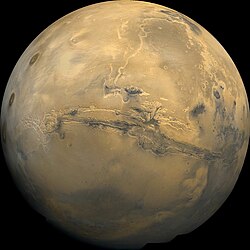 Mars in 1980 as seen by the Viking 1 Orbiter
 -

The image to the left shows a comparison between Mars and Ceres, a dwarf planet in the Asteroid Belt, as seen from the north ecliptic pole, while the image to the right is as seen from the ascending node. The segments of orbits south of the ecliptic are plotted in darker colors. The perihelia (q) and aphelia (Q) are labelled with the date of the nearest passage. The orbit of Mars is shown in red, Ceres is in yellow. 
-
-
26 Mar 11
-
23 Mar 11
-


Mars -
the polar latitudes , which appeared to be seas and continents
-
planet from the Sun in the Solar System. The planet is named after the Roman god of war, Mars. It is often described as the "Red
-
uses, see Mars (disambigua
-
the volcanoes, valleys, deserts, and
-
those of Earth, as is the tilt that produces the seasons. Mars is the site of Olympus Mons, the highest known mountain within the Solar System, and of Valles Marineris, the largest canyon. The smooth
-
Until the first flyby of Mars occurred in 1965, by Mariner 4, many speculated about the presence of liquid water on the planet's surface. This was based on observed periodic variations in light and dark patches, particularly in the polar latitudes, which appeared to be seas and continents; long, dark striations were interpreted by some as irrigation channels for liquid water. These straight line features were later explained as optical illusions, though geological evidence gathered by unmanned missions suggest that Mars once had large-scale water coverage on its surface.[16] In 2005, radar data revealed the presence of large quantities of water ice at the poles,[17] and at mid-latitudes.[18][19] The Mars rover Spirit sampled chemical compounds containing water molecules in March 2007. The Phoenix lander directly sampled water ice in shallow Martian soil on July 31, 2008.[20]
Mars has two moons, Phobos and Deimos, which are small and irregularly shaped. These may
-
Martian
-
artian
-
-
04 Mar 11
-
Mars is the fourth planet from the Sun in the Solar System.
-
-
Mars, when the planet is closest to Earth and hence is most easily visible
-
-
02 Mar 11
-
14 Feb 11
-
13 Feb 11
-
19 Jan 11
-
04 Dec 10
-
Mars is the fourth planet from the Sun in the Solar System. The planet is named after the Roman god of war, Mars. It is often described as the "Red Planet", as the iron oxide prevalent on its surface gives it a reddish appearance.[13] Mars is a terrestrial planet with a thin atmosphere, having surface features reminiscent both of the impact craters of the Moon and the volcanoes, valleys, deserts, and polar ice caps of Earth. The rotational period and seasonal cycles of Mars are likewise similar to those of Earth. Mars is the site of Olympus Mons, the highest known mountain within the Solar System, and of Valles Marineris, the largest canyon. The smooth Borealis basin in the northern hemisphere covers 40% of the planet and may be a giant impact feature.
-
Until the first flyby of Mars occurred in 1965, by Mariner 4, many speculated about the presence of liquid water on the planet's surface. This was based on observed periodic variations in light and dark patches, particularly in the polar latitudes, which appeared to be seas and continents; long, dark striations were interpreted by some as irrigation channels for liquid water. These straight line features were later explained as optical illusions, yet of all the planets in the Solar System other than Earth, Mars is the most likely to harbor liquid water, and thus to harbor life.[16] Geological evidence gathered by unmanned missions suggest that Mars once had large-scale water coverage on its surface, while small geyser-like water flows may have occurred during the past decade.[17] In 2005, radar data revealed the presence of large quantities of water ice at the poles,[18] and at mid-latitudes.[19][20] The Phoenix lander directly sampled water ice in shallow martian soil on July 31, 2008.[21]
-
-
04 Nov 10
-
-
19 Sep 10
 susan nottoli
test
-
The planet is named after the
-
occurred in 1965, by Mariner
-

-
15 Aug 10
-
22 Dec 09
-
Mars can be seen from Earth with the naked eye.
-
Equatorial radius 3,396.2 ± 0.1 km[a][3]
0.533 Earths -
diameter of Mars, whereas Earth is twice
-
the Earth is about ten times more massive than Mars
-
The red-orange appearance of the Martian surface is caused by iron(III) oxide, more commonly known as hematite, or rust.[15]
-
Much of the surface is deeply covered by finely grained iron(III) oxide dust
-
Mars has no evidence of structured global magnetic field
-
In June, 2008, the Phoenix Lander returned data showing Martian soil to be slightly alkaline and containing vital nutrients such as magnesium, sodium, potassium and chloride, all of which are necessary for living organisms to grow.
-
Liquid water cannot exist on the surface of Mars with its present low atmospheric pressure
-
-
09 Dec 09

-
Mars is the fourth planet from the Sun in the Solar System. The planet is named after Mars, the Roman god of war. It is also referred to as the "Red Planet" because of its reddish appearance, due to iron oxide prevalent on its surface.
-
-
24 Apr 09
-
03 Apr 09
-
22 Nov 08
-
Geology
-
Hydrology
-
Geography
-
Atmosphere
-
Climate
-
lengths of the Martian seasons are about twice those of Earth's, as Mars’ greater distance from the Sun leads to the Martian year being about two Earth years in length. Martian surface temperatures vary from lows of about −140 °C (−220 °F) during the polar winters to highs of up to 20 °C (68 °F) in summers.[20] The wide range in temperatures is due to the thin atmosphere which cannot store much solar heat, the low atmospheric pressure, and the low thermal inertia of Martian soil.[55]
-
Mars's seasons are the most Earth-like
-
Exploration
-
Future missions
-
Manned Mars exploration by the United States has been explicitly identified as a long-term goal in the Vision for Space Exploration announced in 2004 by US President George W. Bush.[96]
-
-
18 Apr 08
 James Linzel
Liquid water cannot exist on the surface of Mars with its present low atmospheric pressure, except at the lowest elevations for short periods[11][12] but water ice is in no short supply, with two polar ice caps made largely of ice.[13]
-
Mars lost its magnetosphere 4 billion years ago, so the solar wind interacts directly with the Martian ionosphere, keeping the atmosphere thinner than it would otherwise be by stripping away atoms from the outer layer.
-
The atmosphere of Mars is now relatively thin. Atmospheric pressure on the surface varies from around 30 Pa (0.03 kPa) on Olympus Mons to over 1155 Pa (1.155 kPa) in the depths of Hellas Planitia, with a mean surface level pressure of 600 Pa (0.6 kPa). This is less than 1% of the surface pressure on Earth (101.3 kPa). Mars's mean surface pressure equals the pressure found 35 km above the Earth's surface. The scale height of the atmosphere, about 11 km, is higher than Earth's (6 km) due to the lower gravity.
-
The atmosphere on Mars consists of 95% carbon dioxide, 3% nitrogen, 1.6% argon, and contains traces of oxygen and water.[4
-
Mars lost its magnetosphere 4 billion years ago, so the solar wind interacts directly with the Martian ionosphere, keeping the atmosphere thinner than it would otherwise be by stripping away atoms from the outer layer
-
The polar caps at both poles consist primarily of water ice. However, there is dry ice present on their surfaces. Frozen carbon dioxide (dry ice) accumulates as a thin layer about one metre thick on the north cap in the northern winter only, while the south cap has a permanent dry ice cover about eight metres thick.
-
-
10 Dec 07
-
09 Nov 07
-
05 Nov 07
-
Mars
-


Page Comments
Would you like to comment?
Join Diigo for a free account, or sign in if you are already a member.