
This link has been bookmarked by 74 people . It was first bookmarked on 14 Jan 2008, by someone privately.
-
03 Jun 15
-
Large Hadron Collider
-
the world's largest and most powerful particle collider
-
the largest single machine in the world
-
It was built by the European Organization for Nuclear Research (CERN) between 1998 and 2008 in collaboration with over 10,000 scientists and engineers from over 100 countries, as well as hundreds of universities and laboratories
-
It lies in a tunnel 27 kilometres (17 mi) in circumference, as deep as 175 metres (574 ft) beneath the Franco-Swiss border near Geneva, Switzerland
-
Its first research run took place from 30 March 2010 to 13 February 2013 at an initial energy of 3.5 teraelectronvolts (3.5 TeV per beam (7 TeV total),
-
Test' collisions restarted in the upgraded collider on 5 April 2015
-
Its second research run commenced on schedule, on 3 June 2015
-
The LHC's aim is to allow physicists to test the predictions of different theories of particle physics and high-energy physics and in particular, to prove or disprove the existence of the theorized Higgs boson[9] and the large family of new particles predicted by supersymmetric theories,[10] and other unsolved questions of physics, advancing human understanding of physical laws.
-
Proton–proton collisions are the main operation mode
-
a magnet quench incident that caused extensive damage to over 50 superconducting magnets, their mountings, and the vacuum pipe
-
During its first run (2010 - 2013) the LHC collided two opposing particle beams of either protons at up to 4 teraelectronvolts (4 TeV or 0.64 microjoules), or lead nuclei (574 TeV per nucleus, or 2.76 TeV per nucleon).
-
The LHC's computing grid was (and currently is) a world record holder. Data from collisions was anticipated to be produced at an unprecedented rate for the time, of tens of petabytes per year, a major challenge at the time, to be analysed by a grid-based computer network infrastructure connecting 140 computing centers in 35 countries[20][21] – by 2012 the LHC Computing Grid was also the world's largest distributed computing grid, comprising over 170 computing facilities in a worldwide network across 36 countries
-
Background
-
-
-
19 May 15
-
Large Hadron Collider (LHC) is the world's largest and most powerful particle collider, and the largest single machine in the world,[1] built by the European Organization for Nuclear Research (CERN) from 1998 to 2008.
-
The LHC was built in collaboration with over 10,000 scientists and engineers from over 100 countries
-
It lies in a tunnel 27 kilometres (17 mi) in circumference, as deep as 175 metres (574 ft) beneath the Franco-Swiss border near Geneva, Switzerland.
-
Its aim is to allow physicists to test the predictions of different theories of particle physics and high-energy physics like the Standard Model, and particularly prove or disprove the existence of the theorized Higgs boson
-
The discovery of a particle matching the Higgs boson was confirmed by data from the LHC in 2013
-
It contains seven detectors, each designed for certain kinds of research.
-
-
30 Oct 14
-
15 Jun 14
-
02 Dec 13
-
As well as the planned 2013–2015 increase to its intended 14 TeV collision energy, a luminosity upgrade of the LHC, called the High Luminosity LHC, has also been proposed,[87] to be made in 2018 after ten years of operation.
-
The optimal path for the LHC luminosity upgrade includes an increase in the beam current (i.e. the number of protons in the beams) and the modification of the two high-luminosity interaction regions, ATLAS and CMS. To achieve these increases, the energy of the beams at the point that they are injected into the (Super) LHC should also be increased to 1 TeV. This will require an upgrade of the full pre-injector system, the needed changes in the Super Proton Synchrotron being the most expensive. Currently the collaborative research effort of LHC Accelerator Research Program, LARP, is conducting research into how to achieve these goals.[88]
-
With a budget of 7.5 billion euros
-
Problems occurred on 19 September 2008 during powering tests of the main dipole circuit, when an electrical fault in the bus between magnets caused a rupture and a leak of six tonnes of liquid helium. The operation was delayed for several months.[112] It is currently believed that a faulty electrical connection between two magnets caused an arc, which compromised the liquid-helium containment.
-
Once the cooling layer was broken, the helium flooded the surrounding vacuum layer with sufficient force to break 10-ton magnets from their mountings. The explosion also contaminated the proton tubes with soot.[47][113] This accident was thoroughly discussed in a 22 February 2010 Superconductor Science and Technology article by CERN physicist Lucio Rossi.[114]
-
-
12 Nov 13
-
24 Aug 13
-
19 Aug 13

-
18 Mar 13
-
with the aim of allowing physicists to test the predictions of different theories of particle physics and high-energy physics, and particularly prove or disprove the existence of the theorized Higgs boson[2] and of the large family of new particles predicted by supersymmetric theories.[3]
-
It lies in a tunnel 27 kilometres (17 mi) in circumference, as deep as 175 metres (574 ft) beneath the Franco-Swiss border near Geneva, Switzerland.
-
-
16 Jul 12
-
02 Mar 12
-
Large Hadron Collider
<!-- /firstHeading --> <!-- bodyContent --><!-- tagline -->From Wikipedia, the free encyclopedia<!-- /tagline --> <!-- subtitle --> <!-- /subtitle --> <!-- jumpto -->Jump to: navigation, search<!-- /jumpto --> <!-- bodycontent -->"LHC" redirects here. For other uses, see LHC (disambiguation).Coordinates:
 46°14′N 06°03′E / 46.233°N 6.05°E / 46.233; 6.05
Large Hadron Collider
(LHC)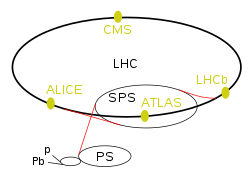
LHC experiments ATLAS A Toroidal LHC Apparatus CMS Compact Muon Solenoid LHCb LHC-beauty ALICE A Large Ion Collider Experiment TOTEM Total Cross Section, Elastic Scattering and Diffraction Dissociation LHCf LHC-forward MoEDAL Monopole and Exotics Detector At the LHC LHC preaccelerators p and Pb Linear accelerators for protons (Linac 2) and Lead (Linac 3) (not marked) Proton Synchrotron Booster PS Proton Synchrotron SPS Super Proton Synchrotron Hadron colliders Intersecting Storage Rings CERN, 1971–1984 Super Proton Synchrotron CERN, 1981–1984 ISABELLE BNL, cancelled in 1983 Tevatron Fermilab, 1987–2011 Relativistic Heavy Ion Collider BNL, 2000–present Superconducting Super Collider Cancelled in 1993 Large Hadron Collider CERN, 2009–present Super Large Hadron Collider Proposed, CERN, 2019– Very Large Hadron Collider Theoretical The Large Hadron Collider (LHC) is the world's largest and highest-energy particle accelerator. It was built by the European Organization for Nuclear Research (CERN) over a ten year period from 1998 to 2008, with the aim of allowing physicists to test the predictions of different theories of particle physics and high-energy physics, and particularly for the existence of the hypothesized Higgs boson[1] and of the large family of new particles predicted by
-
-
07 Jan 12
-
25 Dec 11
-
16 Mar 11
-
02 Mar 11
-
16 Oct 10
-
The Large Hadron Collider (LHC) is the world's largest and highest-energy particle accelerator. It is expected that it will address the most fundamental questions of physics, advancing our understanding of the deepest laws of nature.
The LHC lies in a tunnel 27 kilometres (17 mi) in circumference, as much as 175 metres (574 ft) beneath the Franco-Swiss border near Geneva, Switzerland. This synchrotron is designed to collide opposing particle beams of either protons at an energy of 7 teraelectronvolts (1.12 microjoules) per particle, or lead nuclei at an energy of 574 TeV (92.0 µJ) per nucleus.[1][2] The term hadron refers to particles composed of quarks.
-
-
26 Sep 10

-
24 Sep 10
-
10 Sep 10
-
12 Jun 10
-
03 Jun 10
-
02 Apr 10
-
Cost
With a budget of 9 billion US dollars (approx. €6300M or £5600M as of Jan 2010), the LHC is the most expensive scientific experiment in human history.[49] The total cost of the project is expected to be of the order of 4.6 billion Swiss francs (approx. $4.4 bn, €3.1 bn, or £2.8 bn as of Jan 2010) for the accelerator and 1.16 billion francs (approx. $1.1 bn, €0.8 bn, or £0.7 bn as of Jan 2010) for the CERN contribution to the experiments.[50]
The construction of LHC was approved in 1995 with a budget of 2.6 billion francs, with another 210 million francs towards the experiments. However, cost overruns, estimated in a major review in 2001 at around 480 million francs for the accelerator, and 50 million francs for the experiments, along with a reduction in CERN's budget, pushed the completion date from 2005 to April 2007.[51] The superconducting magnets were responsible for 180 million francs of the cost increase. There were also further costs and delays due to engineering difficulties encountered while building the underground cavern for the Compact Muon Solenoid,[52] and also due to faulty parts provided by Fermilab.[53]
Due to lower electricity costs during the summer, it is expected that the LHC will normally not operate over the winter months,[54] although an exception was being made to make up for the 2008 start-up delays over the 2009/10 winter.
-
-
06 Mar 10
-
23 Nov 09
-
15 Nov 09
-
The LHC physics program is mainly based on proton–proton collisions. However, shorter running periods, typically one month per year, with heavy-ion collisions are included in the program. While lighter ions are considered as well, the baseline scheme deals with lead ions[18] (see A Large Ion Collider Experiment). This will allow an advancement in the experimental program currently in progress at the Relativistic Heavy Ion Collider (RHIC). The aim of the heavy-ion program is to provide a window on a state of matter known as Quark–gluon plasma, which characterized the early stage of the life of the Universe.
-
-
10 Nov 09
-
22 Oct 09
-
15 Mar 09
 Ex3 oP
The Large Hadron Collider (LHC) is the world's largest and highest-energy particle accelerator, intended to collide opposing particle beams, of either protons at an energy of 7 TeV/particle, or lead nuclei at an energy of 574 TeV/nucleus.
-
Of the possible discoveries the LHC might make, only the discovery of the Higgs particle is relatively uncontroversial, but even this is not considered a certainty. Stephen Hawking said in a BBC interview that "I think it will be much more exciting if we don't find the Higgs. That will show something is wrong, and we need to think again. I have a bet of one hundred dollars that we won't find the Higgs." In the same interview Hawking mentions the possibility of finding superpartners and adds that "whatever the LHC finds, or fails to find, the results will tell us a lot about the structure of the universe."
-
-
11 Nov 08
-
05 Oct 08
 Hans-Juergen Kugler
Large Hadron Collider (LHC) is the world's largest and highest-energy particle accelerator complex, intended to collide opposing beams of protons or lead, two of several types of hadrons, at up to 99.99 percent the speed of light.
-
What is the nature of dark matter and dark energy?
-
-
18 Sep 08
-
15 Sep 08
-
13 Sep 08
-
11 Sep 08
-
08 Sep 08
-
06 Sep 08
-
The LHC is the world's largest and the highest-energy particle accelerator.[1] It is funded and built in collaboration with over eight thousand physicists from over eighty-five countries as well as hundreds of universities and laboratories. The idea of the Large Hadron Collider (LHC), began in the early 1980s. The first approval of the project by the CERN Council occurred in December 1994 and the first civil engineering construction work began in April 1998.
-
-
06 Aug 08
-
05 Aug 08
-
29 Jun 08

-
30 Dec 07
-
22 May 07


Would you like to comment?
Join Diigo for a free account, or sign in if you are already a member.