
This link has been bookmarked by 42 people . It was first bookmarked on 05 Nov 2007, by hhajiah.
-
29 Oct 14
-
09 Sep 14
 ralawami
GAS GIANT
two and a half times the mass of all other planet in the Solar System combined
Apparent magnitude of -2.94
quarter of mass is helium
oblate spheroid
Faint PLANETARY RING SYSTEM
Powerful MAGNETOSPHERE
67 moons discovered**
GALILEAN MOON -
21 Sep 12
-
Jupiter is the fifth planet from the Sun and the largest planet within the Solar System.[13] It is a gas giant with mass one-thousandth that of the Sun but is two and a half times the mass of all the other planets in our Solar System combined. Jupiter is classified as a gas giant along with Saturn, Uranus and Neptune. Together, these four planets are sometimes referred to as the Jovian or outer planets.
The planet was known by astronomers of ancient times,[14] and was associated with the mythology and religious beliefs of many cultures. The Romans named the planet after the Roman god Jupiter.[15] When viewed from Earth, Jupiter can reach an apparent magnitude of −2.94, making it on average the third-brightest object in the night sky after the Moon and Venus. (Mars can briefly match Jupiter's brightness at certain points in its orbit.)
Jupiter is primarily composed of hydrogen with a quarter of its mass being helium, although helium only comprises about a tenth of the number of molecules; it may also have a rocky core of heavier elements.[16] Because of its rapid rotation, Jupiter's shape is that of an oblate spheroid (it possesses a slight but noticeable bulge around the equator). The outer atmosphere is visibly segregated into several bands at different latitudes, resulting in turbulence and storms along their interacting boundaries. A prominent result is the Great Red Spot, a giant storm that is known to have existed since at least the 17th century when it was first seen by telescope. Surrounding the planet is a faint planetary ring system and a powerful magnetosphere. There are also at least 67 moons, including the four large moons called the Galilean moons that were first discovered by Galileo Galilei in 1610. Ganymede, the largest of these moons, has a diameter
-
-
29 Nov 11
-
-
-
Jupiter is classified as a gas giant
-
sometimes referred to as the Jovian or outer planets.
-
-
06 Nov 11
-
Jupiter is classified as a gas giant along
-
-
04 Oct 11
-
06 Apr 11
-
23 Mar 11
-
07 Jan 11
-
The oval object rotates counterclockwise, with a period of about six days.[49] The Great Red Spot's dimensions are 24–40,000 km × 12–14,000 km. It is large enough to contain two or three planets of Earth's diameter.[50] The maximum altitude of this storm is about 8 km above the surrounding cloudtops.[51]
-
by Galileo Galilei in 1610. Ganymede, the largest of these moons, has a diameter greater than that of the planet Mercury.
-
A prominent result is the Great Red Spot, a giant storm that is known to have existed since at least the 17th century when it was first seen by telescope. Surrounding the planet is a faint planetary ring system and a powerful magnetosphere. There are also at least 63 moons, including the four large moons called the Galilean moons that were first discovered
-
The best known feature of Jupiter is the Great Red Spot, a persistent anticyclonic storm located 22° south of the equator that is larger than Earth. It is known to have been in existence since at least 1831,[45] and possibly since 1665.[46] Mathematical models suggest that the storm is stable and may be a permanent feature of the planet.[47] The storm is large enough to be visible through Earth-based telescopes with an aperture of 12 cm or larger.[48]
-
-
06 Sep 10
-
17 Aug 10
-
15 Aug 10
-
21 Apr 10
-
15 Dec 09
-
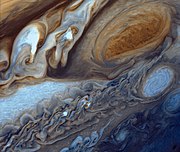 False-color detail of Jupiter's atmosphere, imaged by Voyager 1, showing the Great Red Spot and a passing white oval.
-
-
05 Nov 07
-
Jupiter
-


Would you like to comment?
Join Diigo for a free account, or sign in if you are already a member.