
This link has been bookmarked by 40 people . It was first bookmarked on 08 Oct 2006, by cory plough.
-
08 Dec 14
 vsrodriguez2
It is a wikipedia article
-
23 Sep 14
-
21 Jul 14
-
27 Sep 13
-
24 Aug 13
-
22 Mar 13
-
"Movie" and "Moving picture"
-
film, also called a movie or motion picture
-
nterruptions because of an effect known as persistence of visio
-
The perception of motion is due to a psychological effect called beta movement.
-
"film" originates from the fact that photographic film (al
-
United States is movie, while in Europe film i
-
first animated image sequences photo
-
improved and in the late 1870s Eadweard Muybridge c
-
y the end of the 1880s, the introduction of lengths of celluloid photographic film an
-
invention of motion picture cameras,
-
The first public exhibition of projected motion pictures in America was at Koster and Bial's Music Hall in New York City on the 23rd of April 1896.
-
-
Around the turn of the 20th century, films started stringing several scenes together to tell a story
-
ntil sound film became commercially practical in the late 1920s,
-
while the film industry in the United States flourished with the rise of Hollywood,
-
The rise of European cinema was interrupted by the outbreak of World War I
-
The resulting sound films were initially distinguished from the usual silent "moving pictures" or "movies" by calling them "talking pictures" or "talkies
-
By 1930, silent film was practically extinct in the US and already being referred to as "the old medium."[c
-
nother major technological development was the introduction of "natural color,
-
first used for animated cartoons in 1932, then also for live-action short films and isolated sequences in a few feature films, then for an entire feature film, Becky Sharp, in 1935.
-
The pivotal innovation was the introduction of the three-strip version of the Technicolor proces
-
Various New Wave movements (including the French New Wave, Indian New Wave, Japanese New Wave and New Hollywood)
-
. Digital 3D projection largely replaced earlier problem-prone 3D film systems and has become popular in the early 2010s.[citation needed]
-
Other regional centers exist in many parts of the world, such as Mumbai-centered Bollywood, the Indian film industry's Hindi cinema which produces the largest number of films in the world
-
Although the words "film" and "movie" are sometimes used interchangeably, "film" is more often used when considering artistic, theoretical, or technical aspects, as studies in a university class and "movies" more often refers to entertainment or commercial aspects, as where to go for fun on a date
-
DVD" is a digital format
-
"Cinema" either broadly encompasses both films and movies, or is roughly synonymous with "Film",
-
e "silver screen" refers to classic black-and-white films before color, not to contemporary films without color.
-
oth capitalized when referring to a category of art.
-
The necessary steps for almost any film can be boiled down to conception, planning, execution, revision, and distribution. The more involved the production, the more significant each of the steps becomes. In a typical production cycle of a Hollywood-style film, these main stages are defined as:
-
A fan film is a film or video inspired by a film, television program, comic book or a similar source, created by fans rather than by the source's copyright holders or creators
-
-
28 Oct 12
-
22 Feb 12
-
05 Feb 12
-
31 Jan 12
-
17 Sep 11
-
20 Apr 11
-
22 Jan 11
 Delva Davis
exploring films and its definition/history
-
A film, also called a movie or motion picture, is a story conveyed with moving images. It is produced by recording photographic images with cameras, or by creating images using animation techniques or visual effects. The process of filmmaking has developed into an art form and industry.
-
-
11 Nov 10
-
08 Nov 10
-
19 Oct 10
-
This article is about Motion pictures or Movies. For Still photography film, see Photographic film. For Motion picture film, see Film stock.
-
-
Film critics working for newspapers, magazines, and broadcast media mainly review new releases. Normally they only see any given film once and have only a day or two to formulate opinions. Despite this, critics have an important impact on films, especially those of certain genres. Mass marketed action, horror, and comedy films
-
-
08 Sep 10
-
-
In the 1860s, mechanisms for producing two-dimensional drawings in motion were demonstrated with devices such as the zoetrope, mutoscope and praxinoscope
-
By the 1880s the development of the motion picture camera allowed the individual component images to be captured and stored on a single reel, and led quickly to the development of a motion picture projector to shine light through the processed and printed film and magnify these "moving picture shows" onto a screen for an entire audience.
-
sound quickly eclipsed silent film
-
The next major step in the development of cinema was the introduction of so-called "natural" color.
-
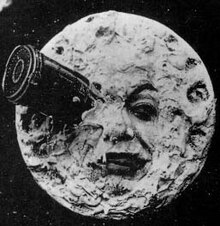 A shot from Georges Méliès Le Voyage dans la Lune (A Trip to the Moon) (1902), an early narrative film.
The rise of European cinema was interrupted by the outbreak of World War I when the film industry in United States flourished with the rise of Hollywood, typified most prominently by the great innovative work of D.W. Griffith in The Birth of a Nation (1914) and Intolerance (1916) . However in the 1920s, European filmmakers such as Sergei Eisenstein, F. W. Murnau, and Fritz Lang,in many ways inspired by the meteoric war-time progress of film through Griffith, along with the contributions of Charles Chaplin, Buster Keaton and others, quickly caught up with American film-making and continued to further advance the medium
-
. By the end of the 1960s, color had become the norm for film makers
-
04 May 10
-
The visual elements of cinema give motion pictures a universal power of communication.
-
-
30 Jan 10
-
By the 1880s the development of the motion picture camera allowed the individual component images to be captured and stored on a single reel, and led quickly to the development of a motion picture projector to shine light through the processed and printed film and magnify these "moving picture shows" onto a screen for an entire audience. These reels, so exhibited, came to be known as "motion pictures". Early motion pictures were static shots that showed an event or action with no editing or other cinematic techniques.
-
Digital technology has been the driving force in change throughout the 1990s and into the 21st century.
-
-
17 Nov 09
-
07 Oct 09
-
Film encompasses individual motion pictures, the field of film as an art form, and the motion picture industry. Films are produced by recording images from the world with cameras, or by creating images using animation techniques or visual effects.
Films are cultural artifacts created by specific cultures, which reflect those cultures, and, in turn, affect them. Film is considered to be an important art form, a source of popular entertainment and a powerful method for educating — or indoctrinating — citizens. The visual elements of cinema give motion pictures a universal power of communication. Some films have become popular worldwide attractions by using dubbing or subtitles that translate the dialogue.
Films are made up of a series of individual images called frames. When these images are shown rapidly in succession, a viewer has the illusion that motion is occurring. The viewer cannot see the flickering between frames due to an effect known as persistence of vision, whereby the eye retains a visual image for a fraction of a second after the source has been removed. Viewers perceive motion due to a psychological effect called beta movement.
-
Film encompasses individual motion pictures, the field of film as an art form, and the motion picture industry. Films are produced by recording images from the world with cameras, or by creating images using animation techniques or visual effects.
Films are cultural artifacts created by specific cultures, which reflect those cultures, and, in turn, affect them. Film is considered to be an important art form, a source of popular entertainment and a powerful method for educating — or indoctrinating — citizens. The visual elements of cinema give motion pictures a universal power of communication. Some films have become popular worldwide attractions by using dubbing or subtitles that translate the dialogue.
Films are made up of a series of individual images called frames. When these images are shown rapidly in succession, a viewer has the illusion that motion is occurring. The viewer cannot see the flickering between frames due to an effect known as persistence of vision, whereby the eye retains a visual image for a fraction of a second after the source has been removed. Viewers perceive motion due to a psychological effect called beta movement.
-
-
26 Jan 09
-
14 May 08
-
Film is a term that encompasses individual motion pictures, the field of film as an art form, and the motion picture industry. Films are produced by recording images from the world with cameras, or by creating images using animation techniques or special effects.
-
Traditional films are made up of a series of individual images called frames. When these images are shown rapidly in succession, a viewer has the illusion that motion is occurring. The viewer cannot see the flickering between frames due to an effect known as persistence of vision, whereby the eye retains a visual image for a fraction of a second after the source has been removed. Viewers perceive motion due to a psychological effect called beta movement.
-
The origin of the name "film" comes from the fact that photographic film (also called film stock) had historically been the primary medium for recording and displaying motion pictures. Many other terms exist for an individual motion picture, including picture, picture show, photo-play, flick, and most commonly, movie. Additional terms for the field in general include the big screen, the silver screen, the cinema, and the movies
-
the development of the motion picture camera allowed the individual component images to be captured and stored on a single reel, and led quickly to the development of a motion picture projector to shine light through the processed and printed film and magnify these "moving picture shows" onto a screen for an entire audience. These reels, so exhibited, came to be known as "motion pictures". Early motion pictures were static shots that showed an event or action with no editing or other cinematic techniques.
-
Around the turn of the twentieth century, films began developing a narrative structure by stringing scenes together to tell narratives. The scenes were later broken up into multiple shots of varying sizes and angles. Other techniques such as camera movement were realized as effective ways to portray a story on film. Rather than leave the audience in silence, theater owners would hire a pianist or organist or a full orchestra to play music fitting the mood of the film at any given moment. By the early 1920s, most films came with a prepared list of sheet music for this purpose, with complete film scores being composed for major productions.
-
-
02 Feb 08
-
16 Mar 06
-
07 Dec 05


Would you like to comment?
Join Diigo for a free account, or sign in if you are already a member.