
This link has been bookmarked by 162 people . It was first bookmarked on 17 Jan 2007, by MICDS Ram.
-
30 Mar 15
 tylerjamison
computer information
computer computers wikipedia WIki technology based School projects
-
24 Mar 15
-
11 Mar 15
-
The abacus was early used for arithmetic tasks. What we now call the Roman abacus was used in Babylonia as early as 2400 BC.
-
The first modern analog computer was a tide-predicting machine, invented by Sir William Thomson in 1872. The differential analyser, a mechanical analog computer designed to solve differential equations by integration using wheel-and-disc mechanisms, was conceptualized in 1876 by James Thomson, the brother of the more famous Lord Kelvin.[15]
-
The art of mechanical analog computing reached its zenith with the differential analyzer, built by H. L. Hazen and Vannevar Bush at MIT starting in 1927. This built on the mechanical integrators of James Thomson and the torque amplifiers invented by H. W. Nieman. A dozen of these devices were built before their obsolescence became obvious.
-
By 1938 the United States Navy had developed an electromechanical analog computer small enough to use aboard a submarine. This was the Torpedo Data Computer, which used trigonometry to solve the problem of firing a torpedo from a boat to a moving target. During World War II similar devices were developed in other countries as well.
-
Early digital computers were electromechanical; electric switches drove mechanical relays to perform the calculation. These devices had a low operating speed and were eventually superseded by much faster all-electric computers, originally using vacuum tubes. The Z2, created by German engineer Konrad Zuse in 1939, was one of the earliest examples of an electromechanical relay computer.[22]
-
There is active research to make computers out of many promising new types of technology, such as optical computers, DNA computers, neural computers, and quantum computers. Most computers are universal, and are able to calculate any computable function, and are limited only by their memory capacity and operating speed. However different designs of computers can give very different performance for particular problems; for example quantum computers can potentially break some modern encryption algorithms (by quantum factoring) very quickly.
-
-
16 Feb 15
-
perations automatically. Since a sequence of operations can be readily changed, the computer can solve more than one kind of problem.
-
Conventionally, a computer consists of at least one processing element, typically a central processing unit (CPU), and some form of memory. The processing element carries out arithmetic and logic operations, and a sequencing and control unit can change the order of operations in response to stored information. Peripheral devices allow information to be retrieved from an external source, and the result of operations saved and retrieved.
-
-
09 Dec 14
-
13 Nov 14
-
Conventionally, a computer consists of at least one processing element,
-
The processing element carries out arithmetic and logic operations,
-
typically a central processing unit
-
and some form of memory.
-
-
31 Oct 14
-
27 Oct 14
-
16 Oct 14
 gleas747
Definition of computers
-
15 Oct 14

-
24 Sep 14
-
10 Sep 14
-
A computer is a general purpose device that can be programmed to carry out a set of arithmetic or logical operations automatically.
-
mov No. 0, sum ; set sum to 0 mov No. 1, num ; set num to 1 loop: add num, sum ; add num to sum add No. 1, num ; add 1 to num cmp num, #1000 ; compare num to 1000 ble loop ; if num <= 1000, go back to 'loop' halt ; end of program. stop running -

-

-
-
30 Aug 14
 ifixitcomputers
Computer's history that should be known to us.
-
06 Jun 14
-
A computer is a general purpose device that can be programmed to carry out a set of arithmetic or logical operations automatically. Since a sequence of operations can be readily changed, the computer can solve more than one kind of problem.
-
-
25 May 14
-
carry out a set of arithmetic or logical operations automatically.
-
in a book called “The yong mans gleanings” by English writer Richard Braithwait I haue read the truest computer of Times, and the best Arithmetician that euer breathed, and he reduceth thy dayes into a short number.
-
human computers, people who performed calculations, often as employment
-
scientific computing needs were met by increasingly sophisticated analog computers, which used a direct mechanical or electrical model of the problem as a basis for computation.
-
to be concise.
-
less related to the workings of the target computer than assembly language, and more related to the language and structure of the problem(s) to be solved
-
device which processes information qualifies as a computer, especially if the processing is purposeful.
-
-
22 May 14
-
25 Apr 14
-
10 Apr 14

-
27 Mar 14
 Trevor Taylor
"A computer is a general purpose device that can be programmed to carry out a set of arithmetic or logical operations automatically. Since a sequence of operations can be readily changed, the computer can solve more than one kind of problem."
computer computers wikipedia projects WIki School technology based
-
09 Dec 13
-
05 Dec 13
-
25 Nov 13
-
A computer is a general purpose device that can be programmed to carry out a set of arithmetic or logical operations. Since a sequence of operations can be readily changed, the computer can solve more than one kind of problem.
Conventionally, a computer consists of at least one processing element, typically a central processing unit (CPU) and some form of memory. The processing element carries out arithmetic and logic operations, and a sequencing and control unit that can change the order of operations based on stored information. Peripheral devices allow information to be retrieved from an external source, and the result of operations saved and retrieved.
The first electronic digital computers were developed between 1940 and 1945. Originally they were the size of a large room, consuming as much power as several hundred modern personal computers (PCs).[1] In this era mechanical analog computers were used for military applications.
-
-
10 Nov 13
-
general purpose device that can be programmed to carry out a set of arithmetic or logical operations. Since a sequence of operations can be readily changed, the computer can solve more than one kind of problem.
Conventionally, a computer
-
The first electronic digital computers were developed between 1940 and 1945. Originally they were the size of a large room, consuming as much power as several hundred modern personal computers (PCs).[
-
-
29 Oct 13
-
A computer is a general purpose device that can be programmed to carry out a set of arithmetic or logical operations
-
-
30 Sep 13
-
the computer can solve more than one kind of problem.
-
-
16 Apr 13

-
A computer is a general purpose device that can be programmed to carry out a finite set of arithmetic or logical operations. Since a sequence of operations can be readily changed, the computer can solve more than one kind of problem.
-
Modern computers based on integrated circuits are millions to billions of times more capable than the early machines, and occupy a fraction of the space.[
-
From the end of the 19th century the word began to take on its more familiar meaning, a machine that carries out computations.[3
-
-
06 Feb 13
-
07 Jan 13
 Luis Gonzalez
Example
-
13 Dec 12
-
A computer is a general purpose device that can be programmed to carry out a finite set of arithmetic or logical operations. Since a sequence of operations can be readily changed, the computer can solve more than one kind of problem.
-
Conventionally, a computer consists of at least one processing element, typically a central processing unit (CPU) and some form of memory. The processing element carries out arithmetic and logic operations, and a sequencing and control unit that can change the order of operations based on stored information. Peripheral devices allow information to be retrieved from an external source, and the result of operations saved and retrieved.
-
analog
-
applications
-
Modern computers based on integrated circuits are millions to billions of times more capable than the early machines, and occupy a fraction of the space.[2] Simple computers are small enough to fit into mobile devices, and mobile computers can be powered by small batteries. Personal computers in their various forms are icons of the Information Age and are what most people think of as "computers". However, the embedded computers found in many devices from mp3 players to fighter aircraft and from toys to industrial robots are the most numerous.
-
computations
-
story of the modern computer begins with two separate technologies, automated calculation and programmability, but no single device can be identified as the earliest computer, partly because of the inconsistent application of that term. A few devices are worth mentioning though, like some mechanical aids to computing, which were very successful and survived for centuries until the advent of the electronic calculator, like the Sumerian abacus, designed around 2500 BC[4] of which a descendant won a speed competition against a modern desk calculating machine in Japan in 1946,[5] the slide rules, invented in the 1620s, which were carried on five Apollo space missions, including to the moon[6] and arguably the astrolabe and the Antikythera mechanism, an anc
-
programmability
-
In 1801, Joseph Marie Jacquard made an improvement to the textile loom by introducing a series of punched paper cards as a template which allowed his loom to weave intricate patterns automatically. The resulting Jacquard loom was an important step in the development of computers because the use of punched cards to define woven patterns can be viewed as an early, albeit limited, form of programmability.
-
ncept of the algorithm and computation with the Turing machine, providing a blueprint for the electronic digital computer.[22] Of his role in the creation of the modern computer, Time magazine in naming Turing one of the 100 most influential people of the 20th century, states: "The fact remains that everyone who taps at a keyboard, opening a spreadsheet or a word-processing program, is working on an incarnation of a Turing machine".[22]
 The ENIAC, which became operational in 1946, is considered to be the first general-purpose electronic computer.

The Atanasoff–Berry Computer (ABC) was the world's first electronic digital computer, albeit not programmable.[23] Atanasoff is considered to be one of the fathers of the computer.[24] Conceived in 1937 by Iowa State College physics professor John Atanasoff, and built with the assistance of graduate student Clifford Berry,[25] the machine was not programmable, being designed only to solve systems of linear equations. The computer did employ parallel computation. A 1973 court ruling in a patent dispute found that the patent for the 1946 ENIAC computer derived from the Atanasoff–Berry Computer.
The first program-controlled computer was invented by Konrad Zuse, who built the Z3, an electromechanical computing machine, in 1941.[26] The first programmable electronic computer was the Colossus, built in 1943 by Tommy Flowers.
George Stibitz is internationally recognized as a father of the modern digital computer. While working at Bell Labs in November 1937, Stibitz invented an
-
Programs
 Alan Turing was an influential computer scientist.
The defining feature of modern computers which distinguishes them from all other machines is that they can be programmed. That is to say that some type of instructions (the program) can be given to the computer, and it will process them. Modern computers based on the von Neumann architecture often have machine code in the form of an imperative programming language.
In practical terms, a computer program may be just a few instructions or extend to many millions of instructions, as do the programs for word processors and web browsers for example. A typical modern computer can execute billions of instructions per second (gigaflops) and rarely makes a mistake over many years of operation. Large computer programs consisting of several million instructions may take teams of programmers years to write, and due to the complexity of the task almost certainly contain errors.
Stored program architecture
-
This section applies to most common RAM machine-based computers.
In most cases, computer instructions are simple: add one number to another, move some data from one location to another, send a message to some external device, etc. These instructions are read from the computer's memory and are generally carried out (executed) in the order they were given. However, there are usually specialized instructions to tell the computer to jump ahead or backwards to some other place in the program and to carry on executing from there. These are called "jump" instructions (or branches). Furthermore, jump instructions may be made to happen conditionally so that different sequences of instructions may be used depending on the result of some previous calculation or some external event. Many computers directly support subroutines by providing a type of jump that "remembers" the location it jumped from and another instruction to return to the instruction following that jump instruction.
-
Machine code
In most computers, individual instructions are stored as machine code with each instruction being given a unique number (its operation code or opcode for short). The command to add two numbers together would have one opcode, the command to multiply them would have a different opcode and so on. The simplest computers are able to perform any of a handful of different instructions; the more complex computers have several hundred to choose from, each with a unique numerical code. Since the computer's memory is able to store numbers, it can also store the instruction codes. This leads to the important fact that entire programs (which are just lists of these instructions) can be represented as lists of numbers and can themselves be manipulated inside the computer in the same way as numeric data. The fundamental concept of storing progra
-
he von Neumann, or stored program, architecture. In some cases, a computer might store some or all of its program in memory that is kept separate from the data it operates on. This is called the Harvard architecture after the Harvard Mark I computer. Modern von Neumann computers display some traits of the Harvard architecture in their designs, such as in CPU caches.
While it is possible to write computer programs as long lists of numbers (machine language) and while this technique was used with many early computers,[35] it is extremely tedious and potentially error-prone to do so in practice, especially for complicated programs. Instead, each basic instruction can be given a sh
-
in assembly language into something the computer can actually understand (machine language) is usually done by a computer program called an assembler.
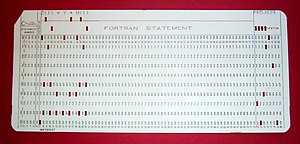 A 1970s punched card containing one line from a FORTRAN program. The card reads: "Z(1) = Y + W(1)" and is labelled "PROJ039" for identification purposes.
Programming language
-
Programming languages provide various ways of specifying programs for computers to run. Unlike natural languages, programming languages are designed to permit no ambiguity and to be concise. They are purely written languages and are often difficult to read aloud. They are generally eith
-
Machine languages and the assembly languages that represent them (collectively termed low-level programming languages) tend to be unique to a particular type of computer. For instance, an ARM architecture computer (such as may be found in a PDA or a hand-held videogame) cannot understand the machine language of an Intel Pentium or the AMD Athlon 64 computer that might be in a PC.[36]
-
Higher-level languages
Main article: High-level programming languageThough considerably easier than in machine language, writing long programs in assembly language is often difficult and is also error prone. Therefore, most practical programs are written in more abstract high-level programming languages that are able to express the needs of the programmer more conveniently (and thereby help reduce programmer error). High level languages are usually "compiled" into machine language (or sometimes into assembly language and then into machine language) using another computer program called a compiler.[37] High level languages are less related to the workings of the target computer than assembly language, and more related to the language and structure of the problem(s) to be solved by the final program. It is therefore often possible to use different compilers to translate the same high level language program into the machine language of many different types of computer. This is part of the means by which software like video games may be made available for different computer architectures such as personal computers and various video game consoles.
-
- Read the code for the next instruction from the cell indicated by the program counter.
- Decode the numerical code for the instruction into a set of commands or signals for each of the other systems.
- Increment the program counter so it points to the next instruction.
- Read whatever data the instruction requires from cells in memory (or perhaps from an input device). The location of this required data is typically stored within the instruction code.
- Provide the necessary data to an ALU or register.
- If the instruction requires an ALU or specialized hardware to complete, instruct the hardware to perform the requested operation.
- Write the result from the ALU back to a memory location or to a regist
Control unit
Main articles: CPU design and Control unit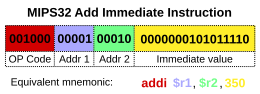 Diagram showing how a particular MIPS architecture instruction would be decoded by the control system.
The control unit (often called a control system or central controller) manages the computer's various components; it reads and interprets (decodes) the program instructions, transforming them into a series of control signals which activate other parts of the computer.[38] Control systems in advanced computers may change the order of some instructions so as to improve performance.
A key component common to all CPUs is the program counter, a special memory cell (a register) that keeps track of which location in memory the next instruction is to be read from.[39]
The control system's function is as follows—note that this is a simplified description, and some of these steps may be performed concurrently or in a different order depending on the type of CPU:
-
A computer's memory can be viewed as a list of cells into which numbers can be placed or read. Each cell has a numbered "address" and can store a single number. The computer can be instructed to "put the number 123 into the cell numbered 1357" or to "add the number that is in cell 1357 to the number that is in cell 2468 and put the answer into cell 1595". The information stored in memory may represent practically anything. Letters, numbers, even computer instructions can be placed into memory with equal ease. Since the CPU does not differentiate between different types of information, it is the software's responsibility to give significance to what the memor
-
n almost all modern computers, each memory cell is set up to store binary numbers in groups of eight bits (called a byte). Each byte is able to represent 256 different numbers (2^8 = 256); either from 0 to 255 or −128 to +127. To store larger numbers, several consecutive bytes may be used (typically, two, four or eight). When negative numbers are required, they are usually stored in two's complement notation. Other arrangements are possible, but are usually not seen outside of specialized applications or historical contexts. A computer can store any kind of information in memory if it can be represented numerically. Modern computers have billions or even trillions of bytes of memory.
-
The CPU contains a special set of memory cells called registers that can be read and written to much more rapidly than the main memory area. There are typically between two and one hundred registers depending on the type of CPU. Registers are used for the most frequently needed data items to avoid having to access main memory every time data is needed. As data is constantly being worked on, reducing the need to access main memory (which is often slow compared to the ALU and control units) greatly increases the computer's speed.
Computer main memory comes in two principal varieties: random-access memory or RAM and read-only memory or ROM. RAM can be read and written to anytime the CPU commands it, but ROM is pre-loaded with data and software that never changes, therefore the CPU can only read from it. ROM is typically used to store the computer's initial start-up instructions. In general, the contents of RAM are erased when the power to the computer i
-
program called the BIOS that orchestrates loading the computer's operating system from the hard disk drive into RAM whenever the computer is turned on or reset. In embedded computers, which frequently do not have disk drives, all of the required software may be stored in ROM. Software stored in ROM is often called firmware, because it is notionally more like hardware than software. Flash memory blurs the distinction between ROM and RAM, as it retains its data when turned off but is also rewritable. It is typically much slower than conventional ROM and RAM however, so its use is restricted to applications where high speed is unnecessary.[42]
In more sophisticated computers there may be one or more RAM cache memories, which are slower than registers but faster than main memory. Generally computers with this sort of cache are designed to move frequently needed data into the cache automatically, often without the need for any intervention on the programmer's part.
Input/output (I/O)
-
I/O is the means by which a computer exchanges information with the outside world.[43] Devices that provide input or output to the computer are called peripherals.[44] On a typical personal computer, peripherals include input devices like the keyboard and mouse, and output devices such as the display and printer. Hard disk drives, floppy disk drives and optical disc drives serve as both input and output devices. Computer networking is another form of I/O.
I/O devices are often complex computers in their own right, with their own CPU and memory. A graphics processing unit might contain fifty or more tiny computers that perform the calculations necessary to display 3D graphics[citation needed]. Modern desktop computers contain many smaller computers that assist the main CPU in performing I/O.
Multitasking
-
While a computer may be viewed as running one gigantic program stored in its main memory, in some systems it is necessary to give the appearance of running several programs simultaneously. This is achieved by multitasking i.e. having the computer switch rapidly between running each program in turn.[45]
One means by which this is done is with a special signal called an interrupt, which can periodically cause the computer to stop executing instructions where it was and do something else instead. By remembering where it was executing prior to the interrupt, the computer can return to that task later. If several programs are running "at the same time", then the interrupt generator might be causing several hundred interrupts per second, causing a program switch each time. Since modern computers typically execute instructions several orders of magnitude faster than human perception, it may appear that many programs are running at the same time even though only one is ever executing in any given instant. This method of multitasking is sometimes termed "time-sharing" since each program is allocated a "slice" of time in turn.[46]
-
A computer does not need to be electronic, nor even have a processor, nor RAM, nor even a hard disk. While popular usage of the word "computer" is synonymous with a personal electronic computer, the modern[51] definition of a computer is literally "A device that computes, especially a programmable [usually] electronic machine that performs high-speed mathematical or logical operations or that assembles, stores, correlates, or otherwise processes information".[52] Any device which processes information qualifies as a computer, especially if the processing is purposeful.
Required technology
-
Historically, computers evolved from mechanical computers and eventually from vacuum tubes to transistors. However, conceptually computational systems as flexible as a personal computer can be built out of almost anything. For example, a computer can be made out of billiard balls (billiard ball computer); an oft-quoted example[citation needed]. More realistically, modern computers are made out of transistors made of photolithographed semiconductors.
There is active research to make computers out of many promising new types of technology, such as optical computers, DNA computers, neural computers, and quantum computers. Most computers are universal, and are able to calculate any computable function, and are limited only by their memory capacity and operating speed. However different designs of computers can give very different performance for particular problems; for example quantum co
-
Further topics
Artificial intelligence
A computer will solve problems in exactly the way it is programmed to, without regard to efficiency, alternative solutions, possible shortcuts, or possible errors in the code. Computer programs that learn and adapt are part of the emerging field of artificial intelligence and machine learning.
Hardware
Main articles: Computer hardware and Personal computer hardwareThe term hardware covers all of those parts of a computer that are tangible objects. Circuits, displays, power supplies, cables, keyboards, printers and mice are all hardware.
History of computing hardware
-
Software
Main article: Computer softwareSoftware refers to parts of the computer which do not have a material form, such as programs, data, protocols, etc. When software is stored in hardware that cannot easily be modified (such as BIOS ROM in an IBM PC compatible), it is sometimes called "firmware" to indicate that it falls into an uncertain area somewhere between hardware and software.
-
Embedded and real-time List of embedded operating systems Experimental Amoeba, Oberon/Bluebottle, Plan 9 from Bell Labs Library Multimedia DirectX, OpenGL, OpenAL Programming library C standard library, Standard Template Library Data Protocol TCP/IP, Kermit, FTP, HTTP, SMTP File format HTML, XML, JPEG, MPEG, PNG User interface Graphical user interface (WIMP) Microsoft Windows, GNOME, KDE, QNX Photon, CDE, GEM, Aqua Text-based user interface Command-line interface, Text user interface Application Office suite Word processing, Desktop publishing, Presentation program, Database management system, Scheduling & Time management, Spreadsheet, Accounting software Internet Access Browser, E-mail client, Web server, Mail transfer agent, Instant messaging Design and manufacturing Computer-aided design, Computer-aided manufacturing, Plant management, Robotic manufacturing, Supply chain management Graphics Raster graphics editor, Vector graphics editor, 3D modeler, Animation editor, 3D computer graphics, Video editing, Image processing Audio Digital audio editor, Audio playback, Mixing, Audio synthesis, Computer music Software engineering Compiler, Assembler, Interpreter, Debugger, Text editor, Integrated developm -
Educational Edutainment, Educational game, Serious game, Flight simulator Games Strategy, Arcade, Puzzle, Simulation, First-person shooter, Platform, Massively multiplayer, Interactive fiction Misc Artificial intelligence, Antivirus software, Malware scanner, Installer/Package management systems, File manager -
Professions and organizations
As the use of computers has spread throughout society, there are an increasing number of careers involving computers.
Computer-related professions Hardware-related Electrical engineering, Electronic engineering, Computer engineering, Telecommunications engineering, Optical engineering, Nanoengineering Software-related Computer science, Desktop publishing, Human–computer interaction, Information technology, Information systems, Computational science, Software engineering, Video game industry, Web design The need for computers to work well together and to be able to exchange information has spawned the need for many standards organizations, clubs and societies of both a formal and informal nature.
Organizations Standards groups ANSI, IEC, IEEE, IETF, ISO, W3C Professional Societies ACM, AIS, IET, IFIP, BCS Free/Open source software groups Free Software Foundation, Mozilla Foundation, Apache Software Foundation
-
-
12 Nov 12

-
09 Nov 12

-
A computer is a general purpose device that can be programmed to carry out a finite set of arithmetic or logical operations. Since a sequence of operations can be readily changed, the computer can solve more than one kind of problem.
-
-
08 Nov 12
-
A computer is a general purpose device that can be programmed to carry out a finite set of arithmetic or logical operations. Since a sequence of operations can be readily changed, the computer can solve more than one kind of problem.
-
A computer is a general purpose device that can be programmed to carry out a finite set of arithmetic or logical operations. Since a sequence of operations can be readily changed, the computer can solve more than one kind of problem.
Conventionally, a computer consists of at least one processing element, typically a central processing unit (CPU) and some form of memory. The processing element carries out arithmetic and logic operations, and a sequencing and control unit that can change the order of operations based on stored information. Peripheral devices allow information to be retrieved from an external source, and the result of operations saved and retrieved.
The first electronic digital computers were developed between 1940 and 1945 in the United Kingdom and United States. Originally they were the size of a large room, consuming as much power as several hundred modern personal computers (PCs).[1] In this era mechanical analog computers were used for military applications.
-
Conventionally, a computer consists of at least one processing element, typically a central processing unit (CPU) and some form of memory. The processing element
-
control unit that can change the order of operations
-
The first electronic digital computers were developed between 1940 and 1945
-
integrated circuits are millions to billions of times more capable than
-
computers are small enough to fit into mobile devices, and mobile computers can be powered by small batteries. Personal computers in their various forms are icons of the Information Age and are what most people think of as "computers". However, the embedded computers found in many devices from mp3 players to fighter aircraft and from toys to industrial robots are the most numerous.
-
-
03 Oct 12
-
26 Sep 12

-
-
A computer is a general purpose device that can be programmed to carry out a finite set of arithmetic or logical operations. Since a sequence of operations can be readily changed, the computer can solve more than one kind of problem.
-
-
21 Sep 12
-
A computer is a general purpose device that can be programmed to carry out a finite set of arithmetic or logical operations. Since a sequence of operations can be readily changed, the computer can solve more than one kind of problem.
-
Originally they were the size of a large room, consuming as much power as several hundred modern personal computers (PCs
-
The first electronic digital computers were developed between 1940 and 1945 in the United Kingdom and United States.
-
-
-
A computer is a general purpose device that can be programmed to carry out a finite set of arithmetic or logical operations. Since a sequence of operations can be readily changed, the computer can solve more than one kind of problem.
-
-
12 Sep 12
-
04 Sep 12
-
29 Aug 12
-
A computer is a general purpose device that can be programmed to carry out a finite set of arithmetic or logical o
-
a computer consists of at least one processing element and some form of memory
-
-
24 Aug 12
-
23 Aug 12
-
Conventionally, a computer consists of at least one processing element and some form of memory. The processing element carries out arithmetic and logic operations, and a sequencing and control unit that can change the order of operations based on stored information. Peripheral devices allow information to be retrieved from an external source, and the result of operations saved and retrieved
-
control unit that can change the order of operations based on stored information. Peripheral devices allow information to be retrieved from an external source, and the result of operations saved and retrieved.
-
-
03 Aug 12
-
A computer is a general purpose device that can be programmed to carry out a finite set of arithmetic or logical operations
-
Since a sequence of operations can be readily changed, the computer can solve more than one kind of problem.
-
-
09 Jul 12
-
mputer is to implement an idea, the terms of whic
-
-
27 Jun 12
-
Computer 


-
sequence of operations can be readily changed, the computer can solve more than one kind of problem. The essential point of a
-
sing element and some form of memory. The processing element carries out arithmetic and logic operations, and a sequencing and control unit that can change the order of operations based on stored information. Peripheral devices allow information to be retrieved from an external source, and the result of operations saved.
A computer's processing unit executes a series of instructions that make it read, manipulate and then store data. Conditional instructions change the sequence of instructions as a function o
-
e United Kingdom and United States. Originally, they were the size of a large room, consuming as much power as several hundred modern personal computers (PCs).[1] In this era mechanical analog computers were used for military applications.
-
capable than the early machines, and occupy a fraction of the space.[2] Simple computers are small enough to fit into mobile devices, and mobile computers can be powered by small batteries. Personal computers in their various forms are icons of the Information Age and are what most people think of as "computers". However, the embedded computers found in many devices from mp
-
 The Jacquard loom, on display at the Museum of Science and Industry in Manchester, England, was one of the first programmable devices.
 Main article: History of computing hardware
The first use of the word "computer" was recorded in 1613, referring to a person who carried out calculations, or computations, and the word continued with the same meaning until the middle of the 20th century. From the end of the 19th century the word began to take on its more familiar meaning, a machine that carries out computations.[3]
Limited-function early computers
-
-
22 May 12
-
21 May 12
-
10 May 12

-
01 May 12
-
A computer is a programmable machine designed to automatically carry out a sequence of arithmetic or logical operations.
-
-
11 Mar 12
-
04 Jan 12
-
15 Nov 11
-
-
Conventionally a computer consists of some form of memory for data storage, at least one element that carries out arithmetic and logic operations, and a sequencing and control element that can change the order of operations based on the information that is stored. Peripheral devices allow information to be entered from an external source, and allow the results of operations to be sent out.
-
-
13 Oct 11
-
A computer is a programmable machine designed to sequentially and automatically carry out a sequence of arithmetic or logical operations. The particular sequence of operations can be changed readily, allowing the computer to solve more than one kind of problem.
-
The first electronic computers were developed in the mid-20th century (1940–1945). Originally, they were the size of a large room, consuming as much power as several hundred modern personal computers (PCs).[1]
-
First general-purpose computers
-
The history of the modern computer begins with two separate technologies—automated calculation and programmability—but no single device can be identified as the earliest computer, partly because of the inconsistent application of that term.
-
In 1801, Joseph Marie Jacquard made an improvement to the textile loom by introducing a series of punched paper cards as a template which allowed his loom to weave intricate patterns automatically. The resulting Jacquard loom was an important step in the development of computers because the use of punched cards to define woven patterns can be viewed as an early, albeit limited, form of programmability.
-
-
25 Sep 11
-
17 Sep 11
-
A number of projects to develop computers based on the stored-program architecture commenced around this time, the first of these being completed in Great Britain. The first working prototype to be demonstrated was the Manchester Small-Scale Experimental Machine (SSEM or "Baby") in 1948.
-
The first transistorised computer was demonstrated at the University of Manchester in 1953.[31]
-
-
16 Sep 11
 brandonl_cc3 l
tells me about computers
-
allowing thecomputer to solve more than one kind of problem
-
allowing thecomputer to solve
-
allowing thecomputer to solve more than one kind of problem.
-
allowing thecomputer to solve more than one kind of problem.
-
allowing the
computer to solve more than one kind of problem.Conventionally a computer consists of some form of memory for data
-
A computer is a programmable machine designed to sequentially and
-
automatically carry out a sequence of arithmetic or logical operations
-
The particular sequence of operations can be changed readily
-
computer to solve more than one kind of problem
-
-
 Tom Corbett
A computer is a programmable machine designed to sequentially and automatically carry out a sequence of arithmetic or logical operations. The particular sequence of operations can be changed readily, allowing the computer to solve more than one kind of problem.
-
14 Sep 11
 Brooke Dunn
the thing you looked up to check out bookmarking on diigo. k, doesnt mean anything. BYE
-
01 Sep 11
 Adnan Fathy
COMPUTER!!
-
A computer is a programmable machine designed to sequentially and automatically carry out a sequence of arithmetic or logical operations.
-
-
31 Aug 11
-
08 Aug 11
-
A computer is a programmable machine designed to sequentially and automatically carry out a sequence of arithmetic or logical operations.
-
A computer's processing unit executes series of instructions that make it read, manipulate and then store data.
-
The first electronic computers were developed in the mid-20th century (1940–1945). Originally, they were the size of a large room, consuming as much power as several hundred modern personal computers (PCs).
-
Modern computers based on integrated circuits are millions to billions of times more capable than the early machines, and occupy a fraction of the space.[2] Simple computers are small enough to fit into mobile devices, and mobile computers can be powered by small batteries. Personal computers in their various forms are icons of the Information Age and are what most people think of as "computers".
-
The first use of the word "computer" was recorded in 1613, referring to a person who carried out calculations, or computations, and the word continued with the same meaning until the middle of the 20th century. From the end of the 19th century onwards, the word began to take on its more familiar meaning, describing a machine that carries out computations.
-
-
09 May 11
-
03 May 11

-
19 Feb 11
-
Modern computers based on integrated circuits
-
George Stibitz is internationally recognized as a father of the modern digital computer. While working at Bell Labs in November 1937, Stibitz invented and built a relay-based calculator he dubbed the "Model K" (for "kitchen table", on which he had assembled it), which was the first to use binary circuits to perform an arithmetic operation
-
In 1837, Charles Babbage was the first to conceptualize and design a fully programmable mechanical computer, his analytical engine
-
Large-scale automated data processing of punched cards was performed for the 1890 United States Census by Hollerith's company, which later became the core of IBM
-
analog computers, which used a direct mechanical or electrical model of the problem as a basis for computation
-
Alan Turing is widely regarded to be the father of modern computer science
-
The history of the modern computer begins with two separate technologies—automated calculation and programmability
-
the Turing machine, providing a blueprint for the electronic digital computer
-
"stored program architecture" or von Neumann architecture
-
Beginning in the 1950s, Soviet scientists Sergei Sobolev and Nikolay Brusentsov conducted research on ternary computers, devices that operated on a base three numbering system of −1, 0, and 1 rather than the conventional binary numbering system
-
Computers using vacuum tubes as their electronic elements were in use throughout the 1950s, but by the 1960s had been largely replaced by transistor-based machines, which were smaller, faster, cheaper to produce, required less power, and were more reliable.
-
In the 1970s, integrated circuit technology and the subsequent creation of microprocessors
-
The defining feature of modern computers which distinguishes them from all other machines is that they can be programmed
-
-
06 Feb 11
-
22 Dec 10
-
01 Dec 10
-

-
30 Nov 10
-
21 Oct 10
-
29 Sep 10
-
13 Aug 10
-
02 Aug 10
-
performed which actions and when.[4] This is the essence of programmability.
-

-

-

-

-

-

-

-

- 3 more image(s)...
-
-
27 Jul 10
-
A computer is a programmable machine that receives input, stores and manipulates data//information, and provides output in a useful format.
While a computer can, in theory, be made out of almost anything (see misconceptions section), and mechanical examples of computers have existed through much of recorded human history, the first electronic computers were developed in the mid-20th century (1940–1945). Originally, they were the size of a large room, consuming as much power as several hundred modern personal computers (PCs).[1] Modern computers based on integrated circuits are millions to billions of times more capable than the early machines, and occupy a fraction of the space.[2] Simple computers are small enough to fit into mobile devices, and can be powered by a small battery. Personal computers in their various forms are icons of the Information Age and are what most people think of as "computers". However, the embedded computers found in many devices from MP3 players to fighter aircraft and from toys to industrial robots are the most numerous.
-
-
10 May 10
-
03 May 10
-
-
26 Apr 10
-
A computer is a programmable machine that receives input, stores and manipulates data, and provides output in a useful format.
Although mechanical examples of computers have existed through much of recorded human history, the first electronic computers were developed in the mid-20th century (1940–1945). These were the size of a large room, consuming as much power as several hundred modern personal computers (PCs).[1]
-
-
02 Mar 10
 Maggie Verster
Wikepedia startpoint for a discussion on what is a computer?
-
13 Feb 10

-
01 Feb 10
 juara pokonamah
A computer is a machine that manipulates data according to a set of instructions.
-
25 Oct 09
-
uters have existed through much of rec
-
capable than the early machines, and occupy a fraction of the space
-
lists of instructions called programs makes computers extremely versatile, distinguis
-


.jpg)


Would you like to comment?
Join Diigo for a free account, or sign in if you are already a member.