
This link has been bookmarked by 132 people . It was first bookmarked on 03 Aug 2006, by Bill H.
-
23 Jan 17
-
03 May 15
-
11 Mar 15
-
03 Mar 15
-
haos theory
From Wikipedia, the free encyclopediaJump to: navigation, searchFor other uses, see Chaos Theory (disambiguation).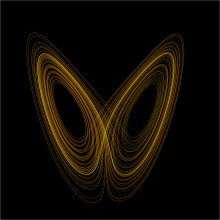
 A double rod pendulum animation showing chaotic behavior. Starting the pendulum from a slightly different initial condition would result in a completely different trajectory. The double rod pendulum is one of the simplest dynamical systems that has chaotic solutions.
Chaos theory is a field of study in mathematics, with applications in several disciplines including meteorology, sociology, physics, engineering, economics, biology, and philosoph
-
Chaos theory is a field of study in mathematics, with applications in several disciplines including meteorology, sociology, physics, engineering, economics, biology, and philosophy. Chaos theory studies the behavior of dynamical systems that are highly sensitive to initial conditions—a response popularly referred to as the butterfly effect
-
-
06 Dec 14
-
In chaotic systems the uncertainty in a forecast increases exponentially with elapsed time
-
a meaningful prediction cannot be made over an interval of more than two or three times the Lyapunov time
-
sensitive to initial conditions
-
-
20 Nov 14
-
05 Jul 14
-
Chaos theory is a field of study in mathematics, with applications in several disciplines including meteorology, sociology, physics, engineering, economics, biology, and philosophy.
-
Chaos theory studies the behavior of dynamical systems that are highly sensitive to initial conditions—a paradigm popularly referred to as the butterfly effect.
-
Small differences in initial conditions (such as those due to rounding errors in numerical computation) yield widely diverging outcomes for such dynamical systems, rendering long-term prediction impossible in genera
-
This happens even though these systems are deterministic, meaning that their future behavior is fully determined by their initial conditions, with no random elements involved.[2] In other words, the deterministic nature of these systems does not make them predictable.[3][4] This behavior is known as deterministic chaos, or simply chaos
-
Chaos: When the present determines the future, but the approximate present does not approximately determine the future.
-
A double rod pendulum animation showing chaotic behavior. Starting the pendulum from a slightly different initial condition would result in a completely different trajectory. The double rod pendulum is one of the simplest dynamical systems that has chaotic solutions.
-
-
26 Jun 14
-
24 Apr 14
-
16 Mar 14
-
23 Feb 14
-
12 Feb 14
-
18 Oct 13
-
Chaos theory studies the behavior of dynamical systems that are highly sensitive to initial conditions, an effect which is popularly referred to as the butterfly effect.
-
Small differences in initial conditions (su
-
yield widely diverging outcomes for such dynamical systems
-
the deterministic nature of these systems does not make them predictable
-
-
07 Sep 13
-
Chaos: When the present determines the future, but the approximate present does not approximately determine the future.
-
-
05 Aug 13
 krakum
" Chaos theory studies the behavior of dynamical systems that are highly sensitive to initial conditions, an effect which is popularly referred to as the butterfly effect. Small differences in initial conditions (such as those due to rounding errors in numerical computation) yield widely diverging outcomes for such dynamical systems, rendering long-term prediction impossible in general."
-
19 Dec 12
-
Chaos theory studies the behavior of dynamical systems that are highly sensitive to initial conditions, an effect which is popularly referred to as the butterfly effect
-
Small differences in initial conditions (such as those due to rounding errors in numerical computation) yield widely diverging outcomes for such dynamical systems, rendering long-term prediction impossible in general.
-
-
04 Sep 12
-
30 May 12
-
mall differences in initial conditions (such as those due to rounding errors in numerical computation) yield widely diverging outcomes for chaotic systems, rendering long-term prediction impossible in genera
-
-
26 Feb 12
-
Sensitivity to initial conditions means that each point in such a system is arbitrarily closely approximated by other points with significantly different future trajectories. Thus, an arbitrarily small perturbation of the current trajectory may lead to significantly different future behaviour
-
Sensitivity to initial conditions is popularly known as the "butterfly effect", so called because of the title of a paper given by Edward Lorenz in 1972 to the American Association for the Advancement of Science in Washington, D.C. entitled Predictability: Does the Flap of a Butterfly’s Wings in Brazil set off a Tornado in Texas? The flapping wing represents a small change in the initial condition of the system, which causes a chain of events leading to large-scale phenomena. Had the butterfly not flapped its wings, the trajectory of the system might have been vastly different.
-
-
21 Feb 12
-
12 Jan 12
-
29 Aug 11
-
-
Chaos theory studies the behavior of dynamical systems that are highly sensitive to initial conditions
-
the butterfly effect
-
-
24 Aug 11
-
01 Jun 11
-
20 Apr 11
-
16 Apr 11
-
Chaos theory studies the behavior of dynamical systems that are highly sensitive to initial conditions; an effect which is popularly referred to as the butterfly effect.
-
-
03 Nov 10
-
studying the behavior of dynamical systems that are highly sensitive to initial conditions
-
-
Chaos theory
-
Small differences in initial conditions (such as those due to rounding errors in numerical computation) yield widely diverging outcomes for chaotic systems, rendering long-term prediction impossible in general
-
even though these systems are deterministic, meaning that their future behavior is fully determined by their initial conditions, with no random elements involve
-
dynamical systems
-
One of the most successful applications of chaos theory has been in ecology
-
have been used to show how population growth under density dependence can lead to chaotic dynamics
-
currently being applied to medical studies of epilepsy
-
field of physics called quantum chaos theory investigates the relationship between chaos and quantum mechanics
-
-
Chaotic dynamics
-
adjective "chaotic" is defined more precisely in chaos theory
-
common usage, "chaos" means "a state of disorder
-
for a dynamical system to be classified as chaotic, it must have the following properties
-
it must be sensitive to initial conditions
-
it must be topologically mixing
-
its periodic orbits must be dense
-
Sensitivity to initial conditions
-
Sensitivity to initial conditions means that each point in such a system is arbitrarily closely approximated by other points with significantly different future trajectories
-
Thus, an arbitrarily small perturbation of the current trajectory may lead to significantly different future behaviour
-
A consequence of sensitivity to initial conditions is that if we start with only a finite amount of information about the system (as is usually the case in practice), then beyond a certain time the system will no longer be predictable
-
most familiar in the case of weather, which is generally predictable only about a week ahead
-
Topological mixing
-
Topological mixing (or topological transitivity) means that the system will evolve over time so that any given region or open set of its phase space will eventually overlap with any other given region
-
the mixing of colored dyes or fluids is an example of a chaotic system
-
sensitive dependence on initial conditions alone does not give chaos
-
consider the simple dynamical system produced by repeatedly doubling an initial value
-
any pair of nearby points will eventually become widely separated. However, this example has no topological mixing, and therefore has no chaos. Indeed, it has extremely simple behaviour: all points except 0 tend to infinity
-
Density of periodic orbits
-
Density of periodic orbits means that every point in the space is approached arbitrarily closely by periodic orbits
-
Topologically mixing systems failing this condition may not display sensitivity to initial conditions, and hence may not be chaotic
-
Strange attractors
-
n many cases chaotic behaviour is found only in a subset of phase space
-
when the chaotic behaviour takes place on an attractor, since then a large set of initial conditions will lead to orbits that converge to this chaotic region
-
attractors which arise from chaotic systems, known as strange attractors
-
and in some discrete systems
-
ccur in both continuous dynamical systems
-
Other discrete dynamical systems have a repelling structure called a Julia set
-
strange repellers
-
Both strange attractors and Julia sets typically have a fractal structure, and a fractal dimension can be calculated for them
-
-
10 Aug 10

-
22 May 10
-
07 May 10
-
30 Mar 10
-
14 Mar 10
-
22 Feb 10
-
01 Oct 09
-
19 Sep 09
-
30 Mar 09
-
11 Feb 09
-
02 Sep 08
-
03 Jun 08
 jihshienlu
"chaos theory describes the behavior of certain dynamical systems – that is, systems whose state evolves with time – that may exhibit dynamics that are highly sensitive to initial conditions (popularly referred to as the butterfly effect)"
@Wikipedia @Research Math Science SystemsTheory Electronics Computation
-
20 Mar 08
-
06 Sep 07
-
21 Jun 07
-
17 Mar 07
-
13 Mar 07
-
30 Nov 06
-
08 Oct 06
-
03 Aug 06
-
In mathematics and physics, chaos theory describes the behavior of certain nonlinear dynamical systems that under certain conditions exhibit a phenomenon known as chaos. Among the characteristics of chaotic systems, described below, is sensitivity to initial conditions (popularly referred to as the butterfly effect). As a result of this sensitivity, the behavior of systems that exhibit chaos appears to be random, even though the system is deterministic in the sense that it is well defined and contains no random parameters
-
-
08 Jun 06

-
28 Dec 05


Would you like to comment?
Join Diigo for a free account, or sign in if you are already a member.