
This link has been bookmarked by 74 people . It was first bookmarked on 18 Apr 2007, by Tina.
-
15 Nov 14
-
11 Sep 14
-
23 Feb 14
-
18 Dec 13
-
16 Dec 13
 ralawami
Concept of solar mass
GENERAL RELATIVITY
Event horizons emit HAWKINGS RADIATION
Mass, charge and angular momentum-
-
, it was during the 1960s that theoretical work showed black holes were a generic prediction of general relativity. T
-
After a black hole has formed it can continue to grow by absorbing mass from its surroundings. B
-
millions of solar masses may form.
-
he presence of a black hole can be inferred through its interaction with other matter and with electromagnetic radiation such as light.
-
exclude possible alternatives (such as neutron stars).
-
-
22 Nov 13

-
11 Nov 13
-
28 Oct 13
-
theory of general relativity predicts that a sufficiently compact mass will deform spacetime to form a black hole
-
25 Apr 13
-
12 Mar 13
-
Black hole
-
-
There is general consensus that supermassive black holes exist in the centers of most galaxies.
-
-
04 Mar 13

-
The idea of a body so massive that even light could not escape was first put forward by geologist John Michell in a letter written to Henry Cavendish in 1783 of the Royal Society:
-
In 1958, David Finkelstein identified the Schwarzschild surface as an event horizon, "a perfect unidirectional membrane: causal influences can cross it in only one direction".[17] This did not strictly contradict Oppenheimer's results, but extended them to include the point of view of infalling observers
-
of an event horizon
-
-
13 Feb 13
-
no-hair theorem emerged, stating that a stationary black hole solution is completely described by the three parameters of the Kerr–Newman metric; mass, angular momentum, and electric charge.[27]
-
-
24 Jan 13
-
A black hole is a region of spacetime from which gravity prevents anything, including light, from escaping.[1] The theory of general relativity predicts that a sufficiently compact mass will deform spacetime to form a black hole. Around a black hole there is a mathematically defined surface called an event horizon that marks the point of no return. It is called "black" because it absorbs all the light that hits the horizon, reflecting nothing, just like a perfect black body in thermodynamics.[2][3] Quantum field theory in curved spacetime predicts that event horizons emit radiation like a black body with a finite temperature. This temperature is inversely proportional to the mass of the black hole, making it difficult to observe this radiation for black holes of stellar mass or greater.
-
Black holes of stellar mass are expected to form when very massive stars collapse at the end of their life cycle. After a black hole has formed it can continue to grow by absorbing mass from its surroundings. By absorbing other stars and merging with other black holes, supermassive black holes of millions of solar masses may form. There is general consensus that supermassive black holes exist in the centers of most galaxies.
-
-
04 Oct 12
-
Information loss paradox
Main article: Black hole information paradoxList of unsolved problems in physics Is physical information lost in black holes? Because a black hole has only a few internal parameters, most of the information about the matter that went into forming the black hole is lost. It does not matter if it is formed from television sets or chairs, in the end the black hole only remembers the total mass, charge, and angular momentum. As long as black holes were thought to persist forever this information loss is not that problematic, as the information can be thought of as existing inside the black hole, unaccessible from the outside. However, black holes slowly evaporate by emitting Hawking radiation. This radiation does not appear to carry any detailed information about the stuff that formed the black hole, meaning that this information appears to be gone forever.[122]
For a long time, the question whether information is truly lost in black holes (the black hole information paradox) has divided the theoretical physics community (see Thorne–Hawking–Preskill bet). In quantum mechanics, loss of information corresponds to the violation of vital property called unitarity, which has to do with the conservation of probability. It has been argued that loss of unitarity would also imply violation of conservation of energy.[123] Over recent years evidence has been building that indeed information and unitarity are preserved in a full quantum gravitational treatment of the problem.[124]
-
-
05 Jul 12
-
-
20 Jun 12

-
A black hole is a region of spacetime where gravity prevents anything, including light, from escaping.[1] The theory of general relativity predicts that a sufficiently compact mass will deform spacetime to form a black hole. Around a black hole there is a mathematically defined surface called an event horizon that marks the point of no return. It is called "black" because it absorbs all the light that hits the horizon, reflecting nothing, just like a perfect black body in thermodynamics.[2][3] Quantum mechanics predicts that black holes emit radiation like a black body with a finite temperature. This temperature is inversely proportional to the mass of the black hole, making it difficult to observe this radiation for black holes of stellar mass or greater.
-
-
05 Feb 12
-
Objects whose gravity field is too strong for light to escape were first considered in the 18th century by John Michell and Pierre-Simon Laplace. The first modern solution of general relativity that would characterize a black hole was found by Karl Schwarzschild in 1916, although its interpretation as a region of space from which nothing can escape was not fully appreciated for another four decades. Long considered a mathematical curiosity, it was during the 1960s that theoretical work showed black holes were a generic prediction of general relativity. The discovery of neutron stars sparked interest in gravitationally collapsed compact objects as a possible astrophysical reality.
-
-
31 Jan 12
-
27 Dec 11
-
19 Dec 11

-
09 Nov 11
-
02 Nov 11
-
05 Oct 11
-
Around a black hole there is a mathematically defined surface called an event horizon that marks the point of no return. It is called "black" because it absorbs all the light that hits the horizon, reflecting nothing
-
12 Sep 11

-
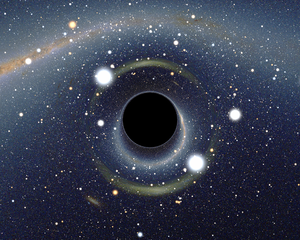 Simulated view of a black hole in front of the Large Magellanic Cloud. The ratio between the black hole Schwarzschild radius and the observer distance to it is 1:9. Of note is the gravitational lensing effect known as an Einstein ring, which produces a set of two fairly bright and large but highly distorted images of the Cloud as compared to its actual angular size.
-
-
07 Jun 11
-
06 Apr 11
-
A black hole is a region of space from which nothing, not even light, can escape.
-
Around a black hole there is an undetectable surface called an event horizon that marks the point of no return. It is called "black" because it absorbs all the light that hits the horizon, reflecting nothing, just like a perfect black body in thermodynamics.
-
Objects whose gravity field is too strong for light to escape were first considered in the 18th century by John Michell and Pierre-Simon Laplace.
-
Black holes of stellar mass are expected to form when heavy stars collapse in a supernova at the end of their life cycle. After a black hole has formed it can continue to grow by absorbing mass from its surroundings. By absorbing other stars and merging with other black holes, supermassive black holes of millions of solar masses may be formed.
-
-
10 Jan 11

-
28 Sep 10

-
-
07 Sep 10
-
According to the general theory of relativity, a black hole, is a region of space from which nothing, not even light, can escape. It is the result of the deformation of spacetime caused by a very compact mass. Around a black hole there is an undetectable surface which marks the point of no return,
-
It is called "black" because it absorbs all the light that hits it, reflecting nothing, just like a perfect black body in thermodynamics.[
-
Alternatively, when gas falls into a stellar black hole from a companion star, the gas spirals inward, heating to very high temperatures and emitting large amounts of radiation that can be detected from earthbound and Earth-orbiting telescopes.
-
-
01 Sep 10
-
According to the general theory of relativity, a black hole, is a region of space from which nothing, not even light, can escape. It is the result of the deformation of spacetime caused by a very compact mass. Around a black hole there is an undetectable surface which marks the point of no return, called an event horizon. It is called "black" because it absorbs all the light that hits it, reflecting nothing, just like a perfect black body in thermodynamics.[1] Under the theory of quantum mechanics, black holes possess a temperature and emit Hawking radiation, but for black holes of stellar mass or larger this temperature is much lower than that of the cosmic background radiation
-
-
27 Aug 10
-
big bang densities were much greater, possibly allowing for the creation of black holes.
-
-
23 Aug 10
-
30 Mar 10
-
15 Aug 09
-
12 Aug 09
-
13 Jun 09
-
05 May 09
 Kirit L.
This is a wikipedia page all about black holes. Really amazing information...
-
In general relativity, a black hole is a region of space in which the gravitational field is so powerful that nothing, including light, can escape its pull. The black hole has a one-way surface, called an event horizon, into which objects can fall, but out of which nothing can come. It is called "black" because it absorbs all the light that hits it, reflecting nothing, just like a perfect blackbody in thermodynamics. Quantum analysis of black holes shows them to possess a temperature and radiate like black bodies.
-
Once a black hole has formed, it can continue to grow by absorbing additional matter. Any black hole will continually absorb interstellar dust from its direct surroundings and omnipresent cosmic background radiation, but neither of these processes should significantly affect the mass of a stellar black hole. More significant contributions can occur when the black hole formed in a binary star system. After formation the black hole can then leech significant amounts of matter from its companion.
-
-
03 May 09
-
21 Sep 08
-
13 Sep 08
-
18 Feb 08
 viniciusjl
A black hole is a region of space in which the gravitational field is so powerful that nothing can escape after having fallen past the event horizon. The name comes from the fact that even electromagnetic radiation (e.g. light) is unable to escape, render
-
18 Apr 07
-
-
black holes as presently understood are described by Einstein's theory of general relativity
-
When an object passes within the event horizon at the boundary of the black hole, it is lost forever
-
can be of almost any mass
-
gravity increases in strength as volume is decreased, almost any object sufficiently compressed will become a black hole
-
when black holes form naturally, only a few mass ranges are common
-
proposed as a possible power source for ultra-luminous X ray sources
-
masses ranging from about 1.5-3.0 solar masses
-
to 15 solar masses.
-
created by the collapse of individual stars.
-
stellar mass black hole is formed by the gravitational collapse of a star of 20 or more solar masses at the end of its life, and can then act as a seed for the formation of a much larger black hole
-
effort required to leave the hole becomes infinite
-
almost all black holes will rotate, because the stars from which they are formed rotate
-
defining feature of a black hole
-
hides whatever happens inside it
-
non-rotating black hole's photon sphere is a spherical boundary of zero thickness such that photons moving along tangents to the sphere will be trapped in a circular orbit
-
non-rotating black holes, the photon sphere has a radius 1.5 times larger than the radius of the event horizon
-
likely to interact with any infalling matter in the vicinity
-
orbit is dynamically unstable; small deviations from a perfectly circular path will grow into larger deviations very quickly, causing the photon to either escape or fall into the hole.
-
pressure, friction and other mechanisms within the disk generate enormous energy
-
evaporation of larger black holes
-
inability of light or anything else to escape from within their event horizons, accretion disks
-
rotating black hole has two photon spheres, one for each event horizon.
-
properties of space-time between the two event horizons allow objects to move only towards the singularity
-
properties of space-time within the inner event horizon allow objects to move away from the singularity, pass through another set of inner and outer event horizons, and emerge out of the black hole into another universe or another part of this universe without traveling faster than the speed of light
-
otating black holes could theoretically provide the wormholes
-
As a test object approaches the event horizon, its gravitational time dilation (as measured by an observer far from the hole) would approach infinity.
-
frequency of light from the object appears to decrease, making it look redder
-
lower-frequency light has less energy and therefore appears dimmer
-
outside observer
-
will never see an infalling object cross this line
-
object appears to halt just above the horizon
-
fading from view as its light is red-shifted and the rate at which it emits photons drops to approach zero
-
As an infalling object approaches the singularity, tidal forces acting on it approach infinity
-
as soon as an object passes within the hole's event horizon, it is lost to the outside world
-
Stars undergo gravitational collapse when they can no longer resist the pressure of their own gravity
-
In either case the star's temperature is no longer high enough to prevent it from collapsing under its own weight
-
all present black hole formation is through gravitational collapse
-
Astronomers are confident that our own Milky Way galaxy has a supermassive black hole at its center, in a region called Sagittarius A*
-
Intense but one-time gamma ray bursts (GRBs) may signal the birth of "new" black holes
-
any mass large enough to power these phenomena must be a black hole
-
extremely large accretion disks and gas jets may be good evidence for the presence of supermassive black holes
-
Rotating black holes share many of the features of non-rotating black holes
-
-
10 Nov 06


Would you like to comment?
Join Diigo for a free account, or sign in if you are already a member.