
This link has been bookmarked by 100 people . It was first bookmarked on 03 Aug 2006, by Antonia Haller.
-
15 Dec 14
-
artificial neural networks (ANNs) are a family of statistical learning algorithms
-
used to estimate or approximate functions that can depend on a large number of inputs and are generally unknown.
-
-
-
capable of approximating non-linear functions of their inputs
-
The adaptive weights are conceptually connection strengths between neurons, which are activated during training and prediction.
-
Neural network models which emulate the central nervous system are part of theoretical neuroscience and computational neuroscience.
-
The first issue was that single-layer neural networks were incapable of processing the exclusive-or circuit. The second significant issue was that computers were not sophisticated enough to effectively handle the long run time required by large neural networks. Neural network research slowed until computers achieved greater processing power. Also key later advances was the
-
The synapses store parameters called "weights" that manipulate the data in the calculations.
-
- The interconnection pattern between the different layers of neurons
- The learning process for updating the weights of the interconnections
- The activation function that converts a neuron's weighted input to its output activation.
An ANN is typically defined by three types of parameters:
-
nonlinear weighted sum
-
Networks such as the previous one are commonly called feedforward, because their graph is a directed acyclic graph. Networks with cycles are commonly called recurrent. Such networks are commonly depicted in the manner shown at the top of the figure, where
 is shown as being dependent upon itself. However, an implied temporal dependence is not shown.
 -
no solution has a cost less than the cost of the optimal solution
-
Learning algorithms search through the solution space to find a function that has the smallest possible cost.
-
There are three major learning paradigms, each corresponding to a particular abstract learning task. These are supervised learning, unsupervised learning and reinforcement learning.
-
infer the mapping implied by the data; the cost function is related to the mismatch between our mapping and the data and it implicitly contains prior knowledge about the problem domain.
-
Tasks that fall within the paradigm of supervised learning are pattern recognition (also known as classification) and regression (also known as function approximation). The supervised learning paradigm is also applicable to sequential data (e.g., for speech and gesture recognition). This can be thought of as learning with a "teacher," in the form of a function that provides continuous feedback on the quality of solutions obtained thus far.
-
n unsupervised learning, some data
 is given and the cost function to be minimized, that can be any function of the data and the network's output, .
-
-
06 Dec 14
-
re capable of approximating non-linear functions of their inputs
-
-
data are usually not given
-
arbitrary function approximation mechanism
-
used to diagnose several cancer
-
a large diversity of training for real-world operatio
-
processing and storage resources
-
create a successful net without understanding how it worked
-
-
29 Oct 14
-
25 Aug 14
-
10 Aug 14
-
14 Jun 14
-
are capable of approximating non-linear functions of their inputs.
-
-
03 Apr 14
-
10 Feb 14
-
computational models inspired by animals' central nervous systems (in particular the brain) that are capable of machine learning and pattern recognition.
-
onsist of sets of adaptive weights
-
re capable of approximating non-linear functions of their inputs
-
-
03 Feb 14
-
10 Nov 13
-
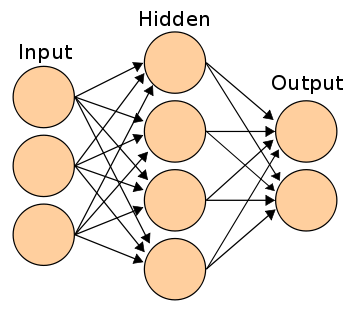
The word network in the term 'artificial neural network' refers to the inter–connections between the neurons in the different layers of each system. An example system has three layers. The first layer has input neurons, which send data via synapses to the second layer of neurons, and then via more synapses to the third layer of output neurons
-
The synapses store parameters called "weights" that manipulate the data in the calculations.
-
- The interconnection pattern between different layers of neurons
- The learning process for updating the weights of the interconnections
- The activation function that converts a neuron's weighted input to its output activation.
An ANN is typically defined by three types of parameters:
-
What has attracted the most interest in neural networks is the possibility of learning. Given a specific task to solve, and a class of functions
 , learning means using a set of observations to find
  which solves the task in some optimal sense.
 -
This entails defining a cost function
 such that, for the optimal solution
  ,
, 
 – i.e., no solution has a cost less than the cost of the optimal solution (see Mathematical optimization).
The cost function
 is an important concept in learning, as it is a measure of how far away a particular solution is from an optimal solution to the problem to be solved. Learning algorithms search through the solution space to find a function that has the smallest possible cost.
 -
There are three major learning paradigm, each corresponding to a particular abstract learning task. These are supervised learning, unsupervised learning and reinforcement learning.
-
In supervised learning, we are given a set of example pairs
 and the aim is to find a function
  in the allowed class of functions that matches the examples. In other words, we wish to infer the mapping implied by the data;
 -
Tasks that fall within the paradigm of supervised learning are pattern recognition (also known as classification) and regression (also known as function approximation
-
This can be thought of as learning with a "teacher," in the form of a function that provides continuous feedback on the quality of solutions obtained thus far.
-
In unsupervised learning, some data is given and the cost function to be minimized, that can be any function of the data and the network's output, .
-
In reinforcement learning, data are usually not given, but generated by an agent's interactions with the environment. At each point in time
 , the agent performs an action
  and the environment generates an observation
  and an instantaneous cost
  , according to some (usually unknown) dynamics. The aim is to discover a policy for selecting actions that minimizes some measure of a long-term cost
-
-
07 Nov 13
 Pier Giuseppe Rossi
""Neural network" redirects here. For networks of living neurons, see Biological neural network. For the journal, see Neural Networks (journal)."
-
31 Oct 13
-
re usually unknown, but can be estimated.
More formally, the environment is modeled as a Markov decision process (MDP) with states

-
Training a neural network model essentially means selecting one model from the set of allowed models (or, in a Bayesian framework, determining a distribution over the set of allowed models) that minimizes the cost criterio
-
- odel: This will depend on the data representation and the application. Overly complex models tend to lead to problems with learning.
- Learning algorithm: There are numerous trade-offs between learning algorithm
-
-
25 Oct 13
-
computational models inspired by animal central nervous systems (in particular the brain) that are capable of machine learning and pattern recognition
-
-
07 Oct 13
-
30 Sep 13
-
Artificial neural network
-
-
03 Sep 13
-
08 Apr 13
-
nts exhibiting
-
-
16 Jan 13
-
12 Dec 12
-
The word network in the term 'artificial neural network' refers to the inter–connections between the neurons in the different layers of each system. An example system has three layers. The first layer has input neurons, which send data via synapses to the second layer of neurons, and then via more synapses to the third layer of output neurons. More complex systems will have more layers of neurons with some having increased layers of input neurons and output neurons. The synapses store parameters called "weights" that manipulate the data in the calculations.
-
- The interconnection pattern between different layers of neurons
- The learning process for updating the weights of the interconnections
- The activation function that converts a neuron's weighted input to its output activation.
An ANN is typically defined by three types of parameters:
-
-
17 Nov 12
-
rtificial neural networks are used with algorithms designed to alter the strength of the connections in the network to produce a desired signal flow.
-
functions are performed collectively and in parallel by the units,
-
Historically, the use of neural networks models marked a paradigm shift in the late eighties from high-level (symbolic) artificial intelligence, characterized by expert systems with knowledge embodied in if-then rules, to low-level (sub-symbolic) machine learning, characterized by knowledge embodied in the parameters of a dynamical system.
-
-
04 Oct 12
-
A neural network consists of an interconnected group of artificial neurons, and it processes information using a connectionist approach to computation
-
The word network in the term 'artificial neural network' refers to the inter–connections between the neurons in the different layers of each system.
-
The synapses store parameters called "weights" that manipulate the data in the calculations.
-
The cost function is an important concept in learning, as it is a measure of how far away a particular solution is from an optimal solution to the problem to be solved.
-
the cost must necessarily be a function of the observations
-
in a probabilistic formulation the posterior probability of the model can be used as an inverse cost
-
to find a function in the allowed class of functions that matches the examples.
-
When one tries to minimize this cost using gradient descent for the class of neural networks called multilayer perceptrons, one obtains the common and well-known backpropagation algorithm for training neural networks.
-
pattern recognition (also known as classification) and regression (also known as function approximation).
-
This can be thought of as learning with a "teacher," in the form of a function that provides continuous feedback on the quality of solutions obtained thus far.
-
the posterior probability of the model given the data.
-
in general estimation problems; the applications include clustering, the estimation of statistical distributions, compression and filtering.
-
In reinforcement learning, data are usually not given, but generated by an agent's interactions with the environment.
-
to discover a policy for selecting actions that minimizes some measure of a long-term cost; i.e., the expected cumulative cost.
-
a policy is defined as conditional distribution over actions given the observations.
-
Evolutionary methods,[3] simulated annealing,[4] expectation-maximization, non-parametric methods and particle swarm optimization[5] are some commonly used methods for training neural networks.
-
The utility of artificial neural network models lies in the fact that they can be used to infer a function from observations.
-
'capacity', which roughly corresponds to their ability to model any given function.
-
This arises in convoluted or over-specified systems when the capacity of the network significantly exceeds the needed free parameters.
-
the regularization can be performed by selecting a larger prior probability over simpler models
-
to minimize over two quantities: the 'empirical risk' and the 'structural risk', which roughly corresponds to the error over the training set and the predicted error in unseen data due to overfitting.
-
-
09 Aug 12
-
15 Jun 12
-
largely abandoned for a more practical approach based on statistics and signal processing
-
-
02 Jun 12
-
infer a function
-
observations
-
models
-
utility
-
function
-
ata or task
-
impractical
-
design
-
complexity
-
broad categories
-
control
-
system identification
-
quantum chemistry
-
Application areas
-
game-playing
-
pattern recognition
-
spam filtering
-
several cancers
-
diagnose
-
behavioral modeling
-
cognitive
-
theory
-
rocesses
-
observed
-
Biophysical models
-
computational algorithms
-
biophysical simulation
-
neuromorphic computing
-
unction approximato
-
valued
-
rational
-
finite numbe
-
full powe
-
linear connections
-
neurons
-
super-Turing power
-
notion of complexity
-
generalizes
-
schools of though
-
resence of overtraining
-
emerges naturall
-
form of regularization
-
(Bayesian) framework
-
larger prior probability
-
simpler models
-
large diversity of training
-
robotics
-
extrapolating
-
training diversity
-
preserving
-
overtrained
-
esponses
-
wide variety
-
columnist
-
toy problems
-
do solve
-
genera
-
roblem-solving tool
-
storage resources
-
committed
-
processing
-
cost of tim
-
monetary efficiency
-
diverse tasks
-
flying aircraft[
-
solve many complex
-
detecting
-
card fraud
-
neural networks
-
symbolic approaches
-
hybrid models
-
-
10 Apr 12
 Janos Haits
An artificial neural network (ANN), usually called neural network (NN), is a mathematical model or computational model that is inspired by the structure and/or functional aspects of biological neural networks. A neural network consists of an interconnected group of artificial neurons, and it processes information using a connectionist approach to computation. In most cases an ANN is an adaptive system that changes its structure based on external or internal information that flows through the network during the learning phase.
-
23 Feb 12
-
artificial neural network (ANN), usually called neural network (NN), is a mathematical model or computational model that is inspired by the structure and/or functional aspects of biological neural networks.
-
artificial neural network (ANN), usually called neural network (NN), is a mathematical model or computational model that is inspired by the structure and/or functional aspects of biological neural networks.
-
most cases an ANN is an adaptive system that changes its structure based on external or internal information that flows through the network during the learning phase.
-
most cases an ANN is an adaptive system that changes its structure based on external or internal information that flows through the network during the learning phase.
-
They are usually used to model complex relationships between inputs and outputs or to find patterns in data.
-
In modern software implementations of artificial neural networks, the approach inspired by biology has been largely abandoned for a more practical approach based on statistics and signal processing.
-
While the more general approach of such adaptive systems is more suitable for real-world problem solving, it has far less to do with the traditional artificial intelligence connectionist models. What they do have in common, however, is the principle of non-linear, distributed, parallel and local processing and adaptation.
-
Neural network models in artificial intelligence are usually referred to as artificial neural networks (ANNs); these are essentially simple mathematical models defining a function
 or a distribution over
  or both and
  , but sometimes models are also intimately associated with a particular learning algorithm or learning rule. A common use of the phrase ANN model really means the definition of a class of such functions (where members of the class are obtained by varying parameters, connection weights, or specifics of the architecture such as the number of neurons or their connectivity).
 -
[edit] Learning
What has attracted the most interest in neural networks is the possibility of learning. Given a specific task to solve, and a class of functions
 , learning means using a set of observations to find
  which solves the task in some optimal sense.
 -
This entails defining a cost function
 such that, for the optimal solution
  ,
, 
 (i.e., no solution has a cost less than the cost of the optimal solution).
 -
The cost function
 is an important concept in learning, as it is a measure of how far away a particular solution is from an optimal solution to the problem to be solved. Learning algorithms search through the solution space to find a function that has the smallest possible cost.
 -
[edit] Supervised learning
In supervised learning, we are given a set of example pairs
 and the aim is to find a function in the allowed class of functions that matches the examples. In other words, we wish to infer the mapping implied by the data; the cost function is related to the mismatch between our mapping and the data and it implicitly contains prior knowledge about the problem domain.
 -
[edit] Unsupervised learning
In unsupervised learning, some data
 is given and the cost function to be minimized, that can be any function of the data and the network's output,
  .
. -
Reinforcement learning
-
In reinforcement learning, data are usually not given, but generated by an agent's interactions with the environment. At each point in time
 , the agent performs an action
  and the environment generates an observation
  and an instantaneous cost
  , according to some (usually unknown) dynamics
 -
formally, the environment is modeled as a Markov decision process (MDP) with states
 and actions
  with the following probability distributions:
 -
[edit] Learning algorithms
Training a neural network model essentially means selecting one model from the set of allowed models (or, in a Bayesian framework, determining a distribution over the set of allowed models) that minimizes the cost criterion. There are numerous algorithms available for training neural network models; most of them can be viewed as a straightforward application of optimization theory and statistical estimation.
-
Perhaps the greatest advantage of ANNs is their ability to be used as an arbitrary function approximation mechanism that 'learns' from observed data. However, using them is not so straightforward and a relatively good understanding of the underlying theory is essential.
-
- Function approximation, or regression analysis, including time series prediction, fitness approximation and modeling.
- Classification, including pattern and sequence recognition, novelty detection and sequential decision making.
- Data processing, including filtering, clustering, blind source separation and compression.
- Robotics, including directing manipulators, Computer numerical control.
The utility of artificial neural network models lies in the fact that they can be used to infer a function from observations. This is particularly useful in applications where the complexity of the data or task makes the design of such a function by hand impractical.
[edit] Real-life applications
The tasks artificial neural networks are applied to tend to fall within the following broad categories:
Application areas include system identification and control (vehicle control, process control, natural resources management), quantum chemistry,[6] game-playing and decision making (backgammon, chess, poker), pattern recognition (radar systems, face identification, object recognition and more), sequence recognition (gesture, speech, handwritten text recognition), medical diagnosis, financial applications (automated trading systems), data mining (or knowledge discovery in databases, "KDD"), visualization and e-mail spam filtering.
-
-
30 Nov 11
-
An artificial neural network (ANN), usually called neural network (NN), is a mathematical model or computational model that is inspired by the structure and/or functional aspects of biological neural networks. A neural network consists of an interconnected group of artificial neurons, and it processes information using a connectionist approach to computation. In most cases an ANN is an adaptive system that changes its structure based on external or internal information that flows through the network during the learning phase. Modern neural networks are non-linear statistical data modeling tools. They are usually used to model complex relationships between inputs and outputs or to find patterns in data.
-
-
13 Oct 11
-
16 Mar 11
-
Reinforcement learning
In reinforcement learning, data
 are usually not given, but generated by an agent's interactions with the environment. At each point in time
  , the agent performs an action
  and the environment generates an observation
  and an instantaneous cost
  , according to some (usually unknown) dynamics. The aim is to discover a policy for selecting actions that minimizes some measure of a long-term cost; i.e., the expected cumulative cost. The environment's dynamics and the long-term cost for each policy are usually unknown, but can be estimated.
More formally, the environment is modeled as a Markov decision process (MDP) with states
 and actions
  with the following probability distributions: the instantaneous cost distribution
  , the observation distribution
  and the transition
  , while a policy is defined as conditional distribution over actions given the observations. Taken together, the two define a Markov chain (MC). The aim is to discover the policy that minimizes the cost; i.e., the MC for which the cost is minimal.
ANNs are frequently used in reinforcement learning as part of the overall algorithm.
Tasks that fall within the paradigm of reinforcement learning are control problems, games and other sequential decision making tasks.
See also: dynamic programming and stochastic control
-
-
09 Jan 11
-
05 Jun 10
-
06 May 10
-
14 Apr 10
-
In most cases an ANN is an adaptive system that changes its structure based on external or internal information that flows through the network during the learning phase.
-
network of simple processing elements (neurons), which can exhibit complex global behavior, determined by the connections between the processing elements and element parameters.
-
These networks are also similar to the biological neural networks in the sense that functions are performed collectively and in parallel by the units, rather than there being a clear delineation of subtasks to which various units are assigned (see also connectionism)
-
-
14 Nov 09
-
11 Nov 09
-
08 Sep 09
-
08 Jul 09
-
06 Jun 09
-
12 Feb 09
-
27 Jan 09
-
-
27 Oct 08
-
22 Aug 08
 evgeny yauhenio
An artificial neural network (ANN), often just called a "neural network" (NN), is a mathematical model or computational model based on biological neural networks. It consists of an interconnected group of artificial neurons and processes information using a connectionist approach to computation. In most cases an ANN is an adaptive system that changes its structure based on external or internal information that flows through the network during the learning phase.
In more practical terms neural networks are non-linear statistical data modeling tools. They can be used to model complex relationships between inputs and outputs or to find patterns in data.ai artificial intelligence brains brain neurons networks connectionism
-
08 Apr 08
 snichrd
Model Gian recc'd for prediction. Possible ASNN looks relevant for its collectiveness.
-
01 Apr 08
-
22 Feb 08
-
08 Feb 08
-
22 Jan 08
-
Artificial neural network
-
-
15 Jan 08
-
23 Dec 07
-
11 Oct 07
-
19 Sep 07
-
14 Aug 07
-
04 May 07
-
28 Apr 07
-
06 Sep 06

 is shown as being dependent upon itself. However, an implied temporal dependence is not shown.


 , learning means using a set of observations to find
  which solves the task in some optimal sense.
 such that, for the optimal solution
  ,
, 
 – i.e., no solution has a cost less than the cost of the optimal solution (see
  is an important concept in learning, as it is a measure of how far away a particular solution is from an optimal solution to the problem to be solved. Learning algorithms search through the solution space to find a function that has the smallest possible cost.
 and the aim is to find a function
  in the allowed class of functions that matches the examples. In other words, we wish to infer the mapping implied by the data;


 or a distribution over
  or both
  , but sometimes models are also intimately associated with a particular learning algorithm or learning rule. A common use of the phrase ANN model really means the definition of a class of such functions (where members of the class are obtained by varying parameters, connection weights, or specifics of the architecture such as the number of neurons or their connectivity).
 , learning means using a set of observations to find
  which solves the task in some optimal sense.
 such that, for the optimal solution
  ,
, 
 (i.e., no solution has a cost less than the cost of the optimal solution).
 is an important concept in learning, as it is a measure of how far away a particular solution is from an optimal solution to the problem to be solved. Learning algorithms search through the solution space to find a function that has the smallest possible cost.
 and the aim is to find a function
  is given and the cost function to be minimized, that can be any function of the data
  .
. , the agent performs an action
  and the environment generates an observation
  and an instantaneous cost
  , according to some (usually unknown) dynamics
 and actions
  with the following probability distributions:




Would you like to comment?
Join Diigo for a free account, or sign in if you are already a member.