
This link has been bookmarked by 20 people . It was first bookmarked on 24 Aug 2008, by Olifante *.
-
19 Jun 10
-
07 May 10
-
23 Sep 08
-
22 Sep 08
 Royce Guin
A major goal of the project has been to set JavaScript up to compete with natively-compiled code, rather than simply against other interpreters. This means that we're starting to see speeds that are completely out of this league when it comes to performance.
-
04 Sep 08
-
02 Sep 08
 Dan Connolly
4 commands to check out and build a command-line js interpreter
-
01 Sep 08
-
-
javascript.options.jit.content
-
-
31 Aug 08
-
Code-named TraceMonkey this engine utilizes a techniques, called trace trees (PDF), which adds just-in-time native code compilation to SpiderMonkey
-
-
28 Aug 08
-
27 Aug 08
-
26 Aug 08
 swordsp N/A
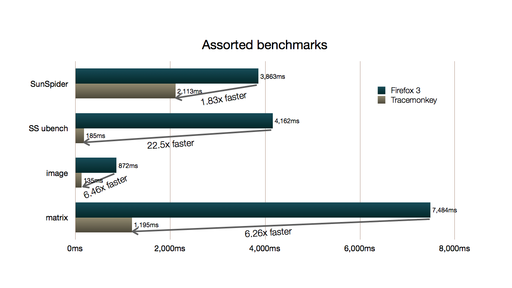
A fantastic new improvement to Mozilla's JavaScript engine (SpiderMonkey) has landed. Code-named TraceMonkey this engine utilizes a techniques, called trace trees (PDF), which adds just-in-time native code compilation to SpiderMonkey.
-
- Function Inlining: Removing the overhead of function calls by simply replacing them with their resulting native code.
- Type Inference: Removing checks surrounding common operators (like "+") when the types contained within a variable are already known. This means that the engine will have already pre-determined, for example, that two strings need to be concated when it sees the "+" operator.
- Looping: The overhead of looping has been grossly diminished. It's one of the most common areas of overhead in JavaScript applications (common repetition of a task) and the constant determining of bounds and the resulting inner code is made negligible.
How Tracing Works
In simple terms tracing works by watching for commonly-repeated actions (such as loops, function calls, or type checking) and tries to optimize their resulting native code into the lowest number of actions. The premise is rather simple - and it's an advance that we'll probably see proliferate to many interpreters and engines in the upcoming years.
Andreas Gal published a paper (PDF) on the subject and Brendan Eich has written up a TraceMonkey-specific explanation.
Some of the improvements made by tracing include:
The code for this project has come from a number of places - one of which is coming from some code contributed to Mozilla, from Adobe: Tamarin Tracing, specifically the nanojit code that's able to work a lot of this just-in-time magic.
-
-
24 Aug 08
-
A fantastic new improvement to Mozilla's JavaScript engine (SpiderMonkey) has landed. Code-named TraceMonkey this engine utilizes a techniques, called trace trees (PDF), which adds just-in-time native code compilation to SpiderMonkey.
-
JavaScript is no longer confined by the previously-challenging resource of processing power. With this improvement it's leap-frogged any sort of traditional and has gone head-to-head with computationally-powerful languages like C.
I fully expect to see more, massive, projects being written in JavaScript. Projects that expect the performance gains that we're starting to see. Applications that are number-heavy (like image manipulation) or object-heavy
-
-
23 Aug 08
-
 Gary Burge
A fantastic new improvement to Mozilla's JavaScript engine (SpiderMonkey) has landed. Code-named TraceMonkey this engine utilizes a techniques, called trace trees (PDF), which adds just-in-time native code compilation to SpiderMonkey
FireFox TraceMonkey Javascript JIT compilation code speed performance Mozilla
-
22 Aug 08


Would you like to comment?
Join Diigo for a free account, or sign in if you are already a member.