
This link has been bookmarked by 6 people . It was first bookmarked on 24 Mar 2007, by eyal matsliah.
-
23 Sep 12
-
We don’t need more information. We don’t need better information. We don’t need automatically filtered and summarized information. We need understanding. We desperately want to understand what’s going on in our business, in our markets. And understanding is not more or higher information.
-
If you want understanding, you have to reenter the human world of stories.
-
If you don’t have a story, you don’t have understanding. From the first accidental wiener roast on a prehistoric savanna, we’ve understood things by telling stories. I don’t mean fiction or stories heavy with plot; I mean narratives that string events together in time and show them unfolding.
-
-
15 Dec 10
-
10 Jun 07

-
24 Mar 07

-
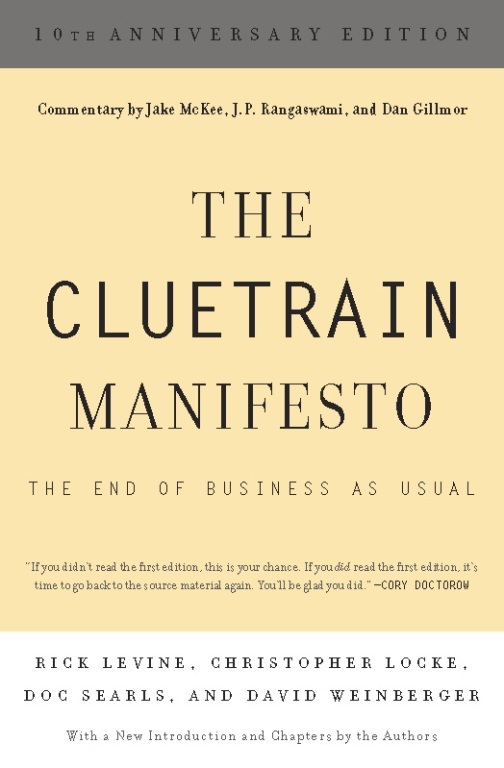
chapter five
the following is the complete fifth chapter of
The Cluetrain Manifesto:
The End of Business as Usual -
The Web, in short, has led every wired person in your organization to expect direct connections not only to information but also to the truth spoken in human voices.
-
The company works in an office building in order to bring together all of the things I need to get my job done and to avoid distracting me. In fact, more and more of what I need is outside the corporate walls. And when I really want to get something done, I go home.
-
The character of business is becoming the same as the character of the Web -- an explosion reconfigured by the intersection of hearts.
-
To the outside, the company begins to look like a set of hyperlinked clusters who select themselves based on trust and respect and even their sense of fun. The trust is built through the quality of voice of the participants: that is all that counts in a hyperlinked team.
-
Every business is dysfunctional because everything human is at least a little bit broken. It’s not an accident. It’s the human condition.
-
When the hurdles to membership lower, the boundaries blur. > The blurring isn’t occurring only inside of the Fort. Businesses are building extranets to enable their strategic partners to access information.
-
Go out and commit a whopper. Then embrace it publicly.
It’s a good feeling. It’s liberating. It’s how you find your voice.
-
- Mistakes give us something to talk about.
- Being wrong is a lot funnier than being right. The right type of laughter -- laughter at what the mistake reveals about our situation rather than laughter aimed at a person who dares to be human -- is enormously liberating. In fact, laughter is the sound that knowledge makes when it’s born.
-
- Errors are how assumptions become visible. And there is nothing more valuable than a newly discovered assumption, because only then can you see what’s holding you back and what could propel you forward.
- There’s too much to know, so all important decisions are, to some extent, random. By being free to make errors, you can try more paths until you stumble on one that takes you somewhere interesting (albeit probably not where you at first thought -- mistakenly -- you should be heading).
-
- Some people are great at generating ideas but terrible at thinking through their impact. You want them to have as many bad ideas as possible because they will thereby randomly generate more good ideas. (I tell my clients that I try to maintain a 9:1 ratio of bad ideas to good. And, no, I can’t tell which are which. If only.)
But wrongness has a lot going for it beyond the fact that some things can only be learned through trial and error. For example:
-
But it’s not just systems that are imperfect. More important, so are we humans. Say it with me: humans are imperfect. I am imperfect.
Feels good, doesn’t it?
-
- Unlike information, they have a start and a finish. The order counts a lot.
- They talk about events, not conditions.
- They imply a deep relationship among the events, a relationship characterized overall as "unfolding" as if the end were present in the beginning
-
We live in stories. We breathe stories. Most of our best conversations are about stories. Stories are a big step sidewise and up from information:
-
We don’t need more information. We don’t need better information. We don’t need automatically filtered and summarized information. We need understanding. We desperately want to understand what’s going on in our business, in our markets. And understanding is not more or higher information.
-
(Here’s the instruction manual for a Web browser: if it’s blue and underlined, click on it.)
-
The Web succeeded where the Internet failed, in other words, simply by adding a document front-end, and hyperlinking those documents together. The document user interface made it simple for people to get started with the Web.
-
Information is built to be managed; the stuff on the Web is the product of the lack of management. Information is stripped down; the content of the Web is rich in its contextuality. These two sets of contrasts go together.
-
The Web isn’t about information, however. While it takes a database administrator or data entry specialist to enter data into a database, it takes any idiot with a computer to post something -- from naked pictures of your cat to an overheated manifesto -- on an intranet or on the Web. And it’s only going to get easier.
-
So, two outcomes are likely as the work of business increasingly moves online. First, we’ll see more ways of deciding because we’re seeing more ways of associating. Second, an important part of every project will be how you are going to decide.
-
wisdom is a property of groups. In most instances, groups are collectively smarter than their individual members and often make more sensible decisions.
-
But if everyone has access to information, those on top no longer necessarily have the widest view. Being close to the customer and being in constant interaction with one’s suppliers may bring an equally deep view into the business and its real possibilities.
-
- People used to keep their drafts secret for fear of looking like idiots, but now they post them and acknowledge they may be completely wrong.
- Work has gone from an individual task to a group task.
- The old model of keeping drafts secret until the moment of publication has been broken; ideas are now public from their inception.
- Ideas are assumed to be given out freely rather than hoarded.
- People are brought in not because they are in a chain of command but because they have necessary skills, share interests, and are fun to work with.
- Sober-sided reports that were the mark of professionalism are often replaced by humor-filled interchanges.
This may not sound revolutionary, but consider:
-
What’s gone wrong here is time. Because we are geared towards heroic presentations, we keep our work under wraps until we go public with it (that is, publish it) at the big meeting. Until that moment, no one is allowed to look at it without our permission. It is secret.
-
The Web isn’t primarily a medium for information, marketing, or sales. It’s a world in which people meet, talk, build, fight, love, and play. In fact, the Web world is bigger than the business world and is swallowing the business world whole.
-
Information wants to be free, sure. But it wants to be free because it wants to find other ideas, copulate, and spawn whole broods of new ideas.
Controlling information is like trying to control a conversation: it can’t be done and still be genuine.
-
And there’s a price to assuming that secrecy is normal, that everything is to be kept secret unless otherwise noted. Not only do you have the expense of keeping the secret, but you lose the value of information. Information by its nature only has value insofar as it’s known. And, when combined with smart people with an impulse to solve problems and exploit opportunities, information increases its value.
-
In this environment, making judgments about what counts is a honed skill, one as personal as writing well or having a sense of humor. It is not something we’re willing to delegate to others.
-
One more thing: the Web changes time from sequential to random.
-
They know better than anyone, in many instances, when the work can realistically be finished. Managing them simply means asking them.
-
He managed by holding people to deadlines. I managed by holding people to people.
-
We are seeing, then, a realignment of loyalties, from resting comfortably in the assumed paternalism of Fort Business to an aggressive devotion to making life better for customers. The business isn’t a machine anymore, it’s a resource I alone and we together can use to make a customer happy.
-
This is a well-known phenomenon in customer support: people would rather find the answers themselves on your Web site than have the answers delivered to them by picking up the phone.
-
How could you hope to capture this on an org chart? And how do you compensate people fairly if their value depends upon their participation in a shifting set of hyperlinked associations? How do you hire great hyperlinked people? How could this ever be expressed on a résumé?
Great questions... because there aren’t clear answers yet.
-
Increasingly, a useful expert is not someone with (containing) all the answers but someone who knows where to find answers. The new experts have value not by centralizing information and control but by being great "pointers" to other people and to useful, current information.
-
This last point is a big shift. Links have value by pointing away from themselves to some other site. All Web pages derive some value from the links on them. (A page with no links is literally a dead end on the Web.)
-
And the value of the individual "node" to a large degree depends upon the node’s links.
-
Pages -- or "documents" as we sometimes say -- are extraordinarily complex ways of presenting information. Typically, they tell you as much about the author as about their topic, a big change from the pre-Web information environment that aimed at generating faceless data.
-
I can take a quick look at a site and come back later without having to find another parking space, go to the end of the line, or pay a second entry fee. The Web puts the control of my time into my hands.
-
Conversations subvert hierarchy. Hyperlinks subvert hierarchy. Being a human being among others subverts hierarchy.
-
To have a conversation, you have to be comfortable being human -- acknowledging you don’t have all the answers, being eager to learn from someone else and to build new ideas together.
You can only have a conversation if you’re not afraid to be wrong.
-
To be human is to be imperfect. We die. We make mistakes.
Sometimes we run from our fallibility by being decisive. But doubt is the natural human state, and decisiveness -- more addictive than anything you might shoot into your veins -- is often based on a superstitious belief in the magic of action.
-
Sure, businesses are legal entities. But that’s just a piece of paper. In fact, the real business is the set of connections among people.
-
Hyperlinks Subvert Hierarchy
Fort Business’s assumptions are being challenged by a meek little thing: a hyperlink.
-
People wander around in information and learn where to find the stuff that counts, the stuff that’s wrong in enlightening ways, the stuff that’s purposefully off-base, the stuff that’s fun, the stuff that’s ludicrous.
-


Would you like to comment?
Join Diigo for a free account, or sign in if you are already a member.