
This link has been bookmarked by 2 people . It was first bookmarked on 24 Mar 2007, by eyal matsliah.
-
24 Mar 07

-
The Web got built by people who chose to build it. The lesson is: don’t wait for someone to show you how. Learn from your spontaneous mistakes, not from safe prescriptions and cautiously analyzed procedures. Don’t try to keep people from going wrong by repeating the mantra of how to get it right. Getting it right isn’t enough any more. There’s no invention in it. There’s no voice.
-
- Relax
- Have a sense of humor
- Find your voice and use it
- Tell the truth
- Don’t panic
- Enjoy yourself
- Be brave
- Be curious
- Play more
- Dream always
- Listen up
- Rap on
The Cluetrain Hit-One-Outta-the-Park Twelve-Step
Program for Internet Business Success -
We are asked, How are the poor people of the world going to get Internet access? when our hearts want to know how we can connect with the poor of the world, because there isn’t a single person we don’t want to talk with. And once we talk, we know the conversation will make palpable the injustice of today’s economics.
-
We’re asked, How can you tell if the person you’re talking with is really the person you’re talking with? when our hearts want to know what people we will really become online and what having a disembodied identity will mean.
-
But our hearts have a different set of questions: when we can’t rely on a central authority -- the government, the newspaper, the experts in the witness box -- for our information, what new ways of believing will we find? How will we be smart in a world where it’s easier to look something up than to know it? How will we learn to listen to ideas in context, to information inextricably tied to the voice that’s uttering it? How can we reverse our habit of understanding matters by jumping to further levels of abstraction and instead learn to dig into the concrete, the personal, and the unique, told as stories worthy of our time?
-
More questions meant to distract us: How will we know what’s junk on the Web and what’s worth believing? How will we avoid being fooled by anyone with a plausible story and a Web address? What will be the new criteria, the new marks of authenticity? These questions express a longing for someone to take charge of our knowledge. We want experts and authorities, just as we crave censors more than we crave sex and prefer certainty to freedom.
-
So, our hearts ask questions, with dread as well as excited curiosity, about the new public world and its relation to the private. What is the relation of our night selves and our day selves, our self behind the company walls and outside of them? Why do we think of our private selves as our real selves? What would privacy be like if it weren’t connected to shame? What is the fierce price we pay for every desire, every whim, every idea we stamp "Secret"? To what degree are shame and embarrassment the expression of the will to control? If we abandon the illusion of controlling private behavior, what type of public-ness will we have? How is the control we yearn to exert over the behavior of others -- at work and beyond -- identical with the white-knuckle control we need to preserve our selves?
-
This leads to a funny conclusion. Ironic, actually. We ask questions about the future of the Web because we think there’s a present direction that can be traced into the future. But in fact, the questions we ask aren’t going to predict the future. They will create the future.
-
The Web is inherently and intrinsically free. Businesses will perceive this fact as either a blessing or a curse depending on how much they value freedom, a quality of mind and heart not typically underscored in the average corporate mission statement.
-
So what, if anything, can businesses do at this juncture? They can begin by searching out people within the organization who understand what’s going on. In almost every case, they’re there. Make friends with them. Make friends with the marketplace again. Start listening. Find your voice. Then start talking as if your life depended on it. It does.
-
- The engagement and passion-for-quality of genuine craft.
- Conversations among recognizably human voices.
And increasingly, we value only two qualities:
-
Markets and workers are once again crafting their own conversations, and these conversations are also about craft -- things we do that we actually care about.
-
What Quality really meant was: "We changed our minds. Please don’t check your brain at the door."
-
Mass production led to mass marketing, which led to (ta-da!) mass media. Broadcast applied the fundamental mass-production brainstorm to marketing communications. This development signaled the dawn of junk mail. Corporate speech became mass produced "messages" jammed into a one-way spam cannon aimed at a dream that hasn’t faded since: interchangeable consumers.
-
-
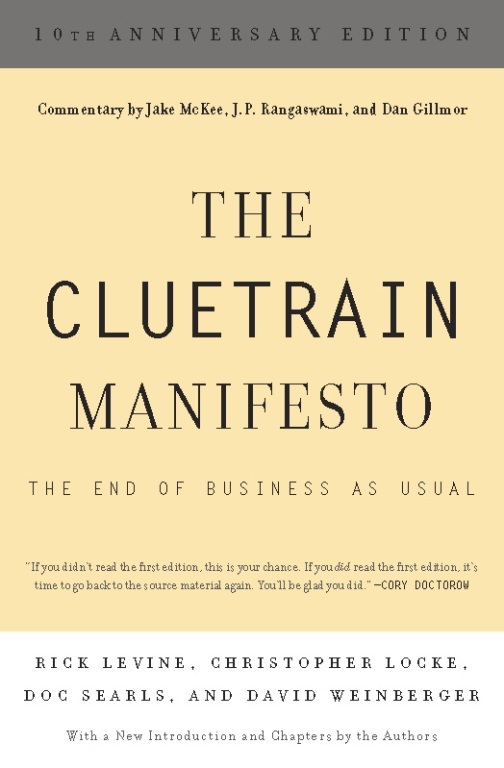
chapter six
the following is the complete sixth chapter of
The Cluetrain Manifesto:
The End of Business as Usual
-
Would you like to comment?
Join Diigo for a free account, or sign in if you are already a member.